
Qunzhi Consulting: The total revenue of mainstream global DRAM manufacturers increased by more than 300% year-on-year in the first half of 2026
The Zhitong Finance App learned that according to data from Qunzhi Consulting, the total revenue of mainstream global DRAM manufacturers reached US$284.1 billion in the first half of 2026, an increase of more than 300% over the previous year. The global DRAM industry ushered in the strongest boom cycle in history. Rigid demand for AI servers for HBM and high-end DDR5 exploded, compounded by the active contraction of mature consumer production lines by leading overseas manufacturers. Supply and demand in the industry continued to be scarce, driving the entire industry's revenue growth by leaps and bounds.
AI drove DRAM's revenue surge in the first half of the year, and the differentiation of vendor strategies widened the performance gap
In the first half of 2026, the DRAM industry's revenue showed the core characteristics of “rising quarter by quarter and surging year over year”. Demand for AI computing power became the core engine of growth throughout the industry, and the overall profit level of the industry reached a record high. The total revenue of the world's top four DRAM manufacturers in the first quarter of 2026 was 89.26 billion US dollars, and the total revenue for the second quarter was about 139.51 billion US dollars. The cumulative revenue for the first half of the year is expected to reach 228.77 billion US dollars, up about 312.5% year on year. The entire industry has achieved several times growth. Among them, Changxin Storage (688825.SH) had the highest year-on-year growth rate of 503.9%, and Samsung, Micron (MU.US), and SK Hynix also grew by more than 200% year on year.
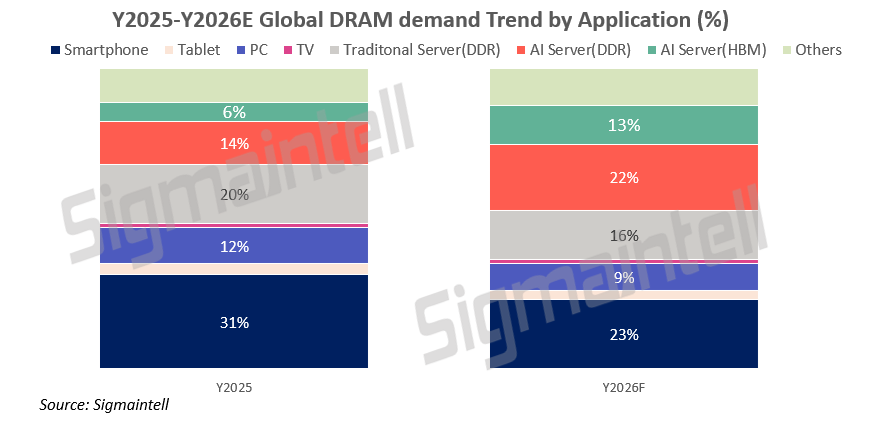
The demand structure also underwent a fundamental shift. According to estimates by Qunzhi Consulting, the total demand for AI servers DDR and HBM in 2026 was about 34.9%, up about 14 percentage points from 20.5% in 2025. The share of DRAM demand for traditional consumer electronics such as mobile phones and PCs continued to decline. The industry growth logic completely shifted from consumer-driven to computing-power-driven. The industry's supply-demand ratio was as low as -5.7% in the first half of the year. The structural supply gap continued to rise throughout the first half of the year. HBM's high premium and DDR5 server prices continued to rise, driving manufacturers Overall gross margin increased substantially.
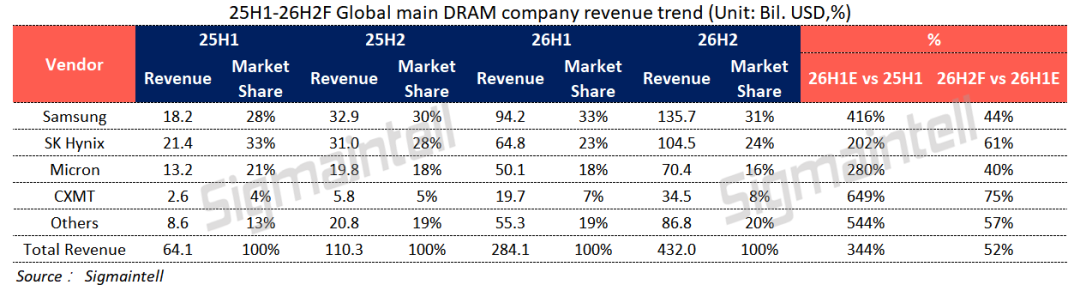
In the context of the overall high growth of the industry, Qunzhi Consulting's analysis believes that the revenue and production capacity performance of the four major manufacturers is significantly differentiated, and each company has embarked on a completely different growth path based on its own industrial chain layout.
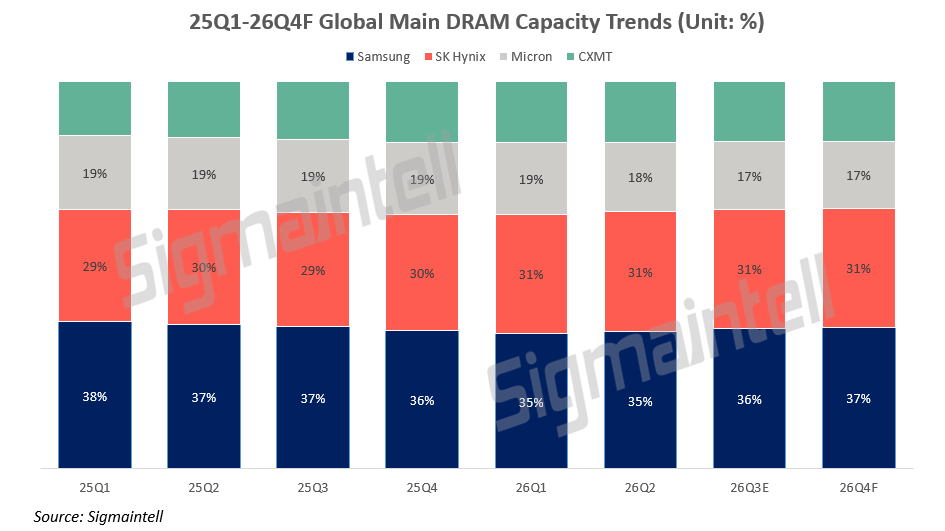
Samsung's cumulative DRAM revenue for the first half of the year was 94.18 billion US dollars, ranking first in the world; revenue for the first quarter was 35.63 billion US dollars, and revenue for the second quarter was about 58.55 billion US dollars, an increase of about 64.3% over the previous quarter. In the first half of the year, Samsung's share of global DRAM production capacity stabilized at around 35%, and its leading position in the industry was stable. Its core business philosophy is to actively optimize the product structure, continue to reduce production capacity in the old Line13/15/17 process in the first half of the year, reduce low-end DRAM output for mobile phones and PCs, tilt limited production capacity towards high-margin server DDR and HBM, and prioritize mass production and delivery of HBM3E and server DDR5; there are no large-scale new wafer production capacity projects throughout the year, and the increase in the revenue share of high-value-added products drives performance growth. The shortcoming is that the consumer memory market share is weak.
SK Hynix's cumulative DRAM revenue for the first half of the year was about US$64.75 billion, ranking second in the industry. Its revenue for the first quarter was US$28.01 billion, and revenue for the second quarter was approximately US$36.74 billion, up about 31.2% month-on-month. SK Hynix maintained more than 30% of global DRAM production capacity in the first half of the year. It relied on the exclusive HBM production line to achieve growth. In the second quarter of 2026, the M15X exclusive high-end HBM production line was officially mass-produced and continued to climb. HBM ranked first in the industry in global shipments, becoming the core support for revenue and profit growth. The production capacity of the mature overseas Wuxi C2 production line remains stable. It is only used as a buffer pool for the consumer memory cycle. It no longer adds capital expenses for mature processes. Relying on the “local high-end HBM + overseas general memory” dual-line layout, it continues to widen the profit gap with peers.
Micron's cumulative DRAM revenue for the first half of the year was about US$50.15 billion, ranking third in the industry; of these, revenue for the first quarter was about US$18.77 billion, and revenue for the second quarter increased 67.2% month-on-month to about US$31.38 billion. The company's share of global DRAM production capacity remained around 18% in the first half of the year, and remained stable overall. Micron has adopted a core strategy for balanced development of both long-life cycle storage products and AI storage. Special transformation work has already begun at the Fab6 factory in the US. The production capacity layout is gradually skewed towards long-life cycle storage products such as vehicle regulation, industry, and defense, and subsequent plans are gradually withdrawing from the consumer market. At the same time, the Fab15 and OMT advanced production lines continued to increase production capacity for HBM and DDR5 servers. The company did not actively reduce production capacity in mature processes, and the overall pace of production expansion was significantly faster than that of the two major Korean manufacturers. Long-life cycle storage such as vehicle specifications can hedge against the downward pressure brought about by declining consumer electronics demand, making corporate performance fluctuations relatively smooth. However, due to restrictions on the production capacity of high-end HBM falling short of Samsung and SK Hynix, there is a significant upper limit on the profitability of Micron's AI computing power-related business.
Meanwhile, the cumulative revenue of domestic Changxin Storage in the first half of the year was about 19.69 billion US dollars. The share of global DRAM production capacity increased from 14% in 2025 to 15.8%, and production capacity continued to increase. As the only DRAM manufacturer in the world that continued to expand production in 2026, the quarterly production capacity growth rate remained above 10% for a long time (overseas manufacturers only maintained a quarterly growth rate range of 0-10%). Its advanced Fab2 production line continued to climb, stably mass-produce DDR5 and import HBM in small batches to target domestic support Creative and AI computing power server. Changxin Storage relies on continuous capacity expansion to seize the general memory market share. The year-on-year revenue growth rate is the highest in the industry, but there is still a generational gap in high-end HBM technology and production capacity scale from leading international manufacturers.
Overall, Qunzhi Consulting's analysis believes that the core differences between the four manufacturers focus on the four dimensions of production capacity scale, product differentiation, technology generation, and strategic focus. Relying on the scale of production capacity and the advantages of all product lines, Samsung strengthens strategic cooperation with CSP manufacturers, especially ASIC and NPU customer groups, in HBM. SK Hynix achieved a high growth rate with exclusive HBM production line volume. Micron relied on vehicle regulation storage and AI computing power to increase revenue and profits; Changxin relied on domestic general storage capacity to increase revenue and profits; in terms of production capacity, Samsung shrank mature production lines and tilted advanced process production lines; SK Hynix HBM production lines climbed and stabilized mature production lines; Micron transformed production lines to maintain a long life cycle storage business and expand computing power production lines simultaneously; Changxin's new production line continued to climb and expand production throughout the production process; the core advantage was that Samsung had a disadvantage in terms of revenue First in scale, all-category layout, SK Hynix HBM has the highest shipping rate in the world, strong profit flexibility, strong business stability and outstanding risk resistance; Changxin has the first growth rate, expands multiple product lines, and continues to increase its share. At the same time, various manufacturers are also facing shortcomings such as loss of consumer electronics memory share, insufficient supply of general-purpose DDR, and generational differences in HBM product performance.
The DRAM boom continued in the second half of the year, and vendor differentiation intensified
In the second half of 2026, the DRAM industry will continue to prosper, revenue will rise quarter by quarter, and the pattern of manufacturer differentiation will further intensify. According to estimates by Qunzhi Consulting, the overall revenue of leading DRAM manufacturers in the fourth quarter of 2026 will be double that of the first quarter, showing a “quarter-by-quarter increase” trend. The cumulative revenue for the second half of the year is expected to be about US$345.17 billion, an increase of about 50.9% over the first half of '26. SK Hynix led the industry in revenue growth in the second half of the year with HBM orders and shipment releases.
In terms of the pace of production capacity investment, Samsung has no new factories put into operation throughout the year, and Samsung's DRAM capacity share remained slightly fluctuated around 36% in the second half of the year; SK Hynix continued to climb the M15X Fab high-end HBM production line, and the overseas Wuxi plant had stable production capacity throughout the year, and the production capacity share stabilized at around 31% in the second half of the year; Micron continued to promote the transformation and expansion of OMT's advanced computing power production line, paving the way for high medium- to long-term production capacity growth, and the share of production capacity fell slightly to about 17% in the second half of the year; it relied slightly on Storage and Storage for a long time; New production capacity continues throughout the year Climbing downward, the year-on-year production capacity growth rate was about 12.8%. The quarterly expansion rate continued to lead overseas peers, and the production capacity share continued to grow around 16% in the second half of the year.
At the level of supply, demand, and price, the structural supply gap in the industry will continue in the second half of 2026. The supply-demand ratio will remain negative throughout the year, and the shortage pattern will not ease significantly. DRAM prices will maintain an upward trend throughout the year, but the pressure on downstream terminal costs will continue to increase, and the increase is expected to continue to narrow.
In the HBM supply competition, leading manufacturers lost their share of production capacity
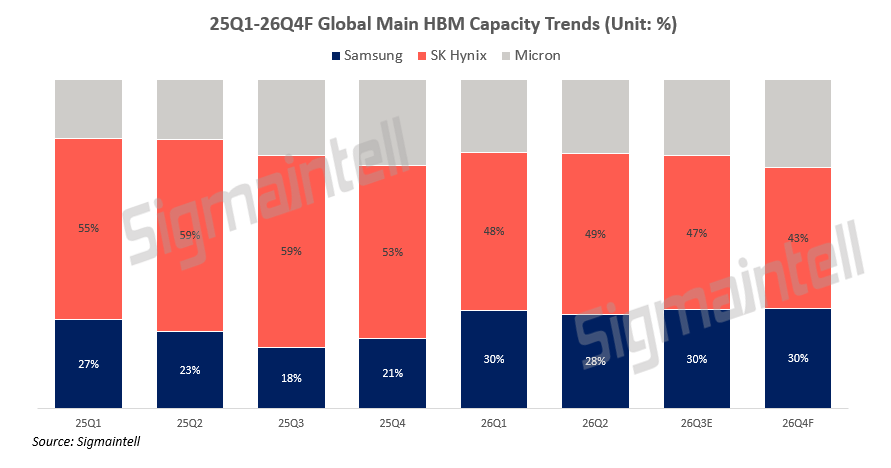
HBM is the storage product with the highest DRAM growth rate, and differences in production capacity layout have become a core factor in the performance differentiation of Samsung, SK Hynix, and Micron. In the first half of 2026, SK Hynix continued to hold the leading position in global HBM production capacity. 26Q1 and 26Q2 production capacity accounted for 48% and 49% respectively. Relying on the M15X exclusive production line, they steadily occupied nearly half of the supply share, deeply connected with AI computing power customers, and sufficient production capacity supported it to fully grasp the boom window of the current industry. Samsung continues to expand HBM production capacity. The share of production capacity remained in the 28%-30% range in the first half of the year, steadily increasing the supply scale of HBM3E and HBM4. Relying on a mature DRAM manufacturing system to continuously optimize the stacking process, the medium- to long-term production capacity release pace was stable. Micron's HBM production capacity is stable at 22%-23%. The pace of expansion of high-end HBM stacked production lines is relatively conservative, and the production capacity scale is significantly lower than that of the two Korean manufacturers. Judging from the trend, SK Hynix's share of production capacity has gradually declined since its high in 2025, Samsung's share of production capacity continues to rise, Micron is slowly expanding, and the three supply patterns are slowly being restructured. At this stage, medium- to long-term orders from the three manufacturers are full, production capacity is basically locked in advance, overall supply in the industry continues to be tight, and the gap in HBM's capacity layout will continue to affect the profit levels of each company.
DRAM pattern reshaping, barriers to HBM growth period, differentiation in overseas & Chinese directions
In the first half of 2026, AI computing power demand completely reshaped the growth logic of the global DRAM industry, and the differentiation of vendor strategies directly brought about a gap in business performance: the Korean giant locked in high-margin product lines by arranging server computing power requirements, Micron achieved steady growth through a balanced layout, and Changxin Storage achieved a steady increase in share and revenue through countercyclical expansion of production.
In the second half of 2026, the industry boom will continue, with revenue rising quarter by quarter, and is expected to peak throughout the year in the fourth quarter; the total production capacity of overseas manufacturers increased slightly. The increase was mainly concentrated in HBM and server DDR, and Changxin Storage's release of increased supply will support the acceleration of domestic domestic production substitution process. In the long run, large-scale HBM advanced production capacity reserves have become a core competitive barrier in the DRAM industry. Storage manufacturers with HBM mass production capacity will continue to control the industry's pricing power and core cloud service customer base, while the overseas and Chinese DRAM markets will be transformed into two major directions: high-end storage and domestic independent supply, respectively.