
Is AMC Entertainment Holdings (AMC) Still Below Fair Value After Record Weekend Revenue?
AMC Entertainment Holdings stock has enjoyed a sharp rebound in 2026, yet both the Discounted Cash Flow (DCF) intrinsic value estimate and market based valuation checks still point to the shares trading below their assessed worth.
- Over the past 5 years, AMC Entertainment Holdings has delivered a return of about 98.3% in losses, which keeps the recent recovery in the context of a very weak longer term track record.
- The record weekend revenue driven by the recent Spider Man premiere can support more optimistic assumptions for future box office and premium format demand. However, the risk is that such event driven spikes prove hard to repeat on a consistent basis.
- The company screens as undervalued on 4 of 6 key checks, so the overall value score of 4 out of 6 points to a mixed picture rather than a clear bargain or clear overpricing.
The issue now is whether AMC Entertainment Holdings' recent share price recovery already reflects this intrinsic value upside, or if there is still a margin between the current price and what the cash flow based estimate suggests.
Is AMC Entertainment Holdings a Bargain on Cash Flow?
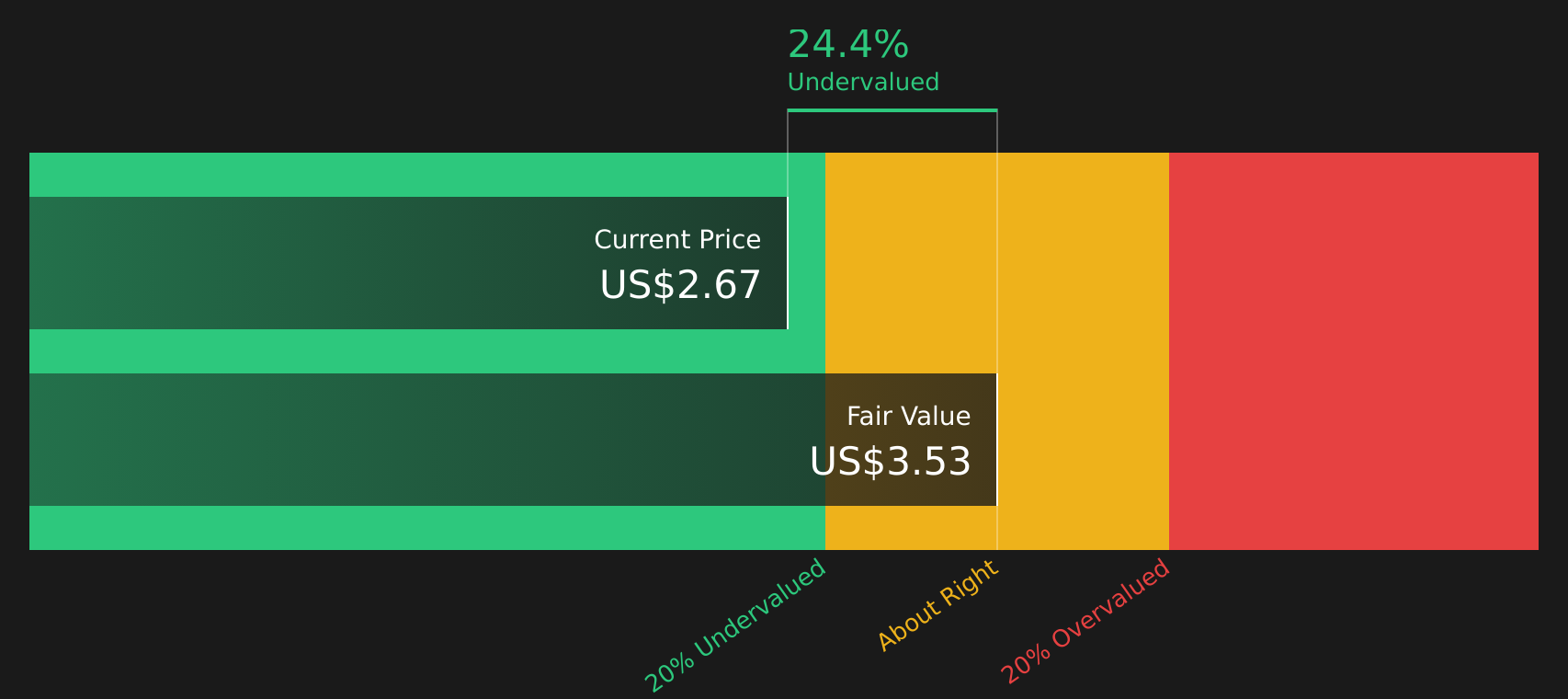
The Discounted Cash Flow (DCF) model here uses projected free cash flows to estimate what AMC Entertainment Holdings shares could be worth today. AMC is currently generating last twelve month free cash flow of about $37.4 million in outflows, and the model assumes a recovering cash flow profile that turns positive over time. Based on those cash flow projections, the DCF indicates an intrinsic value of about $3.51 per share.
That estimate is above the current share price, which implies the stock trades at an 18.8% discount to the DCF value. The recent record weekend revenue from the Spider Man premiere helps explain why some investors may be more comfortable with a recovery path in those future cash flows, even though it reflects a single strong event rather than a steady pattern.
On this DCF view, AMC Entertainment Holdings stock appears undervalued relative to its estimated intrinsic value.
Our Discounted Cash Flow (DCF) analysis suggests AMC Entertainment Holdings is undervalued by 18.8%. Track this in your watchlist or portfolio, or discover 53 more high quality undervalued stocks.
Does AMC Entertainment Holdings Look Undervalued on Sales?
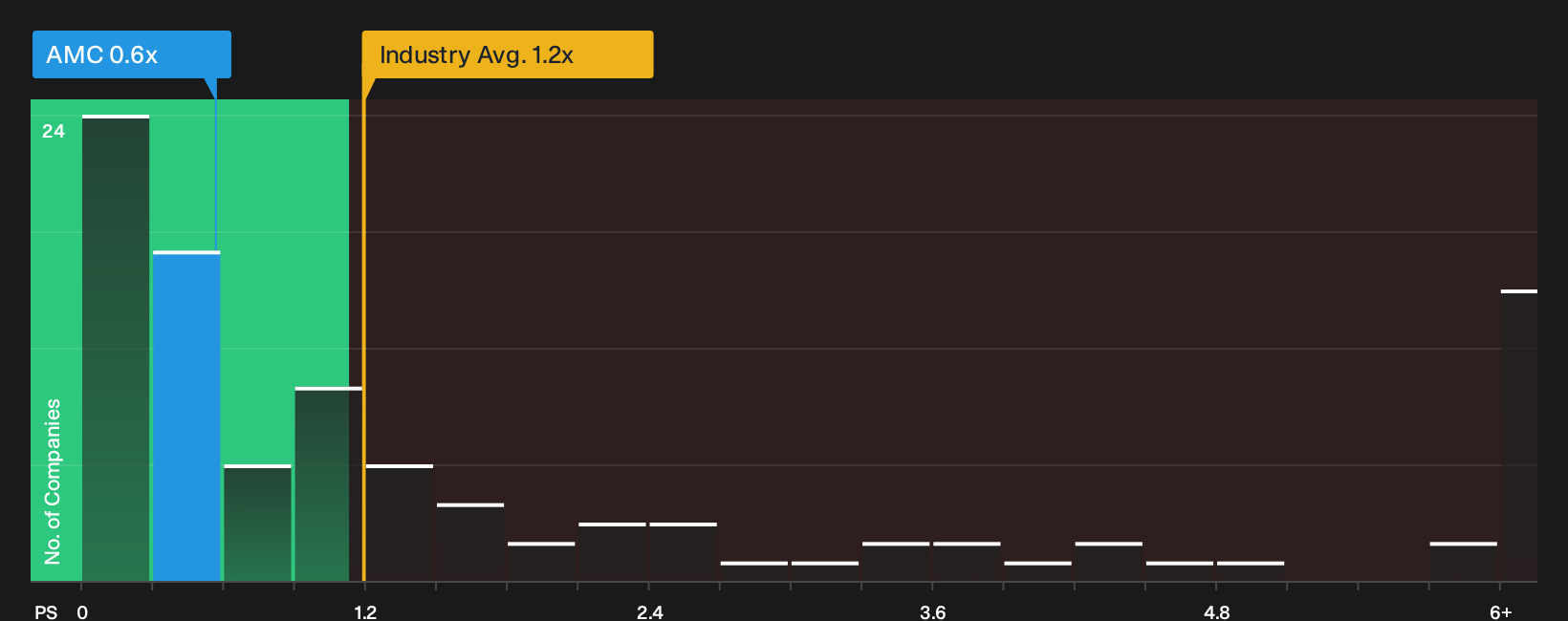
P/S is a useful check for AMC Entertainment Holdings because revenue is still the clearest anchor for valuing a business that has reported free cash flow outflows. AMC trades on a P/S multiple of about 0.5x, which is well below both the Entertainment industry average of roughly 1.3x and the peer group average of about 4.1x.
The model based fair P/S ratio for AMC Entertainment Holdings is about 0.8x, which already factors in the company’s margins, risk profile and scale. The current 0.5x level sits below that fair ratio, which indicates investors are paying less for each dollar of AMC revenue than the model suggests might be reasonable.
On this P/S view, AMC Entertainment Holdings stock appears undervalued relative to what the revenue base would typically justify.
See what the numbers say about this price — find out in our valuation breakdown.
The AMC Entertainment Holdings Narrative: What Would Justify Today's Price?
Simply Wall St Narratives pick up where the AMC Entertainment Holdings valuation puzzle leaves off by spelling out which assumptions on future growth, margins and earnings would need to hold for the stock to be worth significantly more or less than today’s price, and they sit on the company’s Community page. Each narrative sets out fair value as a thesis you can track over time, rather than a single static number.
The community is split on AMC Entertainment Holdings, with one camp focused on premium growth potential and another fixated on balance sheet risk and industry headwinds.
Bull case: roughly fairly valued
"AMC's aggressive buildout of IMAX with Laser, Dolby Cinema, its proprietary XL screens, and extensive laser projection upgrades positions the company to capture an outsize share of 'experiential' consumer spend..."
Read the full Bull Case to see why AMC Entertainment Holdings could be undervalued
Bear case: 32% overvalued
"Management has relied on equity issuances and debt restructurings (including recent new debt issuance and equitization) to address liquidity needs and debt maturities..."
Read the full Bear Case to see why AMC Entertainment Holdings could be overvalued
Do you think there's more to the story for AMC Entertainment Holdings? Head over to our Community to see what others are saying!
The Bottom Line
For AMC Entertainment Holdings, both the Discounted Cash Flow (DCF) intrinsic value estimate and the sales based checks currently lean toward undervalued rather than overvalued. The intrinsic value estimate sits above the market price, and the P/S multiple is below the modelled fair ratio, yet the broader scorecard still reads as mixed rather than emphatic. The key question is whether AMC can turn its improving revenue signals into sustainable, positive free cash flow. That cash flow path, and how investors price the balance sheet and industry risks around it, remains the crux of the bull versus bear debate from here.
This article by Simply Wall St is general in nature. We provide commentary based on historical data and analyst forecasts only using an unbiased methodology and our articles are not intended to be financial advice. It does not constitute a recommendation to buy or sell any stock, and does not take account of your objectives, or your financial situation. We aim to bring you long-term focused analysis driven by fundamental data. Note that our analysis may not factor in the latest price-sensitive company announcements or qualitative material. Simply Wall St has no position in any stocks mentioned.
Have feedback on this article? Concerned about the content? Get in touch with us directly. Alternatively, email editorial-team@simplywallst.com