
The US side sent a strong signal to stabilize the exchange rate! Bezent: Will support Japan to contain the decline in yen
The Zhitong Finance App learned that US Treasury Secretary Scott Bessent (Scott Bessent) said on Tuesday that the weak yen has exacerbated Japan's inflation problem and increased the risk of a wider depreciation of Asian currencies. At the same time, he reiterated that the US side supports efforts to stabilize the exchange rate.
In an interview, Bezent said, “The level the yen is at may cause other problems or trigger competitive depreciation, which is not healthy. A stable yen is important not only to the US, but also to the entire Asian region.”
This statement comes after the US and Japan jointly interfered in the foreign exchange market last week to support the yen. Recently, the exchange rate of the yen against the US dollar has fallen to its lowest level in 40 years.
When asked if the US would further interfere, Bessent said that the US side “maintains close contact” with the Japanese authorities and “we will do our best to support them in a way that helps the US economy, American taxpayers, and stabilizes the global economy.”
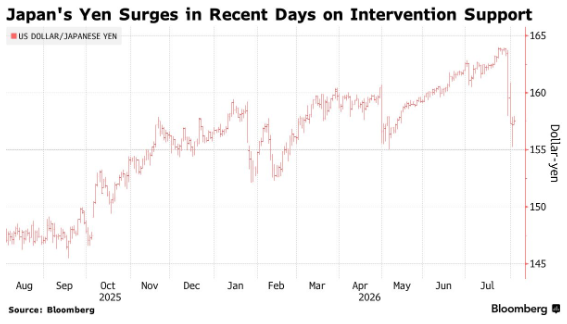
The yen rebounded sharply after the joint intervention of the US and Japan, but gains were suspended on Tuesday, and trading was about 157.54 yen to 1 US dollar. On July 23, the yen fell to a low of nearly 164, the weakest level since 1986.
Bessent pointed out that part of the “problem” with Japan's inflation stems from rising energy costs due to the weakening yen. He also said, “If the yen weakens sharply, other currencies will follow suit. We have seen excessive fluctuations in the won. Many people think the yuan is undervalued.”
Before becoming finance minister, Bezent had decades of experience in hedge fund foreign exchange trading. He said that exchange rate intervention can “send a signal to the market,” but ultimately “policies are needed to reverse the situation.” He mentioned that Japanese Prime Minister Sanae Takaichi (Sanae Takaichi)'s government is “moving towards budget discipline,” including achieving an initial surplus.
When asked if stabilizing the yen would require the Bank of Japan to raise interest rates, Beisent said he would not “predict” how the central bank should act. He said he had known Bank of Japan Governor Kazuo Ueda (Kazuo Ueda) for 15 years and “I am sure he will take the necessary actions.”
“Policy follow-up is needed after the intervention, and I am very confident that we will see this,” Bezent said.
Regarding the fact that his notepad was photographed listing “buying yen” as a to-do item during last Friday's cabinet meeting, Basent hinted that this was an intentional signal. “I just wanted to make sure that all the reporters watching from behind knew that 'JPY' represents the yen,” he said.
When asked about reports that the US interfered in using the euro to buy yen last Friday, Bessent said that the US side “maintains close contact with European partners, including central banks, and some finance ministers.” “I promise them this is just a reallocation of our reserve assets,” he said. He also said, “In my opinion, the euro is closer to an equilibrium price,” and the problem “is actually that the yen is seriously undervalued.”