
The robotics sector in Hong Kong stocks “warms up” ahead of schedule. Who will become the boom leader in intensive catalysis in the second half of the year?
2026 will undoubtedly be an exciting year for the robotics industry as a whole. On the last trading day of July, the day after Yushu's IPO was approved, Hong Kong robotics concept stocks ushered in a collective surge: Xiangong Intelligence (06106) and Laifu Harmonic led the closing with 17.75% and 21.46%; Megaways Mechatronics and Suteng Juchuang rose by more than 9% and 7% respectively. Youbi Choice closed up nearly 5%, and the horizon closed flat.
And after Yushu's listing, a series of major catalysts, such as mass production of Tesla Optimus and the IPO of Zhiyuan Robotics, will surely add another spark to the trend of robot concept stocks. The industry narrative is hot, and the capital attracted will naturally look for directions and targets with higher certainty and a more critical position for the industry.
According to Zhitong Finance, the ranking in the aforementioned growth list is actually quite interesting. The reason behind this is probably an accurate deduction of the degree of benefit from the industrial chain: the almost clear one in the front row is an upstream component company that is thought to fully benefit the mass production volume of general robotics companies, such as Laifu Harmonic, which produces harmonic reducers, and Zhaowei Electromechanical, which makes miniature transmissions. Xiangong Intelligence is an exception. Based on a “robot brain,” the company realizes large-scale deployment of multiple entities and multiple scenarios, continuously accumulates a large amount of actual operation data, and forms a closed loop of data and technology from real data accumulation to model optimization to product application through AI Infra throughout data governance, model training, simulation verification, end-side deployment, and operation feedback. Based on this, the company continues to advance the development of E2E models and VLA models, and uses controllers as carriers to apply intelligent robots such as wheeled figures, self-propelled forklifts, and AI delivery to promote the transformation of model capabilities into product capabilities and commercial applications. Compared to a single hardware or software vendor, Xiangong Intelligence's “brain” positioning makes it more like the existence of physical infrastructure. Objectively speaking, whether the sharp rise on July 31 was a short-term emotional catharsis or the beginning of a new main line, there is still time to be answered. However, back to the industrial chain itself, it is an indisputable fact that robots are a booming circuit with long slopes and heavy snow, and tracking the flow of active capital is unquestionably beneficial to eliminating hypocrisy and actually finding the real boom leader.
A day trip or the start of a new main line?
To determine whether the sharp rise on July 31 is a one-day trip or a new main line, we need to return to two dimensions: industrial logic and financial behavior.
Let's talk about industrial logic first. The humanoid robot circuit is at a critical point in the transition from “proof of concept” to “the night before mass production.” In 2025, the global shipment volume of humanoid robots was about 17,000 units, and in 2026, Yushu alone's target shipment volume will reach 10,000 units. Tesla Optimus's annual production target of 100,000 units is also progressing steadily. The growth rate at the industrial level is no longer linear growth, but an exponential transition.
Yuuki's IPO is only the first sign in this timeline. Subsequently, Tesla Optimus's production capacity climbing and Zhiyuan Robotics' IPO sprint will form the next series of catalysts. In other words, the sharp rise on July 31 was not a pulse reaction to an isolated incident, but rather a collective warm-up before a series of industrial nodes began. Substantial changes on the industrial side are the fundamental basis for sector performance.
Judging from the funding vote, the top targets in the growth list have one common characteristic: they are all concentrated in the upstream sector. The collective surge in “selling shovels” shows that the influx of capital is not chasing concepts and stories, but is based on clear industrial logic — a behavioral characteristic closer to institutional capital, rather than a rhythm of speculation.
Back to the target level. Sorted through the industrial chain, the Hong Kong stock pan-robotics sector has formed a clearly structured hierarchy.
In the hardware layer, Laifu Harmonic is the second-largest manufacturer of harmonic speed reducers in China, with a market share of 21.4%; Sagiteng Juchuang sold 282,600 robot lidars in the first half of 2026, an increase of 510% over the previous year; Zhaowei Mechatronics is the core supplier of miniature transmission of robot finger joints. These companies cannot bypass their hardware supply no matter which OEM wins in the end.
In terms of complete machines and applications, the best choice is the largest humanoid robot company in China. Yuejiang is a leader in collaborative robots, and Jizhijia is the number one AMR warehouse in the world. They directly face the end market and benefit from the expansion in the size of the industry.
However, among these targets, Xiangong Intelligence has the most unique positioning — although it also has a hardware business and even ships complete machines, its core barrier has always been the “robot brain.” Compared with OEM companies or parts companies in the industrial chain, there is an essential difference in the beneficiary logic of Xiangong Intelligence. Hardware companies benefit from “volume” expansion — the more machines are shipped, the more parts are used; OEM companies benefit from the “brand” premium — whoever can take the lead in mass production can obtain market pricing rights. And “brain” companies benefit from platform logic — no matter which OEM wins or how many units are shipped, every robot needs a “brain.” This is exactly where Xiangong Intelligence has the most scarce value in the Hong Kong stock pan-robotics sector.
Why is a “robotic brain” the most definitive infrastructure?
Since the “brain” is the underlying infrastructure of the robotics industry, what is the specific benefit logic of Xiangong Intelligence? It can be broken down into quadruple logic.
First, it does not participate in terminal competition and serves all players. Yuuki, Tesla, and Yubi fight on the whole machine side, while Xiangong Intelligence uses robot brains to serve all machine manufacturers and doesn't bet on the success or failure of any one. This “selling shovel” business model makes it unnecessary to get involved in terminal price wars, and profitability can always remain high. At a stage where the competitive landscape of the industry has yet to subside, such certainty is particularly scarce. While machine manufacturers are still competing for who robots can run and jump, Xiangong Intelligence has already silently taken the bottom of the cake in the entire industry.
Second, the robot brain is the underlying ability of all intelligent robots. What Xiangong Intelligence actually completed was not only a “brain” product containing computing power, models, and controller hardware, but for the first time, robots had unified underlying capabilities and technical language, establishing a standardized lower-level entrance for the robot industry. No matter which company dominates humanoid robots, their core capabilities such as perception, decision-making, reasoning, dexterous operation, full-body control, autonomous navigation, and multi-machine scheduling cannot bypass the brain of Xiangong. In the words of founder Zhao Yue, the main line of development of Xiangong Intelligence is “a continuous transition from controllers in the past, to current open platforms, to future physical infrastructure.” According to 2025 sales, Xiangong Intelligence ranks first among intelligent robot controller suppliers with a global market share of 24.8%. This ability to cover all forms makes it a “shovel seller” throughout all robot forms.
Third, real machine data assets constitute an implicit barrier. Robots equipped with Xiangong's “brain” have entered the actual scene of Nvidia's GPU server hardware production plant. As of July 2026, Xiangong Intelligence's robotic brain system has been connected to more than 50,000 cross-configuration robots, landed in more than 1,000 factories, covered more than 20 industries, and served more than 2,100 customers, with a cumulative total of more than 60 million hours of stable operation. According to estimates of 50,000 devices and 20% data reflow, the potential production capacity of real machine data can reach the level of 30 million hours per year, of which 500,000 hours of high-quality real machine training data have been systematically cleaned. In the age of embodying intelligence, real machine data itself is the most important competitive barrier — once the data flywheel is turned, latecomers can hardly catch up.
Fourth, the ecological lockdown effect brings high pricing power. Once the customer has developed a complete solution based on Xiangong's intelligent ecosystem, replacing the system means rewriting the software and re-debugging, and the switching cost is extremely high. This ecological lockdown effect is reflected in the financial statements as a gross profit margin of up to 80%.
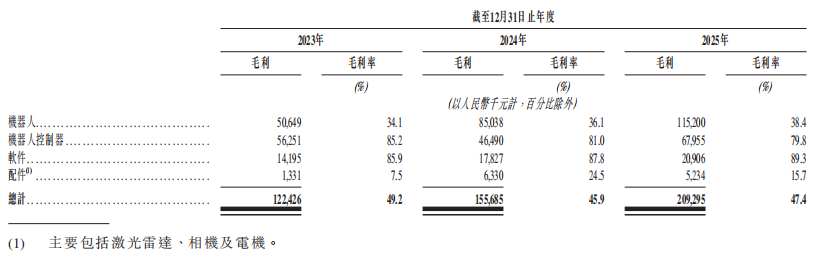
At the financial level, the growth visibility and flexibility of Xiangong Intelligence is also being confirmed. In 2025, the company achieved revenue of 442 million yuan, a three-year compound growth rate of 33.2%. The company has issued a positive profit forecast. The revenue growth rate for the first half of the year was not less than 60%. Based on the current market value of about HK$6 billion, this corresponds to less than 10 times PS in 2026.
It should be pointed out that Xiangong Intelligence is not only a beneficiary of the prosperity of the industry. As a provider of “robot brains,” it has lowered the development threshold for downstream machine manufacturers and accelerated the innovation iteration of the entire industry. This infrastructure attribute means that the more prosperous the industry, the greater the demand for the brain; the more powerful the brain, the wider the boundaries of the industry. This is a forward flywheel — as more robots are connected to the same brain system, the richer the data flow, the faster the model iterates, and the iterated brain can support more scenarios and more forms of robots.
Looking back at the sharp rise on July 31, I think it was a preview of the new main line rather than the end. Yuju's IPO, Tesla mass production, and Zhi Yuan sprint — triple catalytic superposition, the robot industry is moving from a “conceptual narrative” to an inflection point of “mass production verification.” The industry is expanding, and the market is repricing. Those underlying capabilities that no matter who wins can't be circumvented are the real main lines throughout the cycle. From the “brain” with built-in infrastructure to core components such as speed reducers, lidars, and micro drives, every link has found its place in the expansion of the industry. And when an industry changes from “whether to do it” to “how to do it,” the real boom cycle has only just begun.