
Qunzhi Consulting: Global semiconductor market sales are expected to exceed 1.5 trillion US dollars in 2026, up about 107% year-on-year
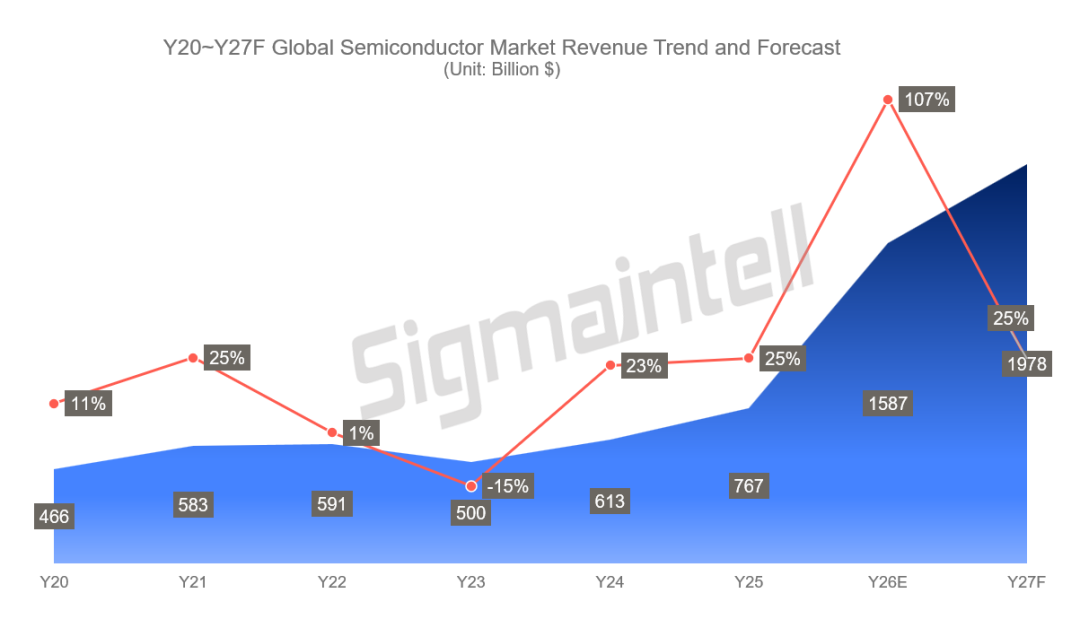
The Zhitong Finance App learned that according to the estimates and forecast data of Qunzhi Consulting, the global semiconductor market sales are expected to exceed 1.5 trillion US dollars in 2026 and are expected to reach 1,587 billion US dollars, an increase of about 107% over 2025. The core of this historic growth is a structural shift driven by a global wave of AI infrastructure investment.
Global cloud services and AI server stocking demand driven by large-scale capital expenditure on AI infrastructure in 2026 will drive overall growth in demand for semiconductor devices from memory chips, GPUs, and CPUs to power devices/control chips.
1. Memory chips: the core of the AI supercycle, and the sharp rise in volume and price drives the entire industry to grow 290% year-on-year
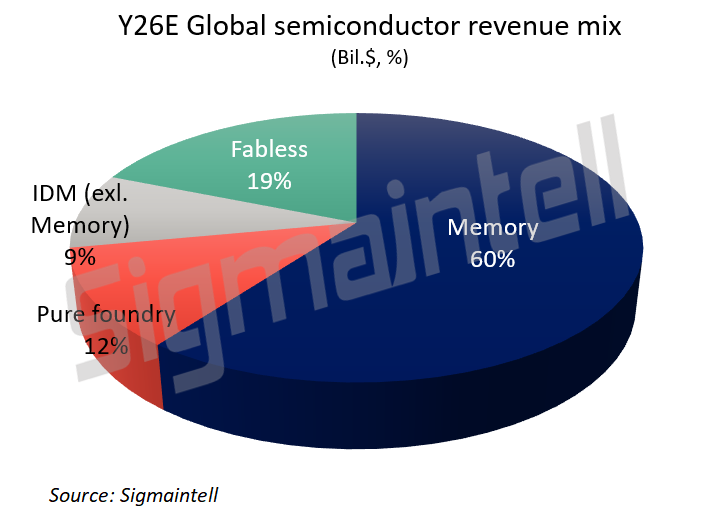
Memory chips are the most prominent sector in this semiconductor supercycle. Qunzhi Consulting expects memory (Memory) revenue for the full year of 2026 to reach about 960 billion US dollars, an increase of about 290% over the previous year, and account for about 60% of global semiconductor sales. Distinguish between DRAM and NAND Flash:
DRAM side: HBM and DDR two-wheel drive, significant imbalance between supply and demand
HBM (High Bandwidth Memory): As the “blood vessel” of AI computing power, HBM is the growth engine of DRAM. Qunzhi Consulting expects the HBM market to exceed 100 billion US dollars in 2026. Original storage manufacturers (such as Samsung, SK Hynix, Micron (MU.US)) actively increased HBM supply capacity in 2026, resulting in a double-digit decline in DDR Wafer's production capacity supply.
DDR (double data rate memory): Due to the double impact of AI server demand for DDR capacity and the crowding out effect of HBM production capacity, the supply and demand relationship for the entire DDR product line is strained as never before. Taking the data for the third quarter of 2026 as an example, the average DDR unit price (ASP) increased 4 to 5 times compared to the same period in 2025. A rigid increase in demand and a sharp rise in prices have jointly driven DDR product line revenue growth several times. Driven by both HBM and DDR, DRAM revenue for the full year of 2026 is expected to increase nearly 300% year over year.
NAND Flash: Demand exploded later than DRAM, but growing strongly
Although demand for NAND Flash started later than DRAM, it is also growing rapidly, driven by the strong demand for shared storage (such as enterprise-grade SSDs) within AI server racks. The demand for ESSD from AI servers will exceed the demand for consumer electronics NAND. It is estimated that in 2026, the NAND Flash market revenue will increase by nearly 250% compared to 2025, and together with DRAM, it forms a “dual engine” for memory chips.
2. Foundry: The whole industry is on the rise, and mature processes benefit from AI spillover effects
In 2026, the foundry (Foundry) industry will show an “industry-wide, full-node” upward trend. Qunzhi Consulting expects global foundry revenue to reach about 189 billion US dollars in 2026, an increase of about 20% over the previous year. The specific performance analysis is as follows:
Advanced manufacturing processes (7nm and below): Iteration and demand growth for AI GPUs, NPUs, and AI acceleration chips continue to seize 3nm/5nm/7nm advanced process production capacity, while squeezing OEM orders for consumer electronics chips (such as mobile phone APs and PC CPUs), increasing demand for advanced packages such as CoWOS, etc., leading wafer factories (such as TSMC) continue to optimize the revenue structure of leading wafers (such as TSMC).
Mature manufacturing processes (mainly 40nm and above): The spillover effect of AI demand has significantly driven order demand for mature processes. Mature process manufacturers (such as world-advanced, Crystalline, PSC, etc.) ushered in the first increase in capacity utilization rate and price in nearly 3 years. Let's take a closer look:
BCD process: Benefiting from the surge in demand for server power/analog chips such as high and low voltage power MOS, power management PMICs, and multi-phase VRM controllers for AI server core power supply, the price and capacity utilization rate of BCD process products continue to rise.
HV (high voltage) and CIS (image sensor): Driven by demand for automotive electronics, industrial automation, and edge AI equipment, Foundry's production capacity utilization rate and price have both increased.
Storage master control chip: The main storage control chip for the AI server DDR and SSD. The main traffic production node is a 65nm/55nm logic process. It is an important source of incremental orders for current mature processes. The capacity utilization rate is close to full load, and the wafer price will rise quarter by quarter.
110nm/90nm mature manufacturing process: The demand for server components such as server motherboards, on-board control MCUs, and special logic chips supports the order requirements of small and medium-sized wafer foundries with production capacity for many mature processes.
Overall, AI server demand for components has led to a high increase in demand for mature manufacturing processes, and has also rapidly boosted the capacity utilization rate of mature process foundries. It is expected that mature process foundry prices will rise steadily in the second half of 2026, and wafer foundries will continue to increase their revenue and repair profit levels. Qunzhi Consulting anticipates that in 2026, foundry companies will have the opportunity to achieve general revenue growth from leading manufacturers to end manufacturers.
3. Fabless&IDM: Performance differentiation intensifies, AI product line determines “winners and losers”
Fabless (fabless design manufacturer): The performance of Fabless vendors will be highly differentiated in 2026. AI GPU/ASIC chip design manufacturers, such as NVIDIA (NVIDIA) and Broadcom (Broadcom), will maintain rapid growth in business performance and are the main contributors to the growth of the Fabless sector. Meanwhile, the product line focuses on consumer electronics, low-end industrial control, and general-purpose analog chip Fabless manufacturers, which face the double pressure of weak downstream demand and rising upstream foundry costs, putting pressure on performance. Overall, there will be significant differentiation in revenue growth among Fabless manufacturers in 2026.
IDM (Integrated Device Manufacturer): Revenue is expected to achieve double-digit year-on-year growth in 2026, but the growth rate is weaker than storage and foundry. The performance differentiation of IDM vendors in 2026 will also be quite significant. Business growth is focused on IDM (such as TI, Renesas, Intel, etc.), which are related product lines such as AI server power management, MCU, CPU, etc., and its revenue growth rate will be significantly faster than IDM manufacturers, which mainly focus on consumer electronics and automotive chips. The speed and depth of AI server product line development has become a core watershed in IDM manufacturers' performance differentiation.
IV. Outlook for 2027: Marginal decline in growth
Looking ahead to 2027, the global semiconductor market will continue to grow, but the growth rate will slow significantly compared to 2026. Qunzhi Consulting expects global semiconductor sales to reach about 1.9 trillion US dollars in 2027, an increase of about 25% over the previous year. The slowdown in growth was mainly affected by multiple factors such as the high base in 2026, a significant slowdown in the price increase of memory chips, and the continued decline in consumer electronics demand. However, the growing trend of AI infrastructure investment will continue in 2027. Although the growth rate will move from an explosive period to a period of steady growth, this will continue to support demand for AI-related components for storage, advanced manufacturing processes, and mature manufacturing processes.
Overall, 2026 is the first year the global semiconductor industry officially enters the “AI supercycle.” However, the increase in market size is not an all-inclusive phenomenon; rather, along the main line of “AI computing power,” it has formed a “differentiated pattern” in various fields of the semiconductor industry such as storage, foundry, IDM, and Fabless. For industry participants, whether they can reshape product lines and quickly integrate into the AI industry chain will determine their room for survival and growth in the next few years.