
Prysmian (BIT:PRY) Stock Looks Fully Valued After Big Data Center Deal
Prysmian’s share price has surged over the past few years, yet its valuation signals are split, with the Discounted Cash Flow (DCF) intrinsic value estimate pointing to a premium while market multiples suggest the stock still screens as relatively cheap.
- Prysmian has delivered a 319.3% total return over the past 5 years, which puts extra focus on whether today’s price still offers a reasonable entry point.
- The long term €5.5b supply agreement with Molex can support expectations for data center and AI related demand. However, the planned €1.25b capacity investment may introduce execution and capital allocation risk for cash flows.
- The stock earns a mixed valuation picture, with Prysmian screening as undervalued on some checks yet achieving only 3 out of 6 valuation checks overall.
The issue now is whether that mix of strong past returns, large new contracts and conflicting valuation signals means Prysmian is priced ahead of its intrinsic value or still offers room for upside.
Has Prysmian Run Too Far on Cash Flow?
The Discounted Cash Flow (DCF) model values Prysmian by projecting its future cash generation and discounting it back to today. On this view, Prysmian’s latest twelve month free cash flow sits at about €956 million, with the model assuming growing cash flows over time that reflect larger fibre and cable projects rather than sharp cyclical swings.
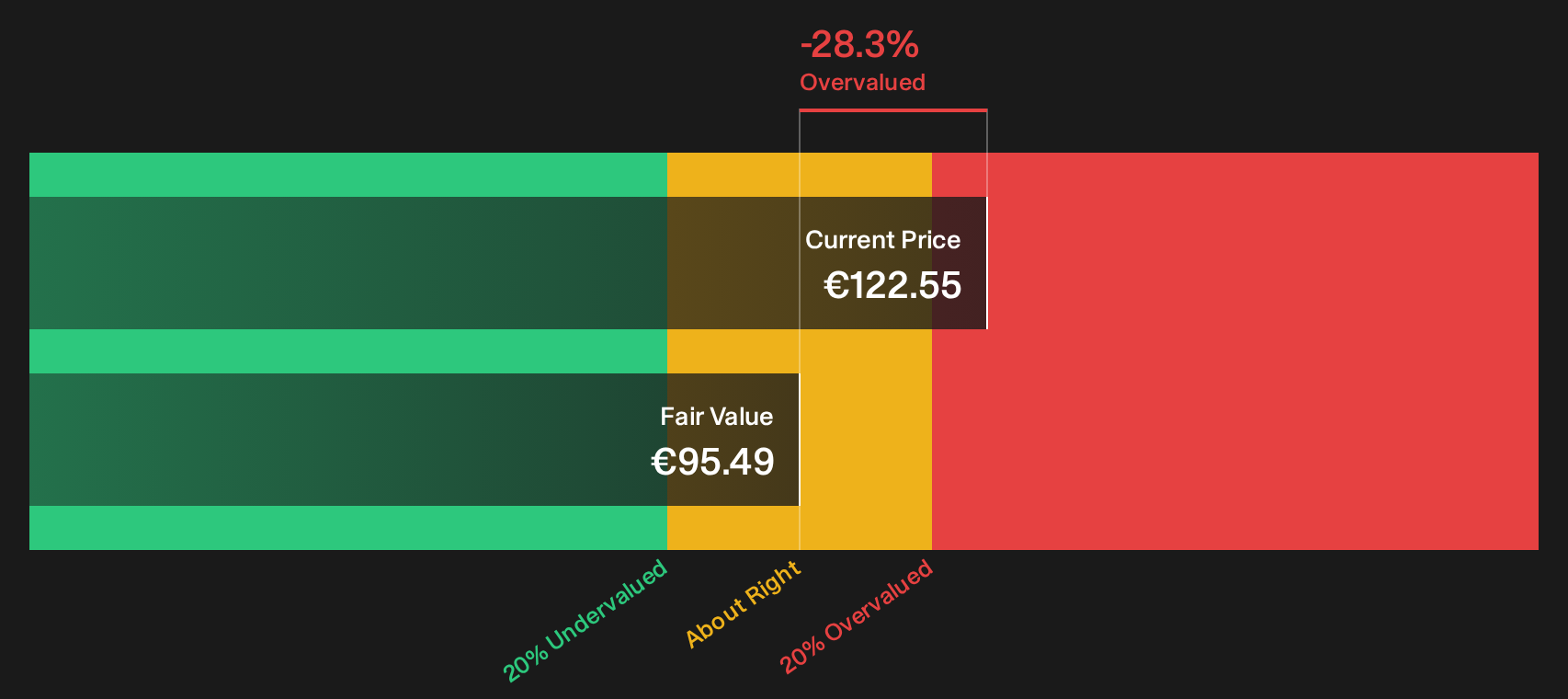
Those cash flows translate into an estimated intrinsic value of about €90.89 per share, which sits below the current market price and implies the stock trades roughly 32.2% above the DCF estimate. The long term €5.5b Molex contract and the linked €1.25b capacity plan are factors that help explain why the market is comfortable paying a premium to the cash flow model today.
On this DCF view, Prysmian currently screens as overvalued relative to its estimated intrinsic value.
Our Discounted Cash Flow (DCF) analysis suggests Prysmian may be overvalued by 32.2%. Discover 254 high quality undervalued stocks or create your own screener to find better value opportunities.
Is Prysmian a Bargain on Earnings?
P/E suits Prysmian because earnings are a core focus for investors in mature industrial businesses with visible contracts. Prysmian currently trades on a P/E of about 24.9x, compared with roughly 29.0x for the wider Electrical industry and about 27.2x for close peers. That means the stock is priced at a lower earnings multiple than many similar companies in its space.
The tailored fair P/E ratio for Prysmian is estimated at about 30.6x. This sits above both the current 24.9x market multiple and the peer and industry averages. The gap suggests the market is valuing Prysmian’s earnings at a discount to what the model indicates could be justified given its profile, even after factoring in execution and capital allocation risks around the large Molex agreement and related capacity expansion.
On this earnings multiple view, Prysmian appears undervalued relative to the level implied by its fair P/E ratio.

See what the numbers say about this price — find out in our valuation breakdown.
The Prysmian Narrative: What Would Justify Today's Price?
Simply Wall St Narratives pick up where Prysmian’s mixed DCF and P/E signals leave you. They spell out what would need to happen to Prysmian’s growth, margins and earnings for the stock to be worth materially more or materially less than today’s price, and they sit on the company’s Community page. Each Narrative sets out a fair value as a thesis about Prysmian’s business that you can track over time rather than a one off snapshot.
Prysmian’s community views sit far apart, with one camp seeing upside if execution risk is priced too harshly and another flagging a rich set of expectations.
Bull case: 21% undervalued
"Ongoing R&D and product innovation, including low-carbon and smart cables, is increasing Prysmian's premium product mix and ESG-linked sales, enabling both margin expansion and better customer stickiness..."
Read the full Bull Case to see why Prysmian could be undervalued
Bear case: roughly fairly valued
"The bear case is simpler: the stock is no longer cheap, with expectations now embedded for continued flawless execution, clean M&A integration, and sustained margins despite commodity and project risk..."
Read the full Bear Case to see why Prysmian could be overvalued
Do you think there's more to the story for Prysmian? Head over to our Community to see what others are saying!
The Bottom Line
Prysmian’s valuation story is split. The Discounted Cash Flow (DCF) intrinsic value estimate points to the stock trading at a premium, while earnings multiples suggest Prysmian is undervalued relative to peers and its tailored fair P/E. That gap mainly reflects how funding needs, cash flow timing and capital intensity are weighed in the DCF, compared with growth expectations and sentiment in the market-multiple view, especially after a very strong five year move. The key question from here is whether Prysmian’s execution on large projects and capacity investment justifies the current earnings multiple, or whether the discount is the market’s way of pricing in those risks.
This article by Simply Wall St is general in nature. We provide commentary based on historical data and analyst forecasts only using an unbiased methodology and our articles are not intended to be financial advice. It does not constitute a recommendation to buy or sell any stock, and does not take account of your objectives, or your financial situation. We aim to bring you long-term focused analysis driven by fundamental data. Note that our analysis may not factor in the latest price-sensitive company announcements or qualitative material. Simply Wall St has no position in any stocks mentioned.
Have feedback on this article? Concerned about the content? Get in touch with us directly. Alternatively, email editorial-team@simplywallst.com