
Japan slashed 34 billion dollars to save yen last Friday! The scale of this round of intervention may hit a new monthly high
The Zhitong Finance App learned that according to an analysis of Bank of Japan account data, the Japanese authorities may have invested about 34 billion US dollars in exchange rate intervention last Friday to support the yen. The move was carried out by the Japanese authorities on the basis of the actions of the previous day, in coordination with the US side.
According to the account data released by the Bank of Japan on Monday and the predictions of currency brokers, the scale of intervention last Friday is estimated to be about 5.33 trillion yen (about 34 billion US dollars). This action comes after the Japanese government invested around 8.45 trillion yen to support the yen the day before — possibly the largest exchange rate intervention in a single day in Japanese history.
If the relevant figures are confirmed, it will set a new record for the amount of investment in a single month in Japan's latest round of exchange rate intervention. Previously, the Japanese authorities provided phased support for the yen by buying yen for a short time during the Golden Week holiday period beginning at the end of April. Japan invested a total of 11.73 trillion yen at the time, which is the highest monthly intervention scale in history.
The US Treasury has also joined the action to support the yen, marking the closest coordination and cooperation between the US and Japan in the field of monetary policy in 15 years. Analysis of the Bank of Japan's accounts does not show the scale of US intervention in the market, but US participation may have reduced the amount of capital Japan needs to invest to achieve the same effect on the exchange rate.
Japan's Finance Minister Katayama Satsuki confirmed that the Japanese government did intervene in the foreign exchange market last Friday. US Treasury Secretary Bessent said that the US will not rule out the possibility of entering the market again. Meanwhile, US President Trump also expressed support for this, calling this intervention a “sign of friendship.”
The strengthening of coordination between the US and Japan stemmed from the signals previously released by US officials that they were concerned about the depreciation trend of the yen. According to the semi-annual exchange rate report released by the US Treasury Department last month, as of April 2026, the yen continued to depreciate for many years “causing the yen to be seriously undervalued.” The report also said that the normalization of monetary policy will help stabilize inflation expectations and reduce excessive exchange rate fluctuations.
At the same time, what is most remarkable about this intervention is not Japan's repeated action, but America's upgrade from “verbal support” to “real money.” The US Treasury directly entered the market through the New York Federal Reserve on July 31 by selling the euro and buying the yen. Some analysts pointed out that stabilizing US debt may be “one of the key reasons” behind America's intervention in the foreign exchange market in collaboration with Japan to support the yen. Japan is the largest overseas holder of US Treasury bonds, holding more than 1.1 trillion US dollars. If the yen continues to depreciate in a disorderly manner, the Japanese authorities will be forced to sell US debt on a large scale in exchange for dollars in order to raise funds for intervention. This will directly push up the already high interest rate on US long-term treasury bonds — the 10-year US Treasury yield has risen nearly 57 basis points since this year, which will have an impact on America's fiscal and financial stability.
Furthermore, the timing of the US-Japan joint intervention is equally intriguing — just after the Federal Reserve kept interest rates unchanged and Chairman Walsh's speech was interpreted by the market as dovish. Economist TS Lombard pointed out that the Federal Reserve's dovish position created a favorable opportunity for Japan's Ministry of Finance to intervene.
Meanwhile, the US also hopes to provide liquidity support to the stock market by lowering the US dollar exchange rate, and form policy resonance with Japan's goal of increasing the yen exchange rate. Nobuyasu Atago, chief economist at Rakuten Securities and a former Bank of Japan official, said bluntly, “I can't help but feel that they are not only considering exchange rate coordination, but also tacit cooperation at the monetary policy level.”
Before the Japanese authorities intervened in the market last week, the exchange rate of the yen against the US dollar was once close to 164 yen per dollar, the lowest level since 1986. However, in the past week, the yen has rebounded as Japan and the US jointly intervened in the foreign exchange market. As of press release, the USD/JPY exchange rate is 156.97 yen per dollar. Earlier today, the yen rose to around 155.23 yen per dollar. It is unclear whether Monday's yen trend was a new round of intervention, or whether it was market tension and the reaction of algorithmic trading platforms to related news.
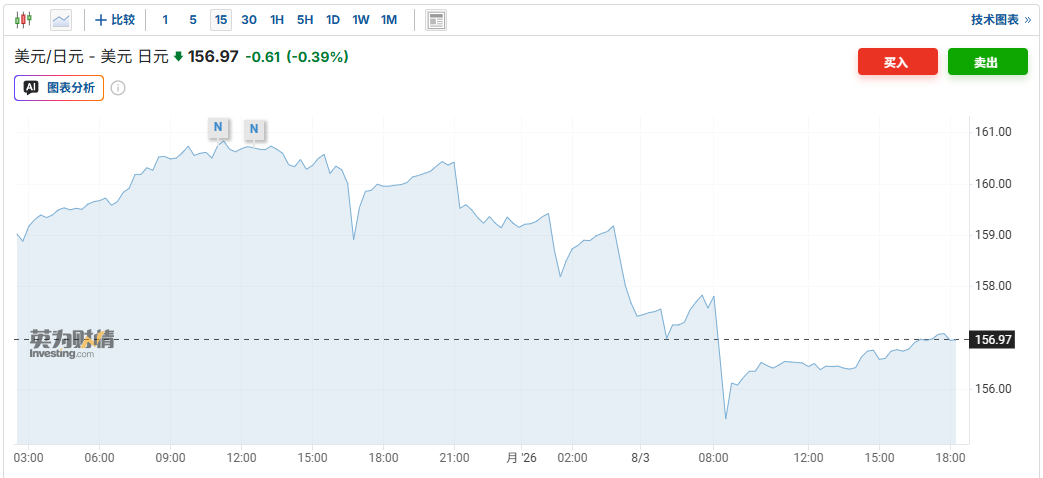
Traders are still watching closely to see if there will be more joint action in the future, while market expectations that the Bank of Japan may raise interest rates as early as September are heating up. Furthermore, the market is shifting its focus to the quarterly foreign exchange market intervention report to be released by Japan's Ministry of Finance this Friday. The report will detail daily market operations from April to June. This data may provide new clues to the market and help investors understand how the Japanese authorities are timing intervention and how they are trying to get ahead of speculative traders.
Although the joint intervention of the US and Japan pushed the exchange rate of the US dollar against the yen away from a low of nearly 40 years, historical experience shows that foreign exchange intervention often only changes the pace, making it difficult to reverse the trend. The fundamental problem is the spread between the US and Japan — the US federal funds rate is as high as 3.50% to 3.75%, while Japan's policy interest rate is only 1%, and the spread remains at 250 to 275 basis points.
A global investment strategist at the Franklin Templeton Research Institute pointed out, “Repeated intervention may buy time, but every round of intervention has the same limitations; that is, the Japanese authorities want the yen to strengthen, but they are unwilling to fully bear the policy costs required to achieve this goal.” A senior Brookings Institution researcher put it bluntly: “As long as the yield on Japanese treasury bonds is artificially limited, the yen is overvalued and needs to fall.” In his view, intervention could not solve the fundamental problem.
Second, the structural impact of the Middle East conflict on the Japanese economy continues, and Japan relies on imports from the Middle East for 70% of its oil. As long as transportation disruptions in the Strait of Hormuz continue, high energy prices will continue to erode Japan's trade balance. Furthermore, Japan's financial and industrial structural difficulties have not changed. Long-term problems such as aging, industrial hollowing out, and insufficient motivation for innovation have left a fundamental impetus for the continued appreciation of the yen.
What is even more worrisome is that the intervention itself also has “side effects.” There are reports that the US sold euros instead of dollars to buy yen during this operation. This is completely different from the traditional practice of using dollar assets to coordinate intervention and financing, which surprised the market.
Robin Brooks, a senior researcher at the Peterson Institute for International Economics, pointed out sharply that if the US were to buy yen by selling the euro, investors would infer that US officials were trying to avoid financing by selling US Treasury bonds; this is actually a distortion. Brooks believes, “This method of operation weakens the actual effect of America's participation in the intervention, because it will inevitably cause the market to speculate about why the US does not directly use dollars to buy yen.” In his view, this arrangement may ultimately weaken rather than strengthen the market's confidence in the yen.