
The Federal Reserve Just Did Something That No One's Witnessed in 56 Years -- and It Has Significant Implications for the Stock Market
Key Points
Fed Chair Kevin Warsh and the Federal Open Market Committee (FOMC) left interest rates steady at the July 29 meeting.
Warsh has inherited a divided central bank, as evidenced by a historic level of dissension so early in his tenure.
The stock market may be in a no-win scenario, with investors losing if the Fed stands pat on interest rates, and also if it raises lending rates.
Last week was a tone-setter for Wall Street. It marked the busiest week of the third quarter for earnings releases and featured a Federal Reserve interest rate decision.
But on July 29, the day Fed Chair Kevin Warsh and the Federal Open Market Committee (FOMC) announced that they were leaving interest rates steady, the Dow Jones Industrial Average (DJINDICES: ^DJI), S&P 500 (SNPINDEX: ^GSPC), and Nasdaq Composite (NASDAQINDEX: ^IXIC) tumbled. In fact, it was the Dow's worst single-session performance in more than a year.
Missed Nvidia in 2009? This Rare Signal Is Flashing Again. In 2009, a "Double Down" signal flashed for a little-known chipmaker called Nvidia. For the first time in years, that same "Total Conviction" signal is flashing for a company 1/100th the size of Nvidia. Continue »
Moreover, it was a history-making FOMC meeting in more ways than one. Wall Street and investors witnessed something that hasn't happened in 56 years at America's foremost financial institution, which has significant implications for the stock market.
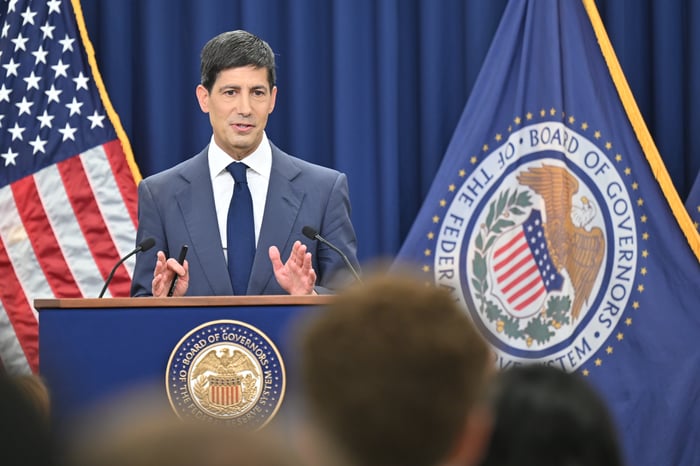
Fed Chair Kevin Warsh has inherited a historically divided FOMC. Image source: Official Federal Reserve Photo.
A Fed divided against itself cannot stand
No one ever said that overseeing U.S. monetary policy would be easy. However, President Donald Trump's handpicked successor to Jerome Powell took the reins at perhaps the most inopportune time.
To begin with, the combination of Trump's tariffs modestly lifting prices in the goods sector and the Trump-led Iran war pushing up fuel prices at the fastest pace in three decades sent trailing 12-month inflation to a three-year high of 4.2% in May (the month Warsh was sworn in).
The other glaring issue for the new head of the central bank is that he took over a historically divided FOMC. While Powell's tenure was marked by the lowest per-meeting dissension rate dating back to 1978, his final FOMC meeting as Fed chair in April was tarnished by four dissents (one member favored a quarter-point rate cut, while three others opposed the inclusion of the easing bias statement).
The FOMC held rates steady, and the vote was 9-3.
-- Nick Timiraos (@NickTimiraos) July 29, 2026
Three bank presidents dissented in favor of a quarter-point rate increase.
It was the first time since 2016 that there were three dissents in the same direction over a policy change. pic.twitter.com/OBnwLJuUmr
Although Warsh's first meeting as Fed chair in June featured no dissents, this wasn't the case on July 29. Beth Hammack, Neel Kashkari, and Lorie Logan all dissented in favor of a quarter-point rate hike. Not only was this the first time we've seen three dissents in the same policy direction since September 2016, but it's the first time a new Fed chair has overseen three dissents this early in their tenure since 1970!
A lack of monetary policy cohesion at the central bank is potentially dangerous for Wall Street. The Fed is commonly viewed as a foundational pillar to Wall Street's long-term success. The longer this historic division continues, the more likely it is that the central bank will lose the credibility it's taken a long time to earn.
This early stage division among FOMC policymakers, coupled with a notable move higher in long-term Treasury bond yields, also suggests an increased likelihood of the Federal Reserve raising interest rates to stabilize prices. If interest rates climb, it could slow the artificial intelligence (AI) infrastructure build-out that's been foundational to the Dow's, S&P 500's, and Nasdaq Composite's rallies.
In other words, if the Fed stands pat on interest rates amid historic division, the stock market loses; and if policymakers act to stabilize prices, the stock market also loses.
Sean Williams has no position in any of the stocks mentioned. The Motley Fool has no position in any of the stocks mentioned. The Motley Fool has a disclosure policy.