
Supply Shortage Impacts Apple (AAPL.US)! Q3 service and Chinese market performance concerns have surfaced, and Q4 revenue guidance falls short of expectations
The Zhitong Finance App learned that due to the shortage of parts affecting Apple (AAPL.US) sales expectations, the company's stock price plummeted during after-hours trading, which indicates that the losses caused by supply restrictions in the entire industry were greater than expected. The company said in an earnings conference call on Thursday that it expects revenue for the fourth fiscal quarter ending in September to increase by 9% to 11%, and analysts previously expected an increase of more than 12%; iPhone revenue growth for the fourth fiscal quarter is expected to reach about 15%, lower than Wall Street's 17.6% forecast; at the same time, gross margin is expected to be between 47% and 48%.
Apple has been struggling to get enough memory chips and processors, a situation that forced the company to raise the price of Macs and iPads last month. Supply shortages have also led to extended wait times for key models such as the Mac mini and Mac Studio. CFO Kevin Parek said during a conference call that these restrictions will affect iPhone, Mac and iPad sales in the September quarter. He also pointed out that exchange rate fluctuations also hindered growth.
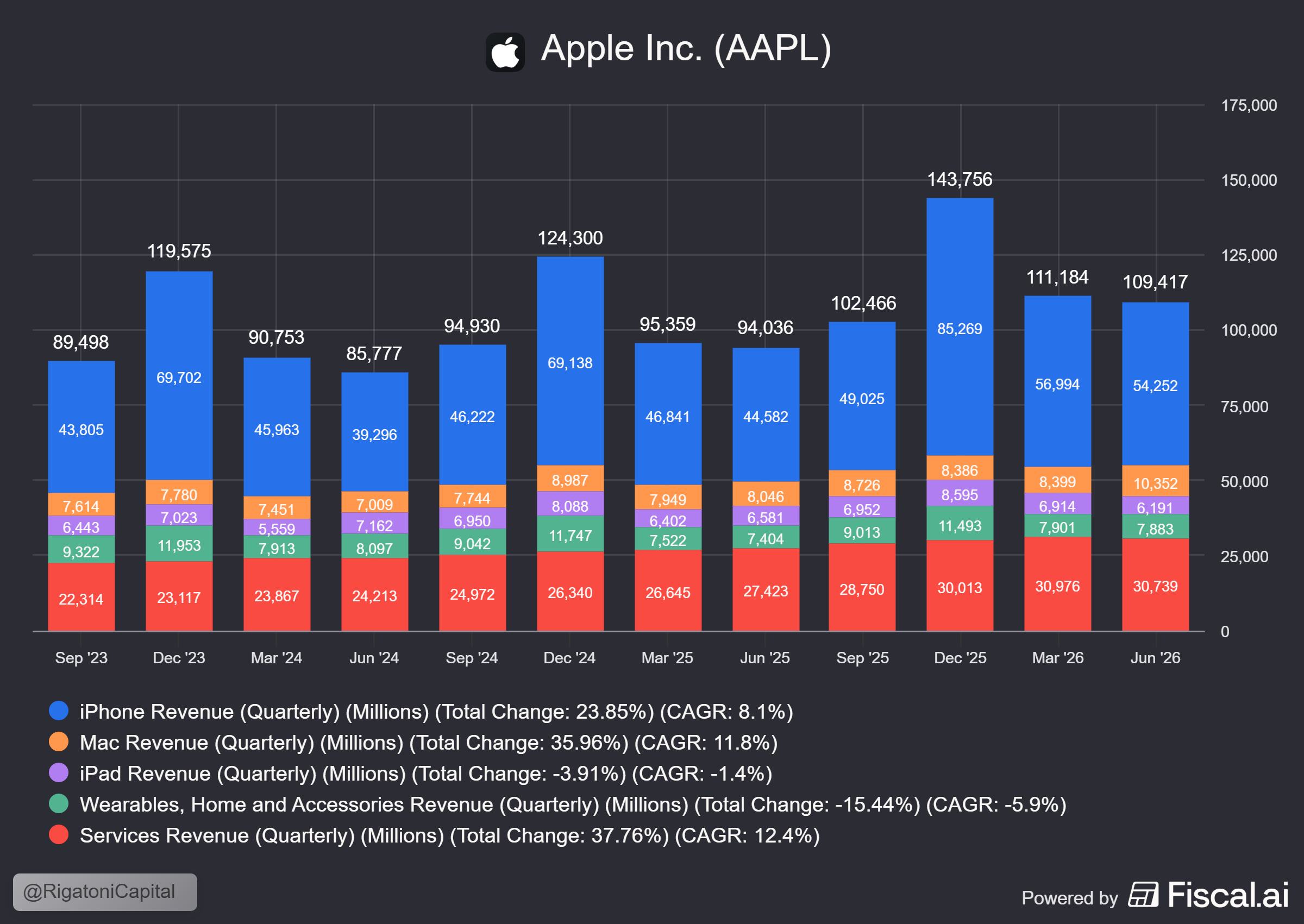
For the third fiscal quarter ending June 27, its sales increased 16.4% to US$109.42 billion. According to the London Stock Exchange Group (LSEG) data, analysts had anticipated an increase of 15.5% to US$108.65 billion. Apple itself had previously predicted a 14% to 17% increase in sales. Earnings per share for the fiscal third quarter increased to $2.02, compared to the previous average forecast of $1.89 per share. Of this, 11 cents came from the US government's tariff refunds, and even without tax refunds, Apple's profit was still higher than Wall Street's estimate of $1.89 per share.
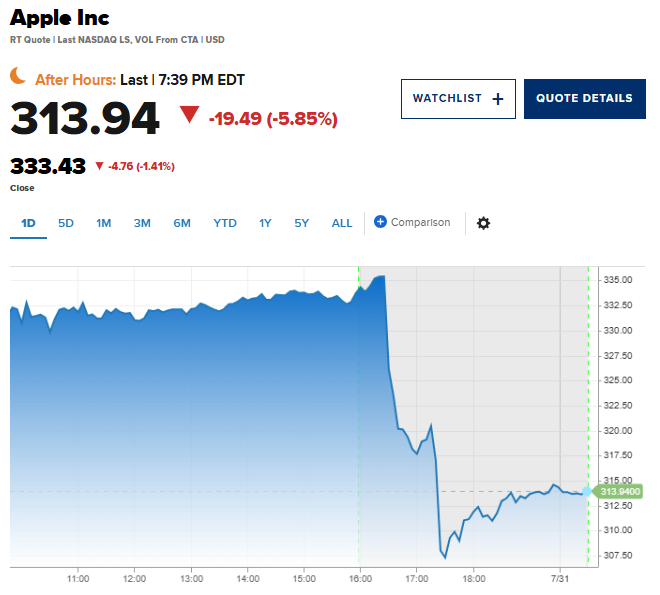
After the results were announced, Apple's stock price fell by about 8% during after-hours trading. As of press time, the decline had narrowed to about 6%.
Two major concerns: service growth is slowing, and Greater China falls short of expectations
The tech giant's performance also showed that its expansion in the Chinese market and service sector was slower than expected, and these two businesses were once its growth engines.
Meanwhile, the recovery of Apple's sales in China has always attracted the attention of investors and analysts. The company is still growing in the Chinese market, but the pace of recovery has not met the expectations of some. Although total revenue exceeded expectations, sales in the Chinese market increased 22.4% to US$18.8 billion in the third fiscal quarter, far below analysts' expectations of US$19.6 billion.
The services business (including Apple Music, App Store, iCloud subscriptions, streaming video, and other digital products) grew by only a disappointing 12% during this period. Services revenue of US$30.7 billion was lower than the previous forecast of US$31.4 billion.
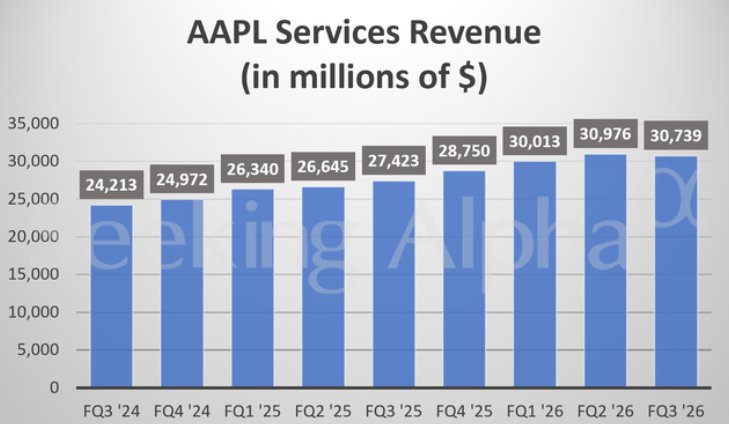
DA Davidson analyst Gil Luria said service growth is slowing. “Investors are concerned that if the growth rate of the service sector slows and iPhone sales increase by more than 20%, then as iPhone sales fall, the service sector growth rate may slow further.” he said.
The iPhone is still the hardest shield for hardware
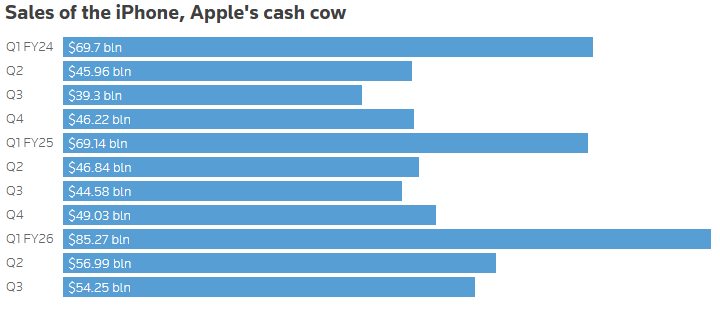
Total product revenue of $78.68 billion was slightly higher than the estimate of $772.5 billion. Among them, the iPhone is Apple's most profitable product, and it is also one of the highlights of Thursday's earnings report. The product's revenue for the quarter increased 22% to $54.3 billion, higher than the previous forecast of $53.6 billion. These data show that demand for the iPhone 17 series, which was released in September last year, is still strong. Additionally, Apple introduced a new entry-level iPhone 17e in March.
Mac revenue was approximately $10.4 billion, up 29% year over year, and Wall Street had previously expected revenue of $8.62 billion. The company unveiled new Mac products in March, including the MacBook Neo, the MacBook Pro with the M5 chip, and the new MacBook Air.
The i-Pad division had sales of $6.19 billion, lower than the previous forecast of $6.89 billion. Apple released the new iPad Air in March and the upgraded iPad Pro in October of last year. But both of these upgrades revolved around a new chip rather than a major design change.
Apple plans to launch a variety of new Macs and iPads at the end of this year and next spring, which is expected to boost sales. These include the first touchscreen MacBook and the redesigned iPad mini as part of Apple's comprehensive renewal of the Mac and iPad product lines.
Apple's wearables, home and accessories business revenue reached US$7.88 billion, up 6.5% year on year, which is basically the same as the previous forecast of US$7.87 billion. Apple plans to boost this business segment by launching new smartwatches and a range of upgraded smart home devices (including smart home centers and new TV set-top boxes) within the next few months.
Shortage of memory chips squeezes performance prospects
In an interview, Cook said that the main supply constraint faced by Apple in the recently completed third fiscal quarter was the shortage of advanced chip manufacturing technology used to produce core chips for Apple devices.
On Apple's March quarterly earnings call, Cook said memory costs would “rise significantly.” He warned that this would have a “growing impact” on business in the fourth fiscal quarter (ending September) and beyond. However, these remarks were made before Apple raised prices, and the price increase should mitigate the impact of rising component costs.
The company is also making some adjustments to how it sells its products. On Tuesday, Apple launched a device rental program called “Apple Upgrade,” which allows users to subscribe to iPhones, iPads, and Mac computers and trade them in after the rental period expires. This plan, which is similar to car rental, is expected to mitigate the impact of recent price increases on many consumers.
Bob O'Donnell, chief analyst at TechNalysis Research, said investors may be concerned that the third-quarter buying boom might not extend into the current fourth quarter or beyond.
O'Donnell said, “I think people are likely to keep buying existing phones because of the price increase. The key question is, how will the Mac computer market change this quarter when the new prices are fully effective?”
Apple said that gross margin for the third fiscal quarter was 50.1%. Previously, the company warned that gross margin would be under pressure due to rising memory costs. Apple said that tariff refunds contributed 2 percent of this. Excluding refunds, the gross margin was 48.1%, higher than the median value previously anticipated by Apple, and higher than the expected value of 47.92% as shown by London Stock Exchange Group (LSEG) data.
Cook's farewell and Turners' takeover: At the crossroads of the AI era
For Cook, that quarter was to some extent his farewell performance. He will hand over leadership to hardware chief John Turners on September 1. Cook has led Apple since 2011, diversified its product line and raised annual sales to nearly $500 billion.
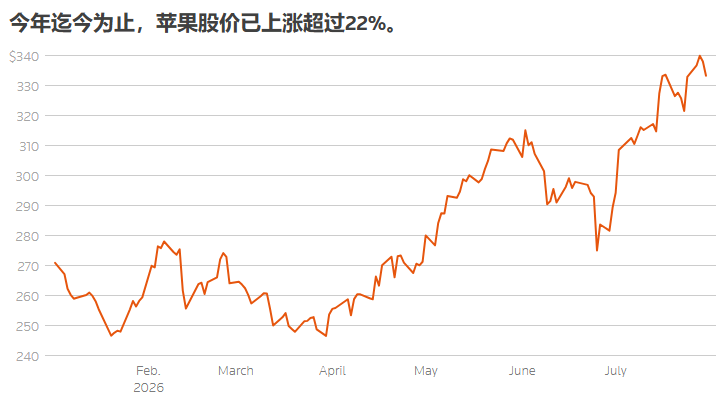
Before the earnings report was released, Apple's stock price had risen 22% this year, surpassing many of its tech peers. Recently, Apple has regained the position of the world's highest company by market capitalization, surpassing Nvidia, in part because it is seen as a safe haven for surging investment in the field of artificial intelligence. The company's current market capitalization is close to $5 trillion, but it is also facing unprecedented challenges.
The veteran Turners, who has worked at Apple for 25 years, will officially take office after half an hour of this season. The fourth fiscal quarter is critical for Apple because new iPhones and other major devices usually go on sale this quarter. The challenge Turners faced was how to help Apple adapt to the age of artificial intelligence. The Cupertino, California-based company has been hard to keep up with in this field, and its artificial intelligence services lag behind its Silicon Valley peers.
The first is the continuation of the supply crisis. Shortage of memory chips and tight production capacity in advanced manufacturing processes will be difficult to resolve in the short term, and may continue to suppress product gross margins and shipments.
Second is the urgency of an AI strategy. At WWDC this year, Apple launched Siri AI (with an annual cost of about 1 billion US dollars) reconstructed based on Google Gemini technology, and confirmed that it will use Google Cloud and Nvidia GPUs to support AI computing power. But Apple's catch up in the field of AI has only just begun. Forrester Research analyst Thomas Husson stated, “The real challenge facing the new CEO is to ensure that Apple can use AI as a new user interface to crack and reshape human-computer interaction.”
The third is the test of the product cycle. Apple is preparing to launch a new Siri with Google technology and new iPhone hardware in September. This is a critical test for the company as investors worry that it is already falling behind in the field of artificial intelligence. The good news is that the incoming CEO will have plenty of new products to showcase. Apple is preparing to launch its first foldable iPhone, smart glasses, and other wearables.
Fourth, there are hidden concerns about brain drain. As many executives are about to retire, Turners needs to supplement Apple's leadership. He must also reverse the company's brain drain, after some employees were taken away by OpenAI and other rivals in the field of artificial intelligence.
At the end of the call, Cook said goodbye to shareholders and analysts: “I would like to take this opportunity to thank all of you — from our shareholders, particularly our long-term shareholders who have trusted us over the years, to the analysts who have closely followed our company. As you know, this will be my last earnings call, and John will be hosting future meetings. The transition is progressing seamlessly, and I'm incredibly excited for John to take over and lead Apple into the next era.”
Cook will be re-elected as executive chairman, while 25-year Apple veteran John Turners, head of hardware engineering, will officially take over as CEO on September 1.
What Turners left behind was a complicated “legacy.” On the one hand, strong demand for iPhones and Macs, a moat built by brand loyalty, and a market capitalization base of nearly 5 trillion US dollars; on the other hand, service growth has stalled, competition in the Chinese market has intensified, AI strategies are lagging behind peers in Silicon Valley, and a worsening memory supply chain crisis.