
Amazon (AMZN.US) surged after the market! Q2 performance exceeded expectations, accelerated growth in cloud business, mitigated concerns about AI investment and raised annual capital expenditure to US$220 billion
The Zhitong Finance App learned that Amazon (AMZN.US)'s second-quarter results exceeded market expectations, and the accelerated growth of cloud computing business revenue for the fifth consecutive quarter mitigated investors' concerns that their huge investment in artificial intelligence (AI) capital would not return. Boosted by this, as of press release, Amazon's US stocks rose more than 9% after the market on Thursday.
According to financial reports, Amazon's total revenue for the second quarter increased 20% year over year to 2006 billion US dollars, better than analysts' average forecast of 1970 billion US dollars; operating profit was 27.5 billion US dollars, up 43% year over year; net profit was 62.6 billion US dollars, up 245% year over year, including 53.4 billion US dollars of non-operating income before tax, mainly from its investment in Anthropic; diluted earnings per share were 5.75 US dollars, far higher than analysts' average expectations of 1.82 billion US dollars.
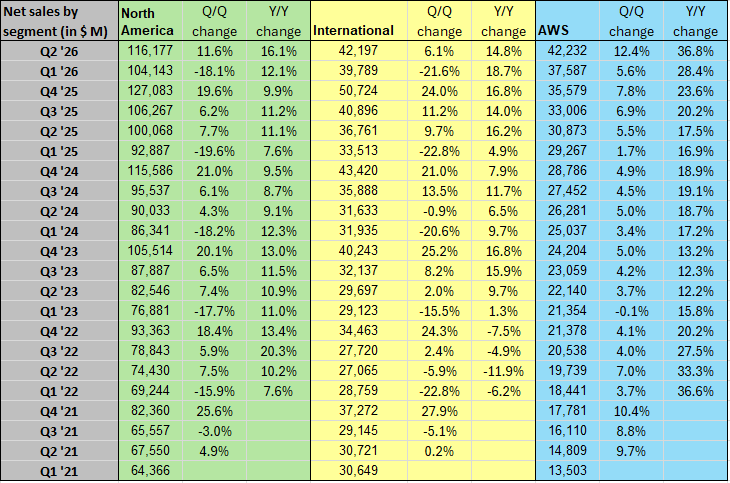
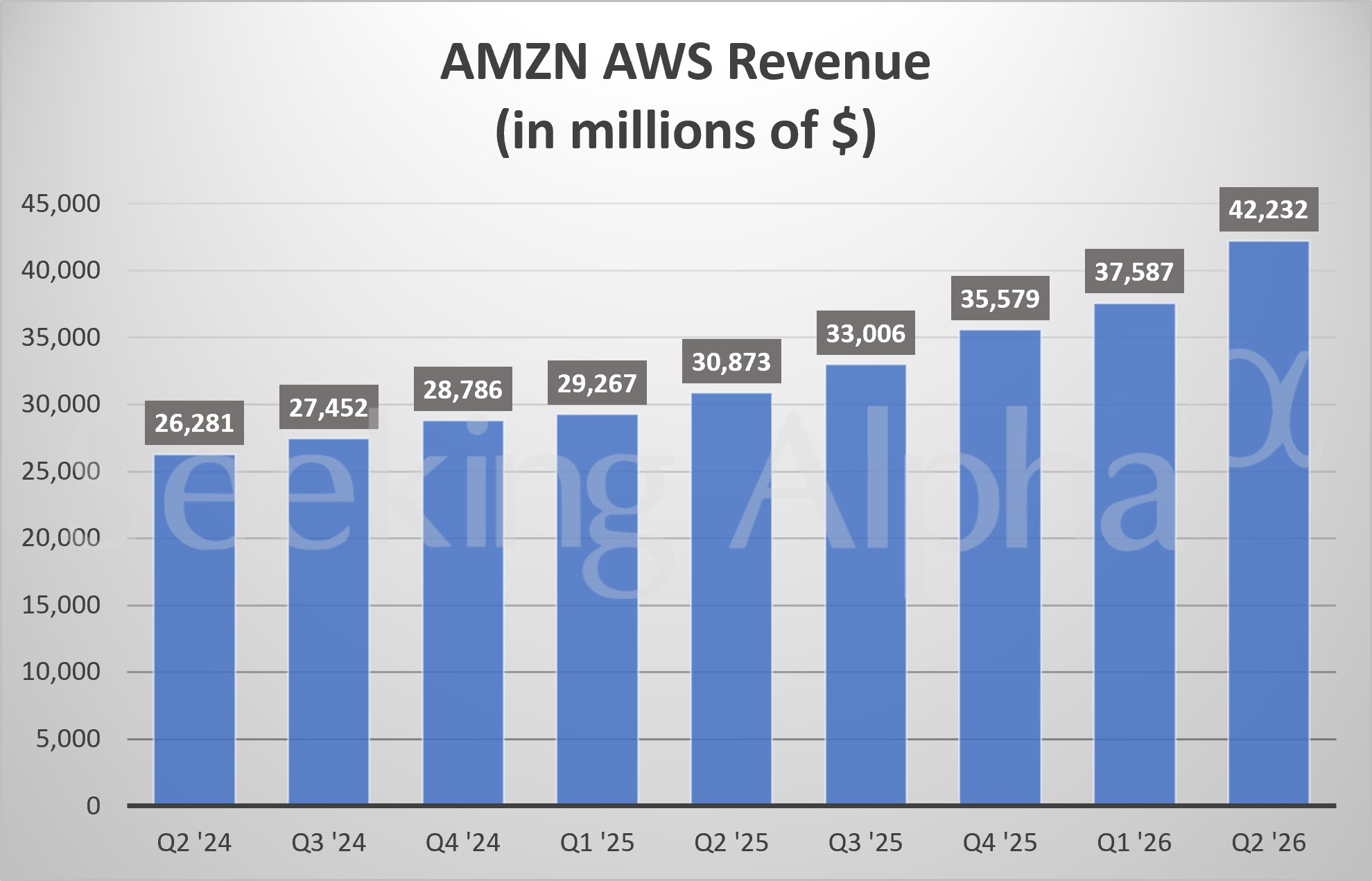
The core Amazon Cloud Services (AWS) revenue increased 37% year over year to $42.2 billion, better than analysts' average forecast of $40.6 billion, and the fastest growth rate since the fourth quarter of 2021. Investors paid close attention to the growth of AWS before the financial report was released. Previously, Amazon's major cloud service competitors all posted strong cloud business results. For example, last week, Google (GOOGL.US) reported an 82% year-on-year increase in Google Cloud revenue; yesterday, Microsoft (MSFT.US) Azure cloud service's revenue for the fourth quarter ending June increased 43% year over year.
Amazon CEO Andy Jassi said that AWS is “booming,” and pointed out that its AI and self-developed chip business divisions are growing strongly. Both have annualized revenue of more than 25 billion US dollars, and both have achieved three-digit percentage growth over the same period last year.
Like other big tech companies, Amazon is investing massively in data centers and chips to seize the opportunities brought by the rapid growth in demand for AI and cloud computing services. Amazon's capital expenditure in the second quarter reached $54.2 billion, up from $32.1 billion in the same period last year. Its heavy investment in AI products and infrastructure led to a negative free cash flow — as of the end of the second quarter, the company had a net free cash outflow of $7.6 billion over the past 12 months, compared to a net inflow of $18.2 billion a year ago.
Amazon also raised its 2026 capital expenditure forecast from the previous forecast of $200 billion to $220 billion. Jaxi said that most of this spending will go to the AI field. Jasi said that the rise in memory prices has boosted expectations of its capital expenditure. He added that Amazon's spending boom is unlikely to slow down in the short term. “Even at this level, we will not be able to have enough production capacity to meet all demand by 2026, and I believe this trend will continue in 2027. In fact, we think the demand for 2028 is already very significant”.
Jasi also said, “We are in a very good position in this wave of AI transformation.” He emphasized that Amazon's investment in AI infrastructure is critical to meet the growing demand for its cloud services. He said that AWS's backlog of work this quarter (that is, contract projects that have not yet gone online) has reached 496 billion US dollars.
Despite increased capital expenditure and negative free cash flow, Emarketer analyst Skye Kanavis said in a statement: “Given that AWS revenue growth is accelerating while the company is strictly controlling costs in other areas, investors are unlikely to be concerned about this.”
Jasi pointed out that with the passage of time, the scale of Amazon's investment will tend to ease because the company is currently building a data center from scratch. He said the service life of these data centers is about 30 years, and the equipment in them needs to be updated every five to six years. Therefore, the future investment required to modernize and upgrade construction capacity this year will not reach the current level.
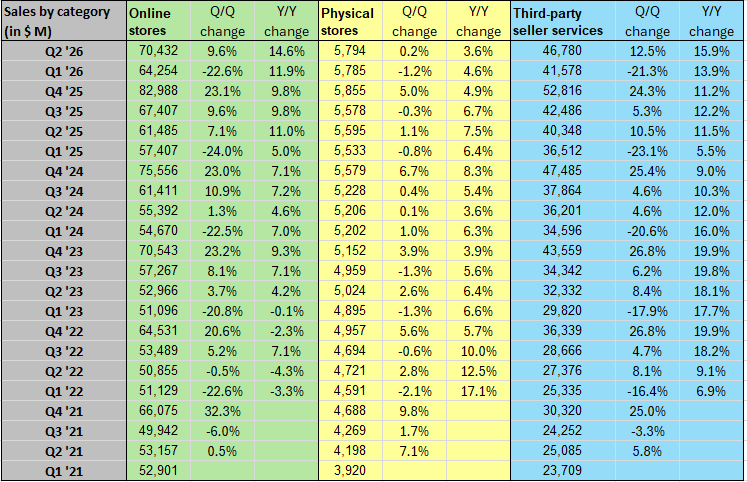
In addition to the cloud computing business, Amazon's e-commerce business still contributes the largest percentage of the company's revenue, and Jia Xi is still pushing to shorten delivery times for online consumers. Online sales for the second quarter increased 15% year over year to $70.4 billion, higher than analysts' average expectations of $69.9 billion. Amazon held its annual Prime Day sale in June. According to Adobe's estimates, the campaign drove total online spending of all retailers in the US to $26.4 billion.
Amazon also said the company received around $600 million in tariff refunds in the second quarter and promised to automatically issue refunds to consumers “under limited circumstances.” Amazon Chief Financial Officer Brian Osafsky said that since Amazon was hoarding inventory ahead of time to cope with the impact of tariffs, the amount of refunds received by the company was lower than it could have achieved.
Osafsky said, “In situations where costs do rise due to tariffs, we mostly choose to absorb these costs ourselves rather than pass them on to consumers.” “We have confirmed that in a limited number of cases, it is possible to trace that we have passed on certain import charges to consumers. Once we receive these refunds, we will proactively contact affected consumers and automatically issue refunds to them.”
Looking ahead, Amazon expects third-quarter revenue to be between US$19.7 billion and US$2020 billion, less than analysts' average expectations of US$203.9 billion; operating profit is expected to be between US$22.5 billion and US$26.5 billion, and the median range of US$24.5 billion is also lower than the analysts' average expectation of US$25.1 billion.
Amazon said that since the company changed its Prime Day promotion to June instead of the usual July, it is difficult to compare its performance with the third quarter of the same period last year; if the impact of Prime Day this year and last year is excluded, the growth rate for the third quarter of 2026 “will be nearly 400 basis points higher.”