
US semiconductor stocks staged a super counterattack! “The ruins of deleveraging” are nurturing the rise, and the AI computing power theme takes the lead
The Zhitong Finance App learned that before the US stock market on Thursday, semiconductor stocks closely linked to AI computing power infrastructure were booming, which seemed to indicate that the semiconductor sector, which has continued to fall into extreme deleveraging and overcrowded positions, and that AI capital expenditure has been slow to return optimism and pessimism, is facing a huge “irrational catharsis of bullish sentiment” that has been lost for a long time. At the same time, according to strategists who are still cautious about global stock market conditions, global investors have been trying for the past two months, but have hardly been able to find a powerful signal that can break the newly formed state of sharp turbulence in the US stock market but has always stood still.
At the beginning of the US stock market on Thursday, the semiconductor sector staged a huge counterattack from “forced liquidation of extreme leveraged positions” to “retaliatory recovery”. The stock price of semiconductor equipment supergiant Fanlin Group, focusing on 3D NAND high depth-to-width ratio (HAR) etching equipment, surpassed expectations and sharp upward guidance, driving up more than 20% next time.
If you look at the recent results and future prospects of AI computing power industry leaders such as Samsung Electronics, UMC, and TSMC, SK Hynix, and Seagate, the conclusion seems even more clear: the physical demand associated with AI computing power infrastructure did not deteriorate in sync with the sharp fall and clearance of stock prices and extremely leveraged positions, but it is not enough to confirm the official restart of a new major wave of the global AI computing power trading theme.
Chris Caso, a strategist from Wolfe Research, a top Wall Street investment agency, pointed out that the Philadelphia Semiconductor Index (SOXX) doubled in the previous three months and then fell about 25% from its high. The recent weakness is more like a reset of expectations after a sharp rise. Caso anticipates that demand for artificial intelligence chips will still exceed supply until at least 2028, and continues to rank Nvidia as the best investment target for AI chips. It believes that the slowdown in capital expenditure for hyperscale cloud computing, which the market previously feared, has not actually occurred. Instead, the competitive trend surrounding AI agents “have no choice not to invest.”
The Goldman Sachs team of traders emphasized in the research report that the market lacked “juice,” which means that there is still a financial recovery between a rebound in overrun decline and trend reversal. According to their trading desk caliber, the total leverage of global hedge funds is still at the 93rd percentile of the past five years; after the S&P 500 falls below the CTA key trigger level, if it continues to decline for some time, it may release about US$15.7 billion and US$68 billion in systematic sales in the next week and month, respectively.
Furthermore, the Goldman Sachs trading team said that retail trading activity has cooled down, mutual funds and overseas investors tend to wait and see before the US midterm elections, and August is also a month of weak seasonal capital flows. Although corporate repurchases can provide reliable underpinning, they may not be enough to immediately push high-beta stocks to break through again.
CTA sales are in full swing, and retail enthusiasm is not picking up. Goldman Sachs warns that the S&P 500 is still stuck and “shaking in ruins”
According to Goldman Sachs's market trading department, this state of lack of clear direction will continue. A number of conflicting factors have kept the S&P 500 index stuck in the fluctuation range since the beginning of June. Even after Wednesday's decline, it was unable to change this situation. The most important factor is the market position factor: although the leveraged positions of hedge funds and retail investors are no longer at extreme levels, it still shows that investors have little desire to be more aggressive in taking risks.
Goldman Sachs senior traders, including Gail Hafif, said that in global hedge funds, the total leverage ratio is currently hovering at the 93rd percentile of the past five years. Mutual funds and overseas investors are likely to wait until after the US midterm elections in November; at the same time, even if corporate buyback activity is beneficial, their effects may be weakened by seasonally weak capital outflows in August.
A Goldman Sachs trader wrote in a recent research report to clients: “In the short term, there are very limited sources that can provide 'sources of juice' (sources of juice) for rising markets. We still need to get through the ruins left by the past few weeks before we start discussing any substantial re-allocation risks.”
This view provides more evidence for skeptics: the S&P 500 index has been stuck in a trading range of 350 points for almost two months, and a breakthrough in the short term is unlikely.
The benchmark stock index for the US stock market fell 1.5% on Wednesday, closing at its lowest level since June 10. The Nasdaq 100 index fell 2.1%, expanding the cumulative decline to 11% from the record high set in June. At the time of this sell-off, market concerns about the speed of spending by US tech giants continued to heat up, and high oil prices may also drive inflation to accelerate again.
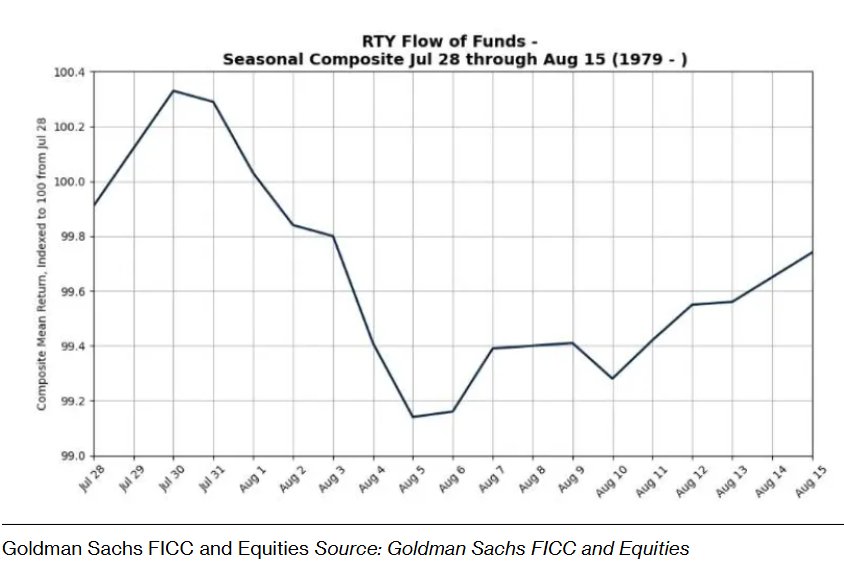
Goldman Sachs traders say the short-term market environment is unlikely to become very easy. According to Goldman Sachs data, in terms of overall stock fund capital flow, August has historically been one of the weakest months; in terms of the scale of mutual fund and ETF fund withdrawals, August and May are the largest net outflows of the year.
Goldman Sachs traders expect mutual funds to remain cautious until the November US midterm elections. They pointed out that judging from historical rules, such investors usually leave cash off the market before voting and then deploy funds after the election is over. Overseas investors also tend to cut their exposure to US stocks in the months leading up to elections.
Retail investors have also begun to retreat significantly. Goldman Sachs said that the average daily trading activity so far this month is more than 3% lower than the average of the past five years, indicating that another source of demand in the stock market has begun to weaken. According to statistics from Vanda Research, retail investors sold individual stocks on Tuesday on the largest scale since the COVID-19 pandemic.
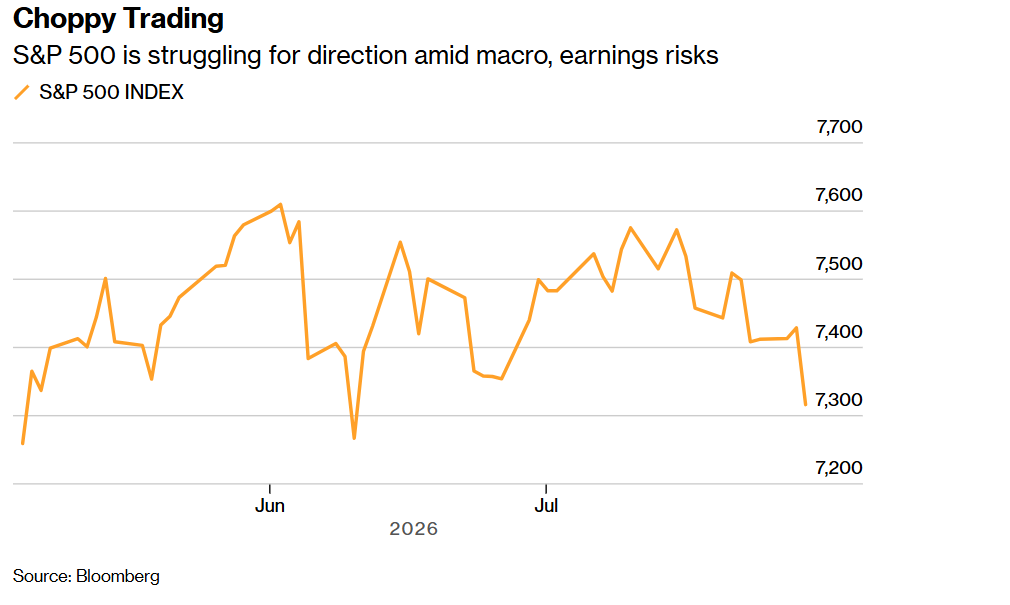
The chart above highlights volatile trading — under macroeconomic and profit risks, Goldman Sachs believes it will be difficult for the S&P 500 index to find a clear direction in the short term.
Systematic investment strategies (i.e. CTA strategies) institutional investors are still another potential source of volatility. Goldman Sachs estimates that many institutional investors focusing on such high-risk strategies (also known as “quick money”) follow the direction of the stock market rather than fundamental drivers, and currently hold a total of about $196 billion in US stocks, which is medium in size compared to historical levels. However, the S&P 500 index is currently below one of the key trigger points of the CTA strategy, which means that if the market falls further, it may trigger sales of about 15.7 billion US dollars in US stocks in the next week, and the sales volume in the next month may reach about 68 billion US dollars.
The semiconductor sector in the US stock market has exploded! Amidst the ruins of deleveraging, the “main rise” opportunity quietly nurtured, and semiconductors took the lead in competing for the main line of counterattack?
For long investors looking for signs of relief, corporate buybacks in the US stock market are expected to provide some support. Goldman Sachs's buyback trading department said that currently about 31% of S&P 500 companies are in the so-called open repurchase window period. The investment strategy department expects this ratio to exceed 50% by the end of next week and reach 90% by mid-August.
Goldman Sachs traders said in the research report: “This will allow one of the larger buyers in the market to return to the stock market. For the upcoming August, this is the strongest and most reliable flow of capital to support the US stock market.”
The major semiconductor counterattack on July 30 in the US stock market can be described as comprehensive semiconductor equipment and storage supergiants such as Fanlin Group, SanDisk, Western Digital, Seagate, and Micron, AI computing power industry chain superleaders such as Arm, AMD, and Intel, as well as TSMC, Asmack, Broadcom, and Nvidia. It shows that the capital is not only making up for a semiconductor stock that has surpassed the decline, but is buying the entire AI computing power industry chain in a big way.
Semiconductor equipment, storage, CPU/IP, foundry, and interconnect chains are strengthening simultaneously. The logic does not contradict Goldman Sachs's claim that the market lacks “fuel” to rise — mutual funds wait and see, retail investors are cooling down, total leverage is still at a five-year high level, and potential CTA sales are limiting the S&P 500's overall ability to break through. Semiconductors, on the other hand, received industry fuel from Fanlin order guidelines, continued AI capital expenditure led by Microsoft and Meta, tight storage supply and demand, and extreme short position compensation. Therefore, this is more like AI hardware structurally seizing power in an exponential market: in the short term, it already has a super counterattack pattern, but only if the rise continues after opening, the breadth of the semiconductor market continues to improve, and breakthroughs are confirmed at key technical points, this means that capital has actually upgraded from “grabbing a semiconductor rebound” to a new round of semiconductor main upswing configurations.
This round of counterattacks has a stronger profit catalyst than an ordinary technical backlash. Fanlin Group's June quarterly revenue reached a record $6.72 billion, up 15.1% month-on-month, and its non-GAAP operating margin rose to 38.4%, and the median revenue for the next quarter is expected to jump further to $8.1 billion and adjusted earnings per share to $2.15; management clearly stated that AI demand is reshaping wafer manufacturing equipment requirements through higher layers of NAND, advanced DRAM, HBM, and complex packaging.
Arm, the ARM instruction set architecture provider for consumer electronics products and AI data center servers, increased 22% year-on-year to US$1.29 billion. Data center royalties more than doubled, and its self-developed data center CPUs are expected to have more than $2 billion in demand in the next two fiscal years; Microsoft Azure revenue grew 43% and is expected to grow 45% next quarter, while maintaining actual AI infrastructure expansion plans, proving that cloud computing power investments are being transformed into cloud revenue, corporate orders, and cash flow, rather than simply accumulating idle GPUs.
Wall Street bulls' core arguments are also being verified by earnings reports. Wolfe Research's Chris Caso predicts that demand for artificial intelligence chips will exceed supply until at least 2028, and continues to rank Nvidia as the best investment target for AI chips. He believes that the market's previous slowdown in capital expenditure for hyperscale cloud computing has not actually occurred. Instead, the competitive trend surrounding AI agents “have no choice not to invest.”
Wolfe raised Nvidia and Broadcom's profit forecasts at the same time, and believes that Nvidia's future Rubin system and business opportunities not yet included in orders are still not fully reflected in current expectations. Caso also believes that the shortage of storage may extend the upward cycle of DRAM and NAND prices to 2028 or even 2029; Bank of America expects global cloud and AI infrastructure capital expenditure to be close to 1.5 trillion US dollars in 2027, an increase of 40% to 50% over the previous year. Together, these views point to the same underlying logic: scaling up training models, increasing inference concurrency, and the evolution of data centers from stand-alone to clustered will simultaneously increase the demand for GPUs, custom ASICs, HBM, server DRAM, NAND, advanced packaging, etch deposition equipment, and high-speed interconnection.
Wall Street financial giant Citigroup's latest research report shows that the arms race in the AI era is shifting from “who has the smartest model” to “who can continuously produce intelligence at the lowest cost and with the highest efficiency under physical constraints”: open weight models such as Kimi K3 are rapidly approaching the frontier of closed source, which means that model capabilities accelerate commercialization, but parameter scale, long context, and multi-step agent reasoning expand simultaneously, causing bottlenecks to shift from simple flops to HBM capacity and bandwidth, high-speed GPU interconnection, cluster scheduling, and power access. Nvidia research also points out that when model size, sequence length, and batch expansion, HBM often becomes the main expansion constraint; IEA predictions show that AI data center electricity consumption is growing significantly faster than overall electricity demand, while the power grid construction cycle is generally longer than the data center deployment cycle.
According to a recent research report led by Brian Nowak, a senior analyst at Morgan Stanley, the 2027/2028 capital expenditure forecasts for the five largest hyperscale cloud computing and vendors (Meta, Amazon, Microsoft, Google, SpaceX) in the global market (Meta, Amazon, Microsoft, Google, SpaceX) have been significantly raised again, reaching approximately $1.2 trillion and $1.4 trillion, respectively. The agency's capital expenditure forecast for major US tech giants in 2026 was drastically raised from 433 billion US dollars a year ago to 805 billion US dollars.
Based on Samsung Electronics' closing price of about 207,000 won and SK Hynix's closing price of 1,322,000 won on July 30, 2026, Wall Street financial giant Nomura's target price of 670,000 won for Samsung Electronics, one of the leaders in the AI computing power industry chain, represents a 225% potential increase over the next 12 months, and a potential increase of about 255.5% for SK Hynix's 4.7 million won target price.
The Nomura analyst team said that Samsung and SK Hynix should no longer be simply viewed as traditional storage stocks that rely on PC and mobile phone cycles, but should be redefined as structural growth assets for AI infrastructure. The judgment was based on three points: AI training, inference, and data center expansion kept storage demand higher than supply expansion; HBM and general storage entered a resonant supercycle; the price-earnings ratio of the two companies, which was about 6 times higher than that of TSMC, was significantly lower than the level of about 20 times that of TSMC, which did not fully reflect the sustainability of profits and the increase in ROE. As a result, Nomura drastically raised Samsung's target price from 590,000 won to 670,000 won, and SK Hynix drastically raised from 4 million won to 4.7 million won.