
The US economy fluctuates amidst consumer frenzy and the headwinds of war: domestic demand cannot help GDP slow to 1.5%, and falling oil prices helped PCE fall unexpectedly
The Zhitong Finance App learned that despite a sharp rebound in consumer spending and the continuation of the commercial investment boom surrounding artificial intelligence (AI), the US economic growth slowed markedly in the second quarter of this year due to widening trade deficits and falling inventories, falling short of market expectations.
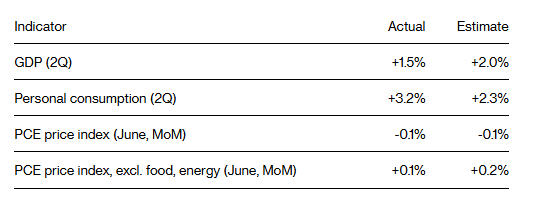
Preliminary estimates released by the US Department of Commerce's Bureau of Economic Analysis on Thursday showed that after adjusting for inflation, gross domestic product (GDP) grew 1.5% month-on-month in the second quarter. This growth rate is not only down from the 2.1% increase in the first quarter, but it is also far below the 2.1% forecast by economists. However, after the official release of forward-looking economic indicators, some economists have lowered the forecast minimum to 1.5% ahead of schedule, and the final data is in line with the revised expectations.
Strong domestic demand: consumption and investment two-wheel drive
The overall GDP data is weak, which largely masks the resilience of domestic demand in the US. Consumer spending, which accounts for more than two-thirds of US economic activity, performed particularly well in the second quarter, with a sharp year-on-month growth rate of 3.2% from 0.5% in the first quarter.
The strong recovery in consumption was supported by multiple one-time factors. Thanks to the “One Big Beautiful Bill” (One Big Beautiful Bill) promoted by former US President Trump, American households received more generous tax refunds this year than in previous years, which to a certain extent buffered the erosion of purchasing power caused by the rising gasoline prices due to the Middle East conflict.
Furthermore, the phased decline in gasoline costs at the end of the second quarter, increased promotional efforts by retailers, and non-profit organization expenses related to the recently concluded World Cup soccer games and midterm elections all stimulated consumption to varying degrees. Inflation-adjusted consumer spending rose 0.4% month-on-month in June, equalizing the highest monthly increase since July 2025.
The increase in household spending is mainly due to durable consumer goods such as furniture and motor vehicles. In terms of service consumption, consumer spending on optional consumption categories such as entertainment, food and lodging has increased markedly.
At the same time, corporate investment remains a core pillar of economic growth. In the fierce competition in the field of AI industrial intelligence, tech giants are ignoring investors' concerns about excessive valuations and are still frantically throwing money. Major technology companies such as Meta (META.US) and Microsoft (MSFT.US) continued to invest heavily in the construction of data centers in the second quarter to accelerate the deployment of AI infrastructure. In addition, demand for industrial and transportation equipment also contributed significantly. Federal Reserve Chairman Kevin Walsh described the resilience of the economy as “impressive” after the interest rate meeting on Wednesday and pointed out that the most “remarkable” characteristic of the economy is the strong momentum of corporate investment.
Since trade fluctuations often distort overall GDP data, economists pay close attention to a more accurate domestic demand indicator that excludes trade, inventory fluctuations, and government spending — final sales to domestic private individuals. The indicator climbed 3.9% in the second quarter, more than double the growth rate in the first quarter, making it the strongest performance since the beginning of 2023, further confirming that the foundations of the US economy have not wavered.
Headwinds of War: Net Exports and Inventories Become the “Achilles' Heel”
Judging from the GDP breakdown data, foreign trade and changes in inventories are the main factors dragging down the economy. In the second quarter, net exports dragged a full 1 percentage point on GDP. The reason behind this is not only a factor for enterprises to surprise imports in time for the new round of tariffs to take effect, but also reflects a surge in demand for capital goods imports.
Inventory changes have further lowered GDP by about 0.67 percentage points, showing that during the six-month war against Iran, many companies chose to actively consume inventory.
Non-residential fixed investment grew by 8.4% annualized. Among them, investment in industrial equipment recorded the biggest increase since 2011, and investment in transportation equipment also recorded the highest growth rate in two years; although investment in information processing equipment and software continued to grow, the rate slowed down.
Despite strong domestic demand, the specter of war is gradually eroding economic prospects. As war resumed in the Middle East, the average price of gasoline in the US has once again climbed above $4 per gallon. With wage growth barely keeping up with inflation, American households are being forced to use savings or lower savings rates to maintain current consumption levels. Economists have warned that in the face of increasing economic uncertainty, this consumption pattern may be unsustainable. It is expected that residents may soon switch to preventative savings. This will inevitably weaken domestic demand, the strongest pillar of the current economy, and bring some downside risks to the US economy in the second half of this year.
Inflation and the Federal Reserve: Internal Divergence Emerges
At the level of inflation, data released on the same day showed that the personal consumption expenditure (PCE) price index, the inflation indicator that the Federal Reserve is most concerned about, fell 0.1% month-on-month in June, for the first time since 2020. This price drop is mainly due to lower international oil prices after the US and Iran reached a temporary cease-fire agreement. On a year-on-year basis, the inflation rate fell back to 3.7% from a three-year high of 4.1% last month; the core inflation index excluding the impact of energy prices rose 0.1% month-on-month in June, and the increase was lower than market expectations. In the 12 months to June, the year-on-year increase in core PCE fell to 3.3% from 3.4% last month.
However, the price pressure brought about by the geopolitical conflict has not been removed. The fall in June was mainly due to the decline in oil prices after the US and Iran agreed to begin peace negotiations. However, the differences between the two sides are still serious, and oil prices are still relatively high. The inflation rate is likely to remain above 3% until the end of the year, putting pressure on the Federal Reserve.
The Federal Reserve decided on Wednesday to keep the benchmark overnight interest rate unchanged in the 3.50%-3.75% range, but there are rare three opponents within the decision makers. They “tend” to raise interest rates by 25 basis points at this meeting. The Federal Reserve said in a statement that despite the high level of uncertainty brought about by the Middle East conflict, economic activity is still expanding steadily.
The Federal Reserve regards the PCE price index (especially the core PCE) as the most accurate indicator for measuring US inflation trends. The indicator shows that for the sixth year in a row, inflation has been well above the 2% target set by the central bank. Market analysts expect that in order to completely curb inflation, the Federal Reserve may restart interest rate hikes as early as September, which also casts a shadow over the economic growth prospects for the second half of the year.