
At a time when the $2 trillion evaporates, it is still difficult to stop the South Korean government's leverage limit! The “Equalization Fund” is moving from an alternative instrument to a market focus
The Zhitong Finance App learned that a senior stock market analyst said that the South Korean government is trying to contain leveraged products that are creating chaos in its financial market, but these measures may still not be enough to calm the sharp fluctuations in the South Korean stock market that has soared rapidly; as the evaporation of the Korean stock market exceeds 2 trillion US dollars and is still expanding, the pain of retail investors and public anger continues to increase. At the level of alternative bailout tools, the Korean government is very close to the severity of having to upgrade the “Market Stability/Equalization Fund” from an emergency plan to a liquidity booster tool that can be implemented at any time.
With the sudden reversal of what was once the hottest deal in the world, the Korean stock market fell by about 40% in a month. The worst hurt were local Korean retail investors who borrowed money and poured into the market later in the market — that is, young people under 30, retirees, and ordinary household investors.
This has further heated up the pressure on the South Korean government. The government previously cheered for the rise in the stock market, but now it is under tremendous pressure as the market falls; some investors have even placed wreaths of condolence outside the Korean National Assembly to protest.
According to Wall Street financial giant Goldman Sachs, the peak of forced sell-off may have passed, but net exposure, financing capacity, market depth, and investor confidence have not been restored, so any macro impact may reactivate mechanical selling. This judgment is highly consistent with the actual market situation in the global semiconductor market. The Philadelphia Semiconductor Index once retreated close to 30% from its June high, setting one of the worst monthly performances since the beginning of this century; South Korea's KOSPI plummeted nearly 11% on July 28, then fell 12.6% intraday on July 29, triggering the suspension of trading, and eventually closed down about 6%. The cumulative decline was about 40% from the June high, and the market value evaporated by about 2.18 trillion US dollars. The key point is that the profits of Samsung Electronics and SK Hynix did not collapse at the same time. The profit of SK Hynix even increased sharply year over year, but it still caused sell-off due to failure to meet extreme expectations, indicating that the current dominant price is not current profit, but the rebalancing of leveraged ETFs, reversal of quantitative momentum, withdrawal of foreign capital, and compression of crowded valuations.
The “wreath of condolences” in front of the South Korean National Assembly escalated a financial deleveraging incident into a political and regulatory crisis: Samsung Electronics and SK Hynix together account for nearly half of KOSPI's market value, and retail investors also placed highly concentrated bets through double-daily leveraged ETFs. The decline in the target price forced the fund to reduce its exposure to derivatives, forming a feedback path of “falling stock prices — rebalancing sales of ETFs — margin recovery — falling stock prices again.”
As a result, the Korean government plans to limit individual investment in such products to less than 20% of total investment assets, increase transaction costs and simulated transaction requirements, and raise the minimum cash threshold to 30 million won from July 31; previously, it had also suspended new product launches and product advertisements, and began establishing a legal basis for emergency market stabilization measures. These measures are not equivalent to the announced use of “equalization funds,” but they mean that the policy response function has been upgraded from investor education to directly suppressing the increase in leverage and providing market support tools when necessary.
The evaporation of $2 trillion still hasn't bottomed out: South Korea's regulations came to an abrupt halt, and retail investors are experiencing “blood washing”, and it is difficult to rely on leverage to relieve pain
During the market crash on Wednesday, the governor of the Bank of Korea and the head of financial regulators immediately held a meeting that night to discuss how to contain market losses.
After the meeting, South Korea's financial sector regulators unanimously stated that they would set an upper limit on individual investment in single-stock leveraged funds and increase the transaction costs of such ETFs. These products played an unusually prominent role in the previous rise and subsequent liquidation, turning the largest stocks in the market into the “fiercest roller coaster” with sharp ups and downs.
However, market participants said that these regulations do not directly limit the leverage ratio of ETFs like the measures taken by Hong Kong regulators this month; as long as investors still want to get rich quickly, it will be very difficult to weaken the influence of these products.
Kim Jin-wook, a senior economist at Citi based in the Korean market, said, “These measures will help mitigate fluctuations in the Korean stock market, but introducing liquid put options such as market stability/equalization funds will be more effective.”
Another analyst — head of research at a major brokerage firm in Seoul — requested anonymity because the topic is sensitive in South Korea. He said that the latest South Korean government regulatory measures may be difficult to work because the investment cap was hastily announced without sufficient policy considerations and market crisis.
The analyst said that Hong Kong's relevant regulations reduced mandatory sell-off during periods of market pressure, thereby helping to reduce volatility.
However, he said that the ETF investment cap set by South Korea cannot help existing investors because they will not be required to sell their holdings on a large scale; moreover, since financial regulations in the Korean market will not affect similar leveraged products listed in New York and Hong Kong, price fluctuations may continue.
The pessimistic voice of “slaughtering retail investors” can be described as being increasingly strong among young Koreans. As the market plummeted this week, about 40 wreaths of condolence were placed on the sidewalk outside the Seoul National Assembly building to protest the government's handling of the single-stock leveraged fund issue.
“Massacre of retail investors” is written on the ribbon of one of the white wreaths. The other one says, “Wait for retribution; I'll give you all back the next time you vote.”
On Wednesday, within the National Assembly, South Korea's Finance Minister Koo Yun-chul was questioned by opposition lawmakers and said he was sorry for introducing these leveraged products without careful consideration.
The backlash has spread to online communities that usually support Lee Jae-myung's government, and there are also calls within the ruling Common Democratic Party to strengthen supervision.
Communist Democratic Party leader candidate Zheng Qinglai proposed on Wednesday to temporarily stop single-stock leveraged ETF trading. He said it was necessary to take extraordinary measures after sharp market fluctuations pushed the Korea Composite Stock Price Index below 6,000 points.
The Korea Composite Stock Price Index (that is, the benchmark stock index of the Korean stock market - KOSPI Composite Index) seemed to stabilize after two consecutive trading days, but it still fell 1%, still far from ending the downward trend. Since reaching an all-time high in June, this round of decline has evaporated KOSPI's market value by $2 trillion.
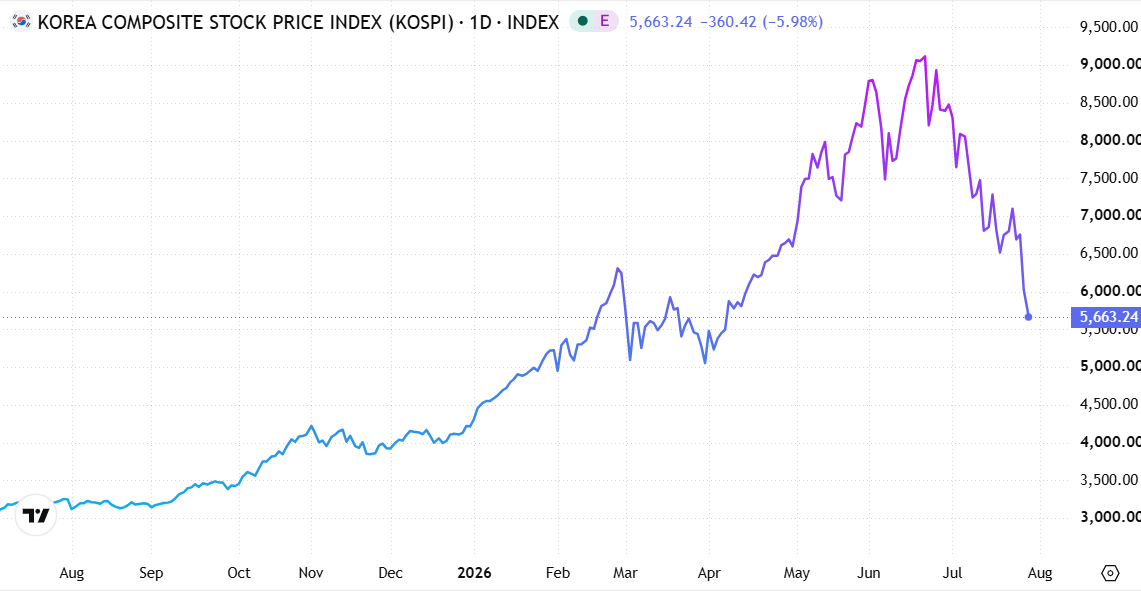
The Korean stock market is heading for its biggest monthly decline in history — although top chip makers Samsung Electronics and SK Hynix reported a combined quarterly profit of 150 trillion won (or about $100 billion) this week.
The current trading volume in the Korean stock market is clearly low, indicating that many investors are still holding positions and waiting to rebound; however, data shows that foreign investors net sold Korean stocks worth about 18.5 trillion won (13 billion US dollars) in July.
Tom Graff, chief investment officer of Facet in Phoenix, Maryland, USA, said that due to market fluctuations, “we have always overmatched the Korean market until last Friday.” “I do think this crash has a logical selling limit on the extent of the decline. But I don't want to try to catch a falling knife.”
Continuous fusing approaches policy tipping point: Korean-style “equalization funds” move from alternative instruments to the center of the stage
Since this year, the South Korean stock market can be described as having experienced frequent break-outs. Recently, KOSPI plummeted 10.84% on July 28, fell sharply by 12.6% during the session on July 29, and triggered a 20 minute suspension of trading in the entire market, eventually closing down 5.98%; the sharp decline for two consecutive days caused it to retreat about 40% from its June high, and the market value evaporated by more than 2 trillion US dollars. Meanwhile, as early as July 17, the Philadelphia Semiconductor Index fell 20% from its record high on June 22, confirming that it has entered a technical bear market. By around July 29, the maximum retracement was close to 30%. This is no longer an adjustment to the Korean single market, but a cross-market liquidity shock caused by Korea's leveraged ETFs, global quantitative momentum, semiconductor congestion positions, and AI valuations.
If forced liquidation continues to cause a liquidity vacuum, continuously trigger a breakdown in the entire market, and begin to impact the financing market and financial institutions' balance sheets, the South Korean government may use or restart the “Stock Market Stability/Equalization Fund” to purchase KOSPI 200 index assets through financial institutions. South Korea has a clear precedent: it established a 10.7 trillion won stock market stabilization fund in 2020 and plans to directly invest in the KOSPI 200 index; in 2024, regulators also indicated that a 10 trillion won financial market stabilization fund could be deployed at any time.
The South Korean government's current regulations and measures to limit leverage can only limit new risks in the future, and cannot quickly absorb existing leverage and overseas transmission channels. South Korea plans to limit individual investment ratios in single-share leveraged ETFs, increase transaction costs, and has suspended the listing and advertising of new products; however, these regulations do not directly reduce the product's leverage ratio by 2 times, nor do they require existing holders to reduce their positions, let alone restrict Samsung and SK Hynix leveraged products listed in New York and Hong Kong.
Because of this, Citibank Korean economists have clearly stated that “liquid put options” similar to market-stabilizing funds will have a stronger effect than current restrictions. The rational function of the so-called leveling fund is not to push KOSPI back to its historical high level, but rather to buy broad-based indices or large blue-chip assets when buyers disappear in depth, resuming two-way quotes, and blocking the mechanical death spiral of “falling prices — passively reducing ETFs — recovering margins — falling again.”
The trigger conditions that actually turned the Pingzhun Fund into a “must start” are that KOSPI continues to melt down again, the market breadth and depth of transactions continue to deteriorate, or the stock market stampede begins to spread to the Korean won, corporate bond financing, and financial institution balance sheets. South Korea has a mature policy precedent in the past: during the 2024 political turmoil, regulators were prepared to deploy a 10 trillion won stock market stabilization fund at any time, and the government also initiated a larger market stabilization arrangement. Therefore, the current judgment should be that “the bottom of the policy has entered the formative stage, and the direct bailout is still on the doorstep”; if fluctuations are still out of control after limiting leverage, the South Korean government will no longer introduce a stable fund with a clear scale, scope of purchase, and start-up conditions. Political costs, loss of wealth effects, and the risk of contagion in the global AI computing power industry chain will all be higher than the moral risk of the bailout itself.