
Hormuz shipping bucked the trend and recovered, and it was hard to hide safety premiums, and global oil and gas trade entered the “era of escort”
The Zhitong Finance App learned that although military hostilities between the US and Iran continue in the Middle East region, investors were surprised that the scale of shipping activity in the key waterway, the Strait of Hormuz, has rebounded in recent days; at the same time, the US side claims that its navy has escorted some large tankers through this waterway.
Earlier on Thursday, the “Al Areesh” publicly left the Persian Gulf, carrying liquefied natural gas from Qatar, the country's first export in three weeks; at the same time, the LPG carrier “CYH Yongchun” appears to have passed through the strait with the transponder turned off, according to ship tracking data.
According to statistics from market intelligence company Kpler, a total of 14 commodity carriers passed through the Strait of Hormuz in both directions on Wednesday, higher than last week's single-digit level. This data is still subject to correction as new information continues to emerge. Additionally, a crude oil supertanker has been initially booked, with a daily rent of close to $500,000. It is planned to load cargo at an unnamed Persian Gulf port next week, and possibly to China.
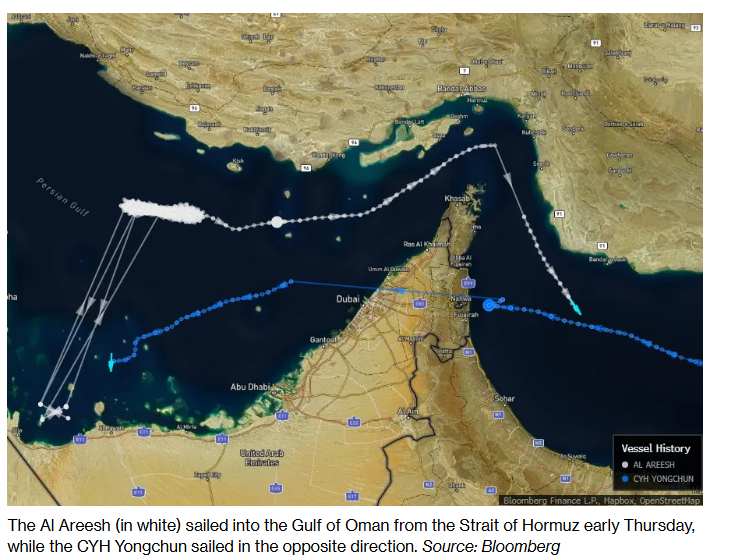
The latest compiled chart above shows ship dynamics on July 30, 2026 — the “Al Areesh” (white) sailed from the Strait of Hormuz into the Gulf of Oman earlier on Thursday, while the “CYH Yongchun” sailed in the opposite direction.
Shipowners and global commodity traders are closely watching the movement of ships through the Strait of Hormuz and the Red Hemand Strait to find signs of how ships are coping with the changing safety environment. As waves of geopolitical attacks in the Middle East between the US and Iran unfold — including frequent attacks on oil tankers — shipping flows to these waterways also fluctuate.
The root cause of the sharp escalation of the current round of conflict between the US and Iran is that the previous short cessation of fire did not resolve the core conflict between control of the Strait of Hormuz and the right to free navigation. The preliminary understanding on June 18 promoted the resumption of shipping, but the US then demanded that Iran stop attacking ships, fully open waterways, and not levy tolls; Iran insisted on its control over safety and traffic order in the strait.
In July, the US carried out continuous air raids on Iran's southern coast, missile, and drone facilities in order to forcibly restore shipping lanes, and Iran expanded the scope of retaliation from maritime transportation to Qatar, the United Arab Emirates, Kuwait, and the US military stationed in Jordan. The direct trigger for the latest round of escalation is that after Iran's missile attack on the US military in Jordan, the US carried out an operation that lasted about two hours and attacked dozens of Iranian Revolutionary Guard Corps commanders and drone facilities; the US and Saudi Arabia simultaneously attacked pro-Iranian forces in Iraq, and the Houthis also attacked Saudi energy facilities, turning the conflict from a bilateral confrontation between the US and Iran into a multi-front energy war covering the Gulf, Iraq, the Red Sea, and the Eastern Mediterranean.
After the US intensified its attack on Iran in mid-July, traffic volume in the Strait of Hormuz was drastically reduced; Iran's Tehran side then launched retaliatory attacks on military bases or ports of US allies, including Kuwait. This week, after a brief cessation of fire, hostilities resumed, but US Secretary of Energy Chris Wright said that with the support of the US military, oil continues to be exported.
“We are using the US military to escort oil and gas out of the Strait of Hormuz,” he said in an interview with the media. He added that over the past week, an average of about 6.5 million barrels of oil were shipped out of the Persian Gulf through this critical strait every day. “We are restoring the region's supply of oil and refined oil products to the global market.”
In the Red Sea, some tankers were spotted sailing into the Gulf of Aden, indicating that they intend to dock at the Saudi Arabian port of Yanbu, even though they still face the threat of military artillery attacks by the Houthis supported by Iran. Some Asian buyers appear to be picking up goods at the Egyptian Mediterranean port Sidi Clare, and Saudi Arabia has historically exported some of its crude oil through this port.
Other important Middle Eastern shipping-level developments:
Strait of Hormuz, Persian Gulf, Gulf of Oman
A finished oil tanker flying the Norwegian flag appears to be preparing to leave; the two Suez tankers “Chloe” and “Kariz” linked to Iran have already sailed into the strait and are currently anchored and waiting off Iran's port of Abbas.
The super-large crude oil carrier “Jamaica Prosperity” has been initially chartered by the shipping department of an Asian charterer. It is scheduled to load a batch of Persian Gulf cargo on August 3. The freight rate is 465 Worldscale points, equivalent to a daily rent of nearly 500,000 US dollars
Southern Red Sea
According to Kpler data, a total of 21 commodity carriers passed through the Mander Strait in both directions on Wednesday, compared to 38 the day before; only Russian crude oil was transported through this throat channel, with a total volume of about 3.5 million barrels, but some ships may have passed through with transponders turned off.
The super-large crude oil carrier “V Glory” controlled by South Korea was recently spotted approaching the Gulf of Aden and then turned off the positioning signal; the “Samha” flying the Saudi Arabian flag was also discovered to have taken the same action on Thursday.
On Wednesday, some ships were initially scheduled to be loaded from Yanbu in August and can choose to sail to South Korea via the Mander Strait.
Northern Red Sea
Late Wednesday night, two LNG carriers were attacked in the Egyptian port of Damietta, near the entrance to the Suez Canal; no organization has claimed responsibility.
The super-large crude oil carrier “Takamatsu Maru” flying the Japanese flag became the latest ship to change course to the port of Sidi Krill on the Mediterranean coast of Egypt; the ship previously departed from the US and is currently located in southeastern Africa.
The “Bidbid” and “VL Prosperity” have arrived in Sidi Clare and are being loaded, after previous reports indicated that their destination is in Asia.
Three very large crude oil carriers departing from Yanbu — “Olympic Luck,” “DHT Gazelle,” and “DHT Mustang” — are currently anchored off Sidi Krill, and there is no clear destination.
The resumption of navigation in Hormuz makes war premiums difficult to overcome: oil prices have regained the right to price inflation, and central banks around the world are forced to extend the cycle of high interest rates
Overall, the resumption of energy transportation in the Strait of Hormuz under military escort is very limited. For the first time in three weeks, an LNG carrier in Qatar was seen leaving the strait. The traffic volume of commercial ships has risen several times from the previous single digit. The US says that in the past week, an average of 6.5 million barrels of oil were shipped out of the Persian Gulf with military support; however, before the conflict, Hormuz carried about 20.9 million barrels of oil and liquid fuel every day, which is equivalent to about 20% of global consumption.
As a result, current traffic only proves that the strait has not been completely blocked, and cannot prove that the supply chain has been normalized; the shutdown of transponders, the daily rent of oil tankers is close to 500,000 US dollars, and the Red Sea ship detour and insurance costs have soared, which means that risk premiums have spread from a shortage of spot supply to shipping, insurance, refining, and inventory systems. The international crude oil benchmark — the price of Brent crude oil once rose sharply to the $100 super mark after the latest round of geopolitical conflict escalated, and once surged by nearly 10% during the day, which highlights the repeated pricing of commodity market traders between “limited resumption of navigation” and “further escalation of the war.”
For the Federal Reserve, this very limited pattern of resumption of navigation means that monetary policy will shift from judging a one-time energy shock to preventing second-round transmission of energy, transportation, commodity prices, and wages. The Federal Reserve voted 9 to 3 on July 29 to maintain the federal funds rate at 3.50% to 3.75%. The three members advocated an immediate increase in interest rates by 25 basis points, indicating a marked increase in the austerity trend within the committee.
As long as crude oil remains high, shipping costs continue to be transmitted, and core inflation stickiness does not recede, the Fed's interest rate hike in September will continue to be a benchmark risk, and the interest rate cut window will basically close; if Hormuz shipping continues to improve and oil production falls steadily back to the pre-conflict range, the Federal Reserve may continue to suspend. The ECB faces stronger restrictions because the Eurozone is more dependent on imported energy: its overall inflation in June was still 2.8%, energy inflation is still 8.5%, and wage growth is expected to rise to 2.7% in early 2027, so the threshold for an “insured rate hike” in September or October is being lowered. The Bank of England is also more likely to maintain 3.75% in the long term, while the interest-rate cut cycle for energy-importing emerging economies will be delayed.