
Refineries are at full capacity, and the trading business is profitable. Shell (SHEL.US) used the Middle East conflict to achieve the best performance in four years
The Zhitong Finance App learned that due to severe shocks in the global energy market caused by the Middle East conflict, energy giant Shell (SHEL.US)'s second-quarter profit more than doubled compared to the same period last year, greatly exceeding market expectations and setting the highest quarterly profit record in four years.
The London-based oil giant announced on Thursday that adjusted net profit for the second quarter reached 9.84 billion US dollars, far higher than the 4.26 billion US dollars in the same period last year. The figure also significantly exceeded the previous market estimate of US$8.7 billion, compared to the consensus estimate provided by the company of US$8.92 billion.
This result marks Shell's best quarterly performance since the second quarter of 2022 — oil and gas prices soared due to the full outbreak of the Russian-Ukrainian conflict, and the company recorded a profit of 11.47 billion US dollars.
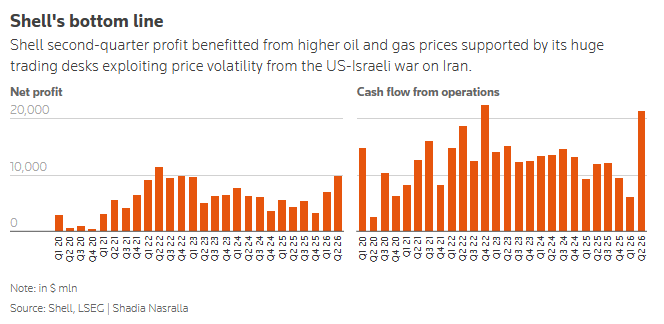
The core driving force behind this blowout in profits comes from drastic changes in the energy supply pattern after the outbreak of war between the US, Israel, and Iran. The conflict directly threatens the transportation of crude oil and natural gas in the Strait of Hormuz, causing global energy prices to rise rapidly and creating an extremely favorable fluctuating environment for trading operations.
Shell's integrated natural gas business (covering the world's largest fuel trading platform) made a profit of 2.7 billion US dollars, 55% higher than the same period last year, and far exceeded expectations. The profit of its chemical and finished products business (which owns the petroleum products trading division) also far exceeded expectations, recording US$2.3 billion, compared to only US$118 million in the same period last year.
Amidst this turmoil, the rise in fuel prices far overtook crude oil itself, causing refining profit margins to expand significantly. Shell fully operated its global refineries in the second quarter, and the equipment utilization rate reached 102%, the highest level since the company changed its statistical methods in 2022. Thanks to demand from the aviation industry and the release of processing capacity, Shell's global aviation fuel production soared 20% year over year.
At the same time, sharp price fluctuations have brought huge trading profits to European energy giants with huge trading teams. Shell's liquefied natural gas (LNG) and petroleum trading business, along with improved chemical profit margins, have offset the decline in sales due to some production disruptions and have become a mainstay supporting performance.
“Volatility has become the new normal,” Shell CEO Wael Sawan said in an interview on Thursday.
“We're always trying to build a company that can thrive in the midst of fluctuations. “The macro environment did drive up commodity prices and provided a strong tailwind for our performance,” Sawan said. “But there are two key factors we can control, and we have continued to excel in both areas. The first is first-class operational performance, which is reflected in every one of our businesses, and this itself supports the second — very strong trading and optimization capabilities.”
Against the backdrop of soaring profits, Shell said it will maintain the pace of share repurchases over the next three months and continue to advance its $3 billion quarterly repurchase plan.
In terms of other indicators, thanks to rising prices, Shell's operating cash flow reached US$21.4 billion, also the highest level since 2022; net debt fell to US$41.75 billion, down from US$52.6 billion at the end of the first quarter, and its leverage ratio (debt-to-equity ratio including leases) fell to 18.7% from 23.2% in the previous quarter, falling below the 20% comfort zone set by the company. Furthermore, the company maintained its 2026 capital expenditure outlook, which is still in the range of 24 billion to 26 billion US dollars.
Qatar's exports interrupted, natural gas sector hurt
Although huge profits make the market excited, the geographical conflict is also a “double-edged sword,” and it is difficult for Shell to stand alone. Earnings revealed the direct impact of the conflict on critical assets: Shell's integrated gas division's production plummeted 31% year over year due to business disruptions in Qatar. According to information, the Middle East region accounts for about 20% of Shell's total oil and gas production, or an average of 550,000 barrels of oil equivalent per day, of which about 10% is related to Qatar.
As the world's largest LNG trader, Shell's liquefied natural gas export facility in Qatar has been shut down due to the spread of the war. In an interview, Sawan said that the factory in Qatar is still in a state of shutdown and will have to wait until the export capacity of products is restored before it can be restarted. This has limited Shell's ability to fully capitalize on rising gas prices as production benefits. Shell said the restoration could take about a year.
Facing the current high profit cycle, Sawan is also facing new issues. After Shell completed years of cost cuts, business streamlining, and strategic adjustments to preferred shareholder returns, the market is closely watching how the CEO will use the short-term financial benefits of the geopolitical conflict to supplement the company's long-term oil and gas reserves base to ensure sustainable future growth.
Boosted by the huge profits brought about by this round of market turmoil, not only industry giants like Shell, but European peers including British Petroleum (BP.US) and Total (TTE.US), as well as the world's top commodity traders, all made significant gains this quarter. Since this year, Shell's stock listed in London has accumulated a cumulative increase of about 21%, but its performance still lags behind British Petroleum, Total, and American giants ExxonMobil (XOM.US) and Chevron (CVX.US).