
Alphabet (GOOGL.US) lost ahead, can Microsoft (MSFT.US) and Meta (META.US) escape the AI capital spending “curse” tonight?
The Zhitong Finance App learned that Microsoft (MSFT.US) and Meta Platforms Inc. (META.US) are about to release financial reports, and the market is becoming increasingly impatient with the large investment of these two tech giants in the field of artificial intelligence (AI) and the resulting continuous shrinkage of cash reserves.
Both companies are scheduled to announce their results after the US stock market on Wednesday EST. Although outsiders expect both to maintain rapid growth, this is not the focus of Wall Street's attention. Last week, Alphabet Inc. (GOOGL.US) surpassed expectations on multiple indicators, but its stock price recorded the biggest one-day decline in more than a year. The reason is that Google's parent company experienced negative cash flow for the first time since its listing, and its capital expenditure is rising sharply.
Microsoft and Meta, along with Alphabet and Amazon (AMZN.US), are in the same camp with the largest investment in AI. However, the market believes that Microsoft and Meta are not as good as Alphabet in terms of industry leadership, so scrutiny of their financial reports is likely to be more stringent.
“If Alphabet can't convince investors that their investment is worth the money, then Microsoft and Meta will probably have a harder time following this path,” said Tim Ghriskey (Tim Ghriskey), senior portfolio strategist at Ingalls & Snyder. The company manages approximately $11 billion in assets and holds shares in Meta and Microsoft. “Both companies still need to work hard to calm market sentiment.”
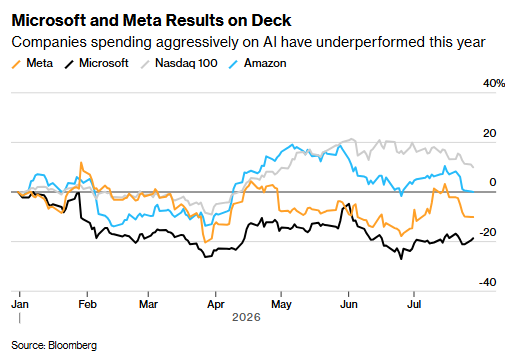
Since this year, Microsoft's stock price has fallen by a cumulative total of 19%. It is currently one of the worst 20 constituent stocks in the Nasdaq 100 Index, which has a high weight in technology stocks, and the index has risen 10% so far in 2026. Meta shares fell 10% during the same period, while Amazon (which is scheduled to release earnings on Thursday EST) remained essentially flat.
Focus on Microsoft's cloud business
Microsoft's capital expenditure (including financial leases) for the fourth quarter of this fiscal year is expected to exceed 42 billion US dollars, driving the total expenditure for the 2026 fiscal year to reach 146.6 billion US dollars, setting a new historical record, almost double that of 24.2 billion US dollars in the same period last year.
Under this trend, Microsoft's spending outlook for fiscal year 2027 will be one of the core highlights of this financial report. Analysts expect that figure to exceed $230 billion, while adjusted free cash flow is expected to fall to $32 billion from $62.3 billion in fiscal 2026.
Similar to Alphabet, investors will keep an eye on Microsoft's cloud business to find signals that turn spending into growth. Its Azure division's revenue is expected to increase by nearly 40% this quarter. However, although Alphabet's cloud business revenue soared by more than 80% and exceeded expectations, it failed to ignite market enthusiasm.
“For Microsoft, I think the situation is more uncertain,” said Paul Meeks (Paul Meeks), head of technology research at Freedom Capital Markets. “It looks like Google is stealing market share from all rivals.”
Analysts expect Microsoft's overall revenue to grow 15% and net profit to rise 16%. Both indicators are expected to maintain double-digit percentage growth over the next three fiscal years.
Leaving aside capital expenditure, the corresponding valuation of this increase is relatively reasonable. Microsoft's current stock price corresponds to less than 20 times the expected earnings for the next 12 months, 27 times lower than its 10-year average, and 21.4 times lower than the Nasdaq 100 Index.
Meta faces more questions
Although Meta's stock valuation is even cheaper than Microsoft — corresponding to future earnings of less than 15 times — Facebook's parent company's path in proving investors a reasonable return on AI investments is more vague. The market expects Meta's capital expenditure to reach 135.6 billion US dollars in 2026, and further rise to more than 175 billion US dollars in 2027.
To raise capital, Meta has begun issuing bonds and is reportedly considering raising tens of billions of dollars by issuing additional shares. The impact of this on Meta's cash position is expected to be quite significant. Analysts expect free cash flow to fall below $1 billion this year, far lower than the $46 billion in 2025; it may turn negative further in 2027, and not return to a positive figure until 2028.
“Meta isn't the right target if you're looking for stable cash flow,” said Griskie of Ingalls & Snyder. “Their future is promising, but the short-term return on investment is quite difficult, and holding this stock requires a great deal of faith.”
In terms of revenue, the agency expects Meta to grow 26% this year, and the growth rate will slow year by year for the next three years. Net profit is expected to increase by 40% in 2026, but it will only be 6.5% in 2027.
Meta is unique among all AI investors — it lacks cloud infrastructure businesses that can rent and sell computing power to the outside world. However, it is reported that the company is planning the relevant layout and has already begun negotiations with AI company Anthropic on computing power leasing.
Matt Stucky (Matt Stucky), chief stock portfolio manager at Northwestern Mutual Wealth Management, said that these measures not only highlight the company's potential, but also reflect the ease with which market sentiment about the stock fluctuates. The company holds Meta shares.
“When the stock price rises, people think it's the best business in the world; but when the stock price falls, the market also thinks management is struggling,” he said. “If implementation is in place, there is room for improvement in performance expectations, but you must be fully prepared for volatility.”