
Geographical conflict creates a “perfect arbitrage storm”! GLNCY.US (GLNCY.US)'s trading profit in the first half of the year doubled to US$3.3 billion, and the annual profit guidance is almost complete
The Zhitong Finance App learned that according to the operating report released on Wednesday, global commodity giant GLNCY.US (GLNCY.US) disclosed that its trading division achieved a profit of about 3.3 billion US dollars in the first half of the year. This impressive performance not only more than doubled from the same period last year, but also enabled the company's annual profit to set a new historical record, once again confirming how the huge geopolitical shock created a rare window of huge profits for commodity traders.
Glencore's marketing department achieved adjusted profit before interest and tax (EBIT) of about 3.3 billion US dollars in the first six months of this year, an increase of 135% compared to 1.4 billion US dollars in the same period last year. At that time, the uncertainty of US tariff policy and the tense situation in the Middle East continued to suppress the macroeconomic environment.
Notably, Glencon can set a regular annual profit guideline limit for this business of only $3.5 billion. This means that based on its performance in the first half of the year alone, the company has almost reached this goal. At the current pace, its trading business will not only easily surpass last year's $2.9 billion, but it is also expected to break the record for the highest profit of 6.4 billion US dollars in 2022. However, the company did not increase its trading profit guidelines for the whole year based on this.
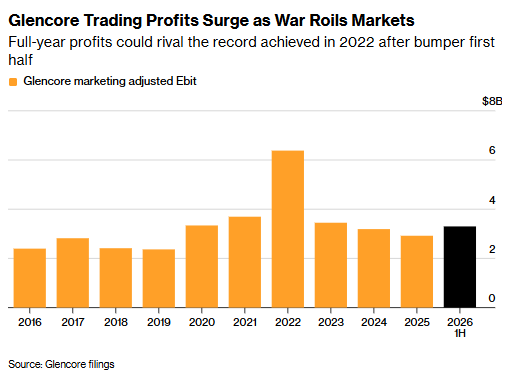
Geographical conflict creates a “perfect arbitrage storm”
As the Middle East conflict continues to disrupt energy markets, commodity traders are reaping rich rewards from it. At the same time, from the artificial intelligence (AI) boom to trade tariff policies, multiple factors are jointly driving up metal prices.
At the end of February this year, the war in Iran led to the actual closure of the Strait of Hormuz, a global energy source, and large quantities of crude oil and refined oil products that were supposed to flow to the global market were trapped in the Persian Gulf. At the same time, several smelters in the region were attacked, which severely shook the aluminum and other metal markets. Faced with the supply gap, buyers had to seek alternative oil sources from the US and other places at high prices, lengthening transportation distances and restructuring trade flows, creating a large number of arbitrage opportunities for traders.
To make matters worse, Ukraine recently launched multiple waves of attacks on fuel plants in Russia, further exacerbating the global shortage of refined oil products and pushing refining profits to a historical peak. It is by buying low and selling high between different markets that Glencore traders have obtained excess profits by taking advantage of huge price differences under extreme fluctuations.
In terms of metals, varieties such as copper and aluminum also contributed greatly. Due to the combination of demand expectations brought about by the AI boom and cross-market price differences created by global trade tariff policies, metal prices have continued to rise to historic highs, providing traders with rich profit soil.
In addition to the impressive trading business, Glencore's industrial mining business is also progressing steadily. As the core of its development strategy, copper production increased 15% year-on-year in the first half of the year, reaching 397,000 tons. The company is investing heavily to become one of the world's largest copper miners to seize the long-term demand dividends brought about by the energy transition.
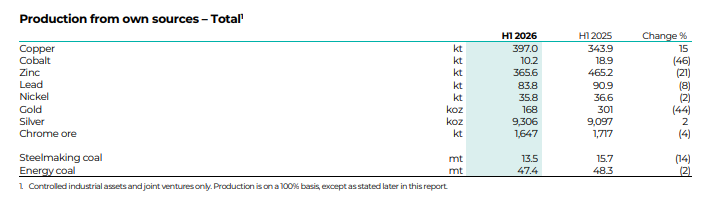
In terms of production guidelines, Glencore maintained its annual targets for copper, zinc and nickel. However, the company made minor adjustments to the coal business: the midpoint of the production guideline for energy coal was raised by 1 million tons, and the midpoint of the production guideline for steelmaking coal was lowered by 1 million tons.
The impressive performance report quickly ignited enthusiasm in the capital market. After the news was announced, Glencore's stock price in London once rose by more than 4.1%, extending its cumulative increase to about 30% during the year.
Currently, Glencore has yet to refine the exact composition of this $3.3 billion profit. More details will be revealed when the company releases its full semi-annual earnings report next week.