
Buck the trend and exceed expectations! Deutsche Bank (DB.US)'s Q2 net profit set a record, and FIC transaction revenue surged 16% to outperform Wall Street peers
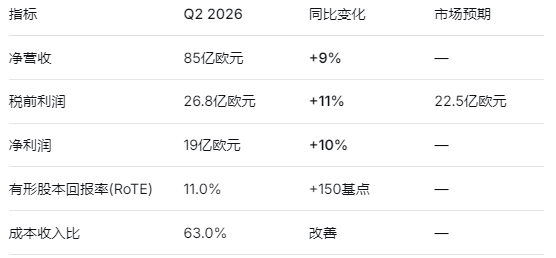
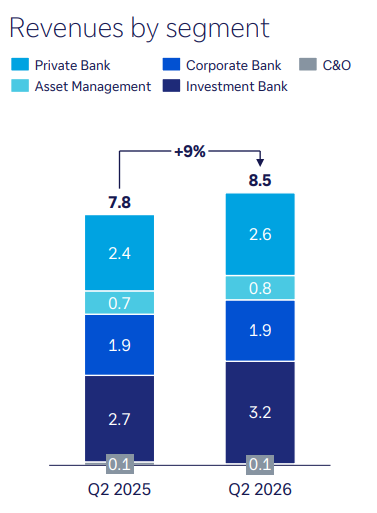
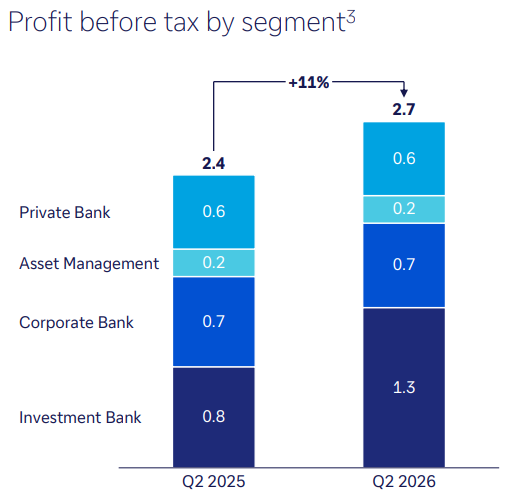
The Zhitong Finance App learned that Deutsche Bank (DB.US) handed over a report card that completely exceeded expectations on Wednesday. Net profit for the second quarter increased 10% year over year to 1.9 billion euros, breaking the decline in analysts' expectations and recording the strongest second-quarter results in the bank's history. Net revenue increased 9% year over year to 8.48 billion euros, exceeding market expectations of 8.13 billion euros. Profit before tax increased 11% year over year to 2.68 billion euros, also higher than market expectations of 2.39 billion euros. Profit after tax in the first half of the year reached 4.1 billion euros, the highest annual performance in the bank's history.
Trading revenue soared 16%: FIC and investment bank two-wheel drive
Deutsche Bank's core highlights this quarter came from investment banking. The division's revenue increased 19% year over year to €3.19 billion, far exceeding market expectations of €2.92 billion.
Specifically, fixed income, foreign exchange and commodity (FIC) sales and trading revenue reached 2.61 billion euros, an increase of about 16% over the same period last year. It also exceeded market expectations of 2.41 billion euros, an increase above the 13% average of large Wall Street banks. This strong performance was mainly due to increased market volatility caused by the Iran war, as well as the trading boom brought about by the recovery of global mergers and acquisitions transactions and IPO activities.
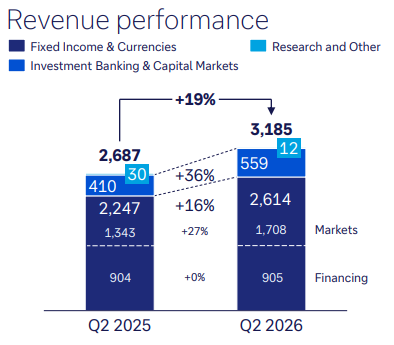
Growth was mainly driven by two major sectors: interest rate trading and credit trading. This performance not only proved Deutsche Bank's competitiveness in the global fixed income market, but also jumped its ranking in the US fixed income and currency business from 7th to 5th place.
Furthermore, investment banking and capital markets (IB&CM) revenue soared 36% year over year, indicating the full recovery of Deutsche Bank in the investment banking business. This growth is mainly due to the strong performance of corporate finance and consulting services; active capital market activities such as IPOs and securities issuance; and the positive spillover effects of US economic resilience on global capital markets. CEO Christian Sewing said in a letter to employees that investment banking business revenue has reached the highest level since the 2019 business restructuring.
Extensive growth across all business lines with record customer capital inflows
The investment banking business wasn't the only highlight of the quarter. All four business segments of Deutsche Bank achieved revenue growth:
Private banking: Wealth management and personal banking businesses both grew, receiving a net inflow of 9 billion euros;
Asset management: Attracting a record net inflow of €25 billion;
Corporate banking: Customer activity has maintained a strong momentum, the size of loans and deposits has increased, and business activity in Germany has shown initial signs of recovery.
The bank's return on tangible equity (ROte) reached 11.0%, and the cost-revenue ratio improved to 63.0%, all significantly better than the same period last year. Overall RoTE increased further to 11.9% in the first half of the year, and the cost-revenue ratio fell to 60.9%.
Increased return on capital: additional 500 million euro repurchase program
Based on strong profit performance, the bank has been authorized by the ECB to add 500 million euros (about 569 million US dollars) of stock repurchase plans, which will be launched after completing the current 1 billion euro repurchase plan. Deutsche Bank also slightly raised its annual net interest income forecast to more than 14 billion euros.
Deutsche Bank's capital position remains strong. The common stock Tier 1 capital (CET1) ratio remained at 13.9%, within the target operating range.
Chief Financial Officer Raja Akram said, “We are still well positioned to both invest in business development and provide attractive returns to shareholders.”
Poor market expectations: from “weaker” to “overall exceeding expectations”
The “exceeding expectations” of this financial report is particularly prominent, because just three weeks ago, market sentiment was still quite pessimistic. On July 8, Bank of America Securities predicted in a research report that Deutsche Bank “will be even weaker” in the second quarter, lowering the target price from 44 US dollars to 43 US dollars. The reasons include a 7% year-on-year increase in costs reflecting an increase in strategic investment.
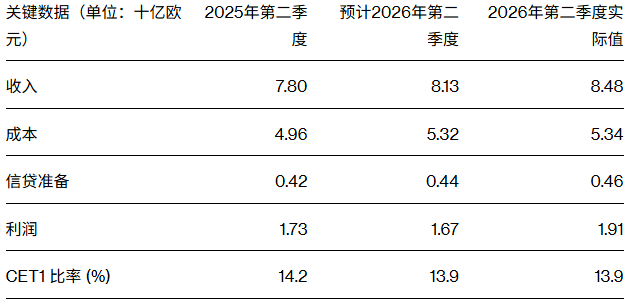
The final data completely shattered this pessimistic forecast: net profit growth of 10% versus expected decline of 2%, and revenue growth of 9% vs. expected increase of 4%. “Operational strength, financial discipline, and enduring success make our goals credible — we showed all three in the second quarter,” Sewing said in the earnings report.
Outlook: The 2026 revenue target of 33 billion euros is in sight
Looking ahead, Deutsche Bank management is optimistic about the second half of the year. Akram said that the trading business started “well” in the third quarter, that investment bank project reserves were “quite adequate”, and that “the second half of the year's results may be as strong as the first half.”
Deutsche Bank reiterated its 2026 full-year revenue target of around 33 billion euros and said it is more confident that it will surpass the 2028 financial target. The bank expects non-interest expenses to be in line with the plan, and the credit loss provision will reflect an improving trend since 2025.
In a letter to employees, Sewing described several key trends driving Deutsche Bank to achieve its 2028 goals: increasing German infrastructure and defense spending; major political reforms being carried out in Germany are expected to bring structural opportunities to the banking industry; AI is expected to significantly improve the efficiency of bank operations; and European regulators are increasingly paying attention to bank competitiveness.
“Advances in artificial intelligence and improvements in the policy and regulatory environment may unleash further efficiency improvements and support future growth,” Sewing said during the earnings call. Strong performance this quarter enabled Deutsche Bank to achieve revenue growth for the 20th consecutive quarter. The goal set by SEWING is to increase ROTE to over 13%, and calls it the “lower limit.”
When Bank of America Securities warned in early July that “the second quarter will be even weaker,” and the market generally expected a decline in profits, Deutsche Bank counterattacked with a report card that completely exceeded expectations. Net revenue of 8.48 billion euros exceeded expectations by 4.3%, net profit of 1.9 billion euros bucked the trend, and investment banking business revenue was the strongest since 2019 — the three figures together outline one of Europe's largest banks that are completing a “turnaround war.” Against the backdrop of global geopolitical turmoil and increased market volatility, Deutsche Bank traders used 16% FIC revenue growth to prove that uncertainty itself is the best business for investment banks.
Strategic strength: stand alone in the wave of mergers and acquisitions in the industry
Amidst the wave of mergers and acquisitions in the European banking industry — UniCredit Bank of Italy seeks to acquire Commerzbank, Spain's Santander Bank of America and TSB Bank of the United Kingdom, and BNP Paribas to acquire AXA Investment Management Company — Sewing has maintained its strategic strength to avoid large-scale acquisitions.
Instead, he focused on improving profitability and investor returns through organic growth to close the long-standing valuation gap between Deutsche Bank and its European peers. This strategy is gradually paying off — the bank's price-earnings ratio is about 10.34 times, and the PEG ratio is only 0.32, which is still attractive for valuation compared to its growth trajectory.