
Be wary of the Federal Reserve's “surprise rate hike” tonight! A number of Wall Street institutions sounded the alarm, and traders were “hedging against anxiety” by historic “anxiety”
The Zhitong Finance App learned that when Federal Reserve Chairman Kevin Walsh announced his second interest rate decision since taking office at 2 a.m. Beijing time on Thursday, the global capital market was watching with bated breath an unprecedented suspense. Just a month ago, the market was almost certain that July would stand still; at the moment, the CME FedWatch tool shows that the probability of a 25 basis point rate hike has soared to 30% from 13% a week ago. Citi said bluntly that this was “the moment of greatest disagreement since September 2024.”
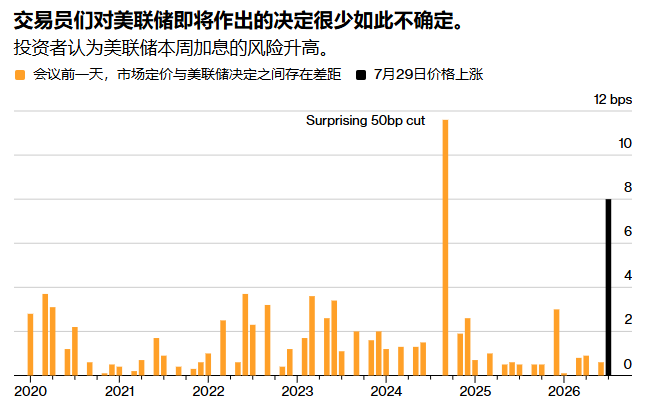
What is even more worrying is that after reaching 909,714 open positions on Friday, the number of open federal funds rate futures surged further to 967,136 on Monday, setting a new historical record. “In the past, when it was time before the meeting, the market's expectations for policy results were usually highly consistent,” but this time it was completely different. BMO Capital Markets data shows that since 2015, the average error of traders predicting the final interest rate decision the day before the Federal Reserve's decision was only 2.4 basis points — and this time, the error may be calculated in “codes.”
From “10%” to “30%”: An Inflation Narrative Reversed by Geopolitics
On July 14, the US Department of Labor released the June CPI data: CPI rose 3.5% year on year, significantly down from 4.2% in May, down 0.4% month-on-month, the biggest month-on-month decline since April 2020; core CPI remained flat month-on-month, the smallest increase since January 2021. This data once convinced the market that the Federal Reserve could continue to stand still, and signs of cooling inflation once lowered the market's bet on the July rate hike to about 10%.
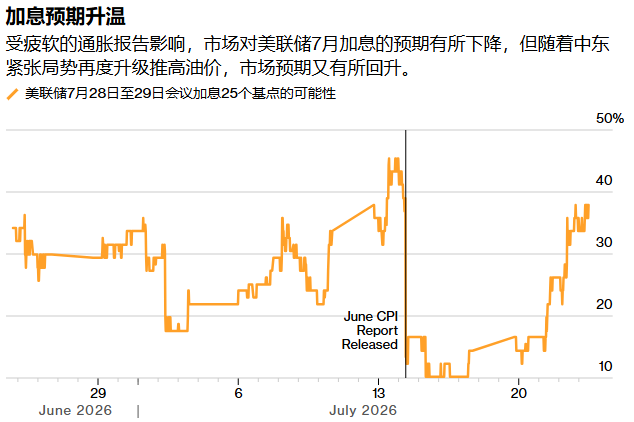
However, it is only data that is cooling down, not trends. After the fragile cease-fire agreement between the US and Iran broke down, the situation in the Middle East escalated again. On July 24, Brent crude oil surpassed $100 per barrel in the intraday period, with a cumulative increase of 25% since the June Federal Reserve meeting. The rise in oil prices quickly spread to gasoline and diesel prices, putting pressure on both consumers and US industry costs. Meanwhile, the Trump administration announced new tariffs of 10% to 12.5% on 60 countries on July 24, as an alternative to the Supreme Court's previous rejection of the “Liberation Day” tariffs. Furthermore, investment in AI continues to be strong, driving related demand growth. The combination of three factors reversed the market's judgment on cooling inflation.
PGIM's chief US economist Robert Sockin described this week's conference as “almost five or five.” Neil Dutta, chief economist at Pantheon Macroeconomics, put it bluntly that the July rate hike would allow the Federal Reserve to gain “future flexibility” and avoid being forced into a corner in September. “You have to look for opportunities in consensus, and I think this might be the time,” Dutta wrote in the July 22 report.
Walsh's “Silent Revolution”: The Path to No Advance Appointment, No Guidance
The biggest variable in this meeting came from Walsh himself. Since taking office on May 22, Walsh has completely disrupted the Federal Reserve's communication paradigm. He clearly promised to abandon “forward-looking guidance” — that is, no longer hint to the market about interest rate paths ahead of time.
At a congressional hearing on July 15, he declined to provide any specific insight into interest rate trends over the next few months. He set up several working groups to re-evaluate the Federal Reserve's communication mechanisms, inflation framework, and balance sheet management. As Joe Boyle, a fixed-income investment expert at Hartford Funds, said, “Walsh is still an elusive person, and he has always insisted that he is not interested in forward-looking guidance.”
The consequences of this approach are showing — the market has lost the “policy compass” to which it has been accustomed for over a decade. Alex Manzara, R.J. O'Brien derivatives broker, stated: “In the past, the Federal Reserve did not usually surprise the market. As the meeting approaches, the implied interest rate on federal funds futures and the final policy rate usually do not differ by more than two or three basis points. Now there is a sudden uncertainty in the contract, and this has brought about transaction demand.”
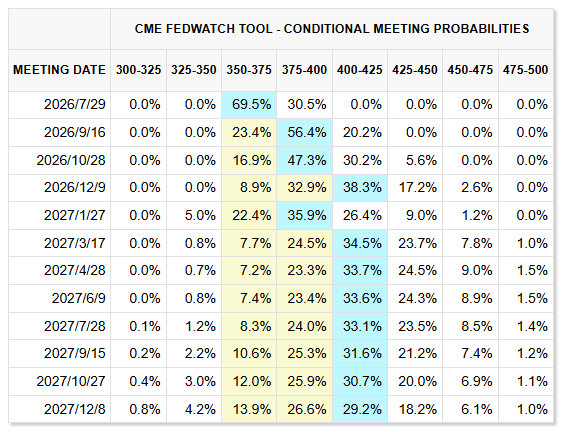
Jim Bianco, president of Bianco Research, said, “There is no forward-looking guidance, which means we will frequently see 20%, 30%, and 40% probability distributions.” Goldman Sachs pointed out that investors believe there is “unusually great uncertainty” about the results of the July meeting due to differences of opinion within the Federal Reserve and that Walsh's own position is still unclear.
Political Undercurrents: Walsh's Delicate Balance with Trump
Behind this policy game, complex political calculations are also hidden. Trump has publicly pressured Walsh to cut interest rates, saying “interest rates should be lowered” and “we should have the lowest interest rates in the world.” Bond market veteran Harley Bassman said bluntly in the report that the Federal Reserve should “rip off the band-aid” and raise interest rates by 50 basis points. “The 50 basis point rate hike indicates that a new sheriff has appeared in the market, and he is not bound by the president” — a move that not only gains anti-inflationary credit, but also resists President Trump's pressure to reduce borrowing costs.
Joseph Lavorgna, the US chief economist at SMBC Nikko Securities, pointed out that if you wait until September or even October to act — the first rate hike just before the midterm elections — “What would that look like? He might as well act now”.
The test facing Walsh is that he promised “zero tolerance” for inflation in Congress, but he has been slow to reveal the exact path. As BlackRock previously pointed out, Walsh “recognises that credit remains the central bank's most powerful policy tool” — but “ultimately, these words need to be supported by action.”
Hawks rally: at least two negative votes are on the way, Castle Securities is betting on a “raid rate hike”
Disagreements within the Federal Reserve are equally rare. Dallas Federal Reserve Chairman Logan recently clearly called for “slightly higher interest rates,” believing that inflation is still clearly above the 2% target. Cleveland Federal Reserve Chairman Hamak also warned that inflationary pressure was too high. Both have the right to vote in the 2026 FOMC. They voted against it in April and are likely to oppose it again this week. Goldman Sachs expects at least one member to vote against raising interest rates; Danske Bank expects 2 to 4 members to support interest rate hikes; while Citi is betting on staying on hold. However, Citi expects that if there are more than two negative votes, it will be interpreted by the market as a stronger hawkish signal. The agency predicts at least two negative votes this week.
More aggressive signals are coming from Wall Street. Frank Flight, head of macro strategy at Castle Securities, unexpectedly changed basic expectations and instead supported this week's rate hike. In his report, he wrote that a 25 basis point rate hike would reinforce Walsh's promise to restore price stability, while showing that policymakers no longer rely on “clarifying” every policy action to the market in advance. Flight believes that the market has once again underestimated the extent to which the Federal Reserve's policy stance has turned hawkish, and that “this week's interest rate hike will clearly end the era of forward-looking guidance.”
Lou Crandall, chief economist at Wrightson iCAP, said there is no reason for the Fed not to raise interest rates. Robert Tipp, PGIM's head of global bonds and chief investment strategist, said that the market may have underestimated the possibility of interest rate hikes on Wednesday. “He's really ready for a rate hike,” Tipp said. Postponing the decision now would increase the possibility of a 50 basis point rate hike in September.”
However, the analysis indicates that Walsh himself may not support the current rate hike. In his congressional testimony on July 15, he described the energy price shock as “a specific shock at a specific price that we cannot control.” A rate hike would “predict” the conclusion of the working group he just set up. Furthermore, in June, CPI declined for the first time in six years, and employment growth slowed, providing a reason to stay on hold. According to the agency's survey of 76 economists, all respondents expected the Federal Reserve to keep interest rates unchanged.
The market takes its breath away: regardless of the outcome, the volatility will be sharp
Jonathan Pingle, chief US economist at UBS, admits that he has never felt so uncertain about the Federal Reserve's upcoming interest rate decision in 20 years. The last time he felt uncertain dates back to when Ben Bernanke was the chairman of the Federal Reserve; he pointed out that Walsh's lack of past history and recent differences among Federal Reserve officials further exacerbated the uncertainty of the outlook, but he did not rule out the possibility that Walsh would eventually cast a decisive vote. Mark Cabana, head of US interest rate strategy at Bank of America, summed it up more eloquently: “Investors are still trying to understand how the Federal Reserve will operate during Walsh's presidency.”
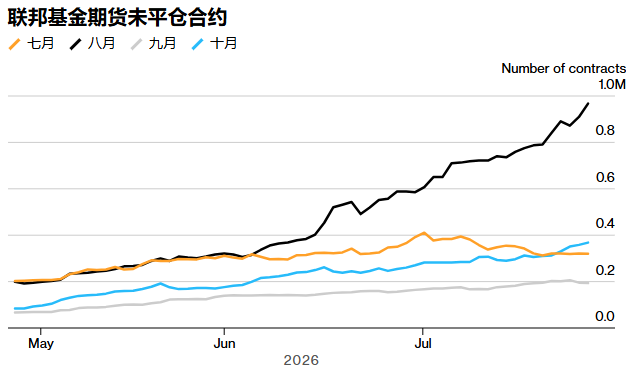
Uncertainty is driving unprecedented demand for hedging. The number of open positions in August federal funds futures contracts reached 967,136 on July 27, setting a new historical record. The Citigroup trading team has purchased the July FOMC contract — the position will profit when the central bank keeps interest rates unchanged. Akshay Singal, the global head of short-term interest rate trading, said, “Walsh has always made it clear that he wants the market to pay attention to the data, and the current data is not enough to support interest rate hikes.”
Macro strategist Michael Ball pointed out, “Although the market is entering unknown territory with a Federal Reserve chairman who may act without predicting intentions, such a move may eventually be accepted by investors as an appropriate policy. That will support risky assets in the short term”.