
Crude Oil Volatility in Context
By Brett Friedman, Winhall Risk Analytics/OptionMetrics Contributor
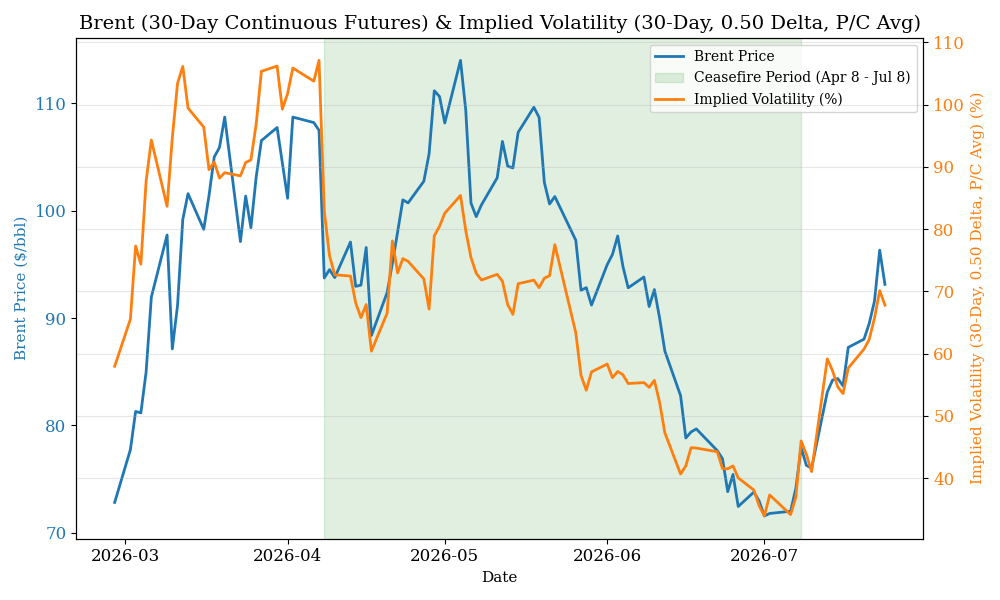
A familiar cycle has emerged in the oil markets since the beginning of the war. First come hostilities, accompanied by threats of escalation and warnings of severe and prolonged supply shortages. The combination leads to higher prices and volatility, which inevitably leads to the second phase. As tensions grow more intense and just as the market seems to be spinning out of control, reports of a ceasefire or negotiations emerge, and crude oil prices retreat. Significant daily changes in both price and implied volatility accompany each stage of the cycle, leaving the market uncertain and anxious.
This recurring pattern has led many to conclude that the current period of unrest in crude oil is unprecedented or somehow unique. That is not the case. Frequent rumors of an impending ceasefire dampened both price and implied volatility since the initial shock:
Source: OptionMetrics
When compared to previous periods of high volatility such as during the height of the pandemic in March, April, and May of 2020, Brent’s absolute price and volatility levels since the beginning of the war have been elevated but not historically exceptional. Consider the following:
1) Brent (30-day continuous) peaked at $114.01 on May 4th. While elevated, that level did not rank among Brent’s 10 highest historical readings; since 03/04/2008, it was only the 288th highest and $32.37 lower than the all-time high of $146.38 recorded on July 3rd, 2008.
2) Brent’s implied volatility peaked on April 7th at 107.6%, which is only the 17th highest level ever recorded.
However, that is not to say that the period since the war began in late-February has not been more volatile than previous periods. Daily changes in both price and volatility reveal a different conclusion. Three of the top-10 largest negative price changes since 2008 have occurred since the war began:
| Rank | Date | Daily Return (%) |
| 1 | 3/9/20 | -23.77% |
| 2 | 4/21/20 | -21.67% |
| 3 | 3/9/22 | -13.29% |
| 4 | 4/8/26 | -12.79% |
| 5 | 3/18/20 | -12.60% |
| 6 | 11/26/21 | -11.74% |
| 7 | 3/10/26 | -10.86% |
| 8 | 3/23/26 | -10.67% |
| 9 | 3/16/20 | -10.51% |
| 10 | 12/1/08 | -9.79% |
Source: OptionMetrics
In addition, Brent registered two Top-10 positive and negative changes in implied volatility since the war began. The negative change of -24.2% is impressive:
| Rank | Date | Ending IV | Daily IV Change | |
| IV Positive Change | 6 | 7/13/26 | 59.16% | 18.1% |
| IV Negative Change | 2 | 4/8/26 | 82.91% | -24.19% |
Source: OptionMetrics
Using the metrics employed above, 2020 is still the most volatile of all time, and it’s not even close. One fact alone would be enough to settle the argument: on April 20th, 2020, crude oil settled at an astounding negative $37.63, a first for a mainstream exchange-traded commodity, and at an all-time record implied volatility of 153.9%. That’s a full 46.8 percentage points higher than when Brent implied volatility topped out at 107.1% last April 7th. And if that’s not enough, consider the share of Top-10 price and implied-volatility swings recorded from March to May 2020:
Percentage of Top-10 Ranking, March - April 2020 (%) |
|
| Positive Daily Return | 30 |
| Negative Daily Return | 40 |
| Positive Daily IV Change | 40 |
| Negative Daily IV Change | 60 |
Source: OptionMetrics
Clearly, the most volatile era for crude oil was during the height of the pandemic in March through April 2020. What can we take away from the comparison to the current period?
The current episode has produced historically large daily moves, particularly to the downside, along with a notable rebound in implied volatility. Although daily price and implied volatilty swings have been extreme, neither outright prices nor volatility levels have approached the pandemic-era extremes. However, this could change rapidly. The supply situation remains extremely tight, especially in refined products such as gasoline and diesel, and is growing worse. So far, prices and volatility have been restrained by the possibility of renewed negotiations or another ceasefire. If neither materializes, crude oil may be entering a much more volatile regime. The pandemic era offers an extreme example of what could happen if hostilities continue to intensify.
For more insights on futures options, the options markets and volatility, visit the OptionMetrics blog.
There is an inherent risk involved with financial decisions. The information in this article is for informational purposes only and is not intended to provide financial advice. Views expressed are those of the author(s) and are not necessarily those of the company.