
The war in the Middle East has leveled Europe's interest rate curve, and traders are still betting that “a cease-fire is an inflection point”
Although European long-term treasury bond yield curve betting transactions have deviated from the expected trajectory time and time again since this year, there are still traders who stick to one of Europe's most popular interest rate bets. Traders are betting that the 30-year swap rate will rise more than the 10-year swap rate, even though the US attack on Iran derailed the deal. This also means that the so-called strategy of steeper 10-year/30-year European Treasury yield and swap interest rate curves is still one of the most popular trading topics among institutional investors, because hedge funds and asset managers are betting that long-term interest rates need to rise to stimulate market demand for government debt.
The Zhitong Finance App notes that betting that the 30-year swap interest rate will increase more than the 10-year exchange type — that is, transactions related to a steeper yield curve on European treasury bonds — have been hit hard by the US attack on Iran, which seriously disrupted inflation expectations. The deal regained momentum during the hiatus of fighting in the Middle East in May and June. Since then, demand for this themed deal has remained strong. However, the resumption of military strikes between the US and Iran in July pushed oil prices back up to 100 US dollars per barrel last week and squeezed interest spreads.
One of Europe's most congested interest rate transactions — the steeper 10-30 year exchange curve for the euro — has been repeatedly impacted by the US-Iran conflict, oil price rebound, and expectations of interest rate hikes by the ECB and the Federal Reserve since this year, but institutional investors do not seem to have retreated on a large scale. Its core bet is that the Dutch pension system of 1.6 trillion euros is shifting to a fixed contribution system, the expansion of the supply of European government bonds, and the structural weakening of demand for long-term bonds, which will ultimately drive the yield on 30-year European bonds to continue to rise compared to the 10-year yield.
After the outbreak of the US-Iran war, the risk of inflation took the lead in boosting front-end interest rates, erasing 60% of the previous steepening. Currently, the 10-30 year spread is only about 8 basis points; however, the forward carry of about 7 basis points per year, the decline in front-end yields brought about by a potential cease-fire, and long-term market structural logic still made the transaction a “low beta hopeful position” for hedge funds. The real risk is that the ECB will still be included in interest rate hikes of about 42 basis points before the end of the year. Geographical conflicts and implied volatility may continue to repeatedly flatten the curve, so this deal is more like betting on cooling the war and repricing long-term supply and demand, rather than one-way deterministic arbitrage.
Iran's war breaks through the curve consensus: front-end inflation deals fight back Europe's “king of steepening”
“In March, the Eurozone curve steeper and the closing of trading positions was quite painful for many market participants,” said Julian Beck, co-head of linear interest rate trading in Europe, the Middle East and Africa from J.P. Morgan Chase. However, he added that so-called steeper 10-30 year curve transactions are still very popular with the bank's institutional clients.
As hedge funds and other asset managers bet, in order to stimulate the market to absorb the growing supply of government debt, long-term treasury yields will have to rise at an accelerated pace, and trading with a steep swap rate curve is popular around the world.
In Europe, the deal has worked almost all the way since the end of 2024 and has become one of the most crowded market positions. In 2025, after Dutch reforms pushed the country's 1.6 trillion euro (1.8 trillion US dollars) pension system to a fixed contribution plan, investors further increased this classic bet. The market believes that this change will support a steeper European bond yield curve by redirecting demand to riskier assets.
The Dutch pension system is shifting from a fixed income system to a fixed contribution system, which means that asset allocation will reduce the mechanical demand for ultra-long-term bonds and long-term swaps, and increase the tendency to allocate risky assets; compounded by the continued growth in the supply of European government bonds, long-term interest rates need to provide higher risk compensation to attract capital. As a result, despite short-term losses in trading, its market structure logic of “increased supply of long-term bonds+weakening of structured buying” has not changed
The same was true of the market trend last year. The 10-30 year swap spread widened by more than 50 basis points, the second largest increase since records began after 2009. After the US-Iran geopolitical war broke out at the end of February, the market is betting that short-term interest rates will rise in response to inflationary shocks, thus erasing 60% of the steeper curve. As market hopes for a lasting cease-fire heated up, the curve recovered some of its losses, but leveled off again this month, and interest spreads remained sluggish at about 8 basis points.
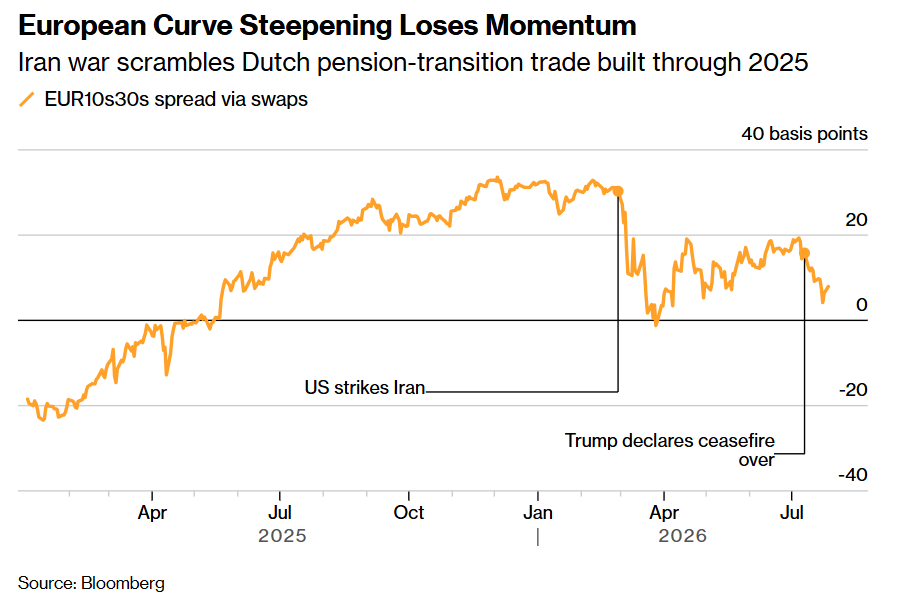
As shown in the chart above, the momentum of steeper yield/interest rate curves in Europe has weakened markedly — the war in Iran disrupted Dutch pension transformation deals established throughout 2025.
However, according to indicators that European banking giant Barclays Bank has been tracking for a long time, the escalation of tension between the US and Iran earlier this month did not trigger a new round of large-scale market positions; it only led to a moderate reduction in positions. This shows that although the ECB may raise interest rates further in the future, many investors still expect that short-term government bonds will continue to perform better than long-term bonds.
The ECB decided not to raise interest rates twice in a row last week, but policymakers have hinted that they are preparing to raise interest rates again soon. The market has now included expectations of a 42 basis point rate hike by the end of the year.
Is a cease-fire a major buying signal? Positive Carry supports “low beta hope trading”, but volatility is still the biggest enemy
If the situation between the US and Iran cools down believably, the decline in oil prices and interest rate hikes may first drive short-term yields down, leading to a “sharp steeper bull market”. This is also the main reason why institutional investors insist on this deal; at the same time, steep positions from 10 to 30 years have progressed positively by about 7 basis points every year, increasing position tolerance. However, the ECB is likely to continue to raise interest rates, and long-term positions are also highly sensitive to implied volatility, so although it is currently cheaper to enter the market, it is still a high-path dependent transaction that relies on the geographical situation, monetary policy, and pension fund flow to be realized together.
Rohan Kana, managing director of Barclays Bank, wrote in a research report last week that although the European yield curve is still mainly dominated by front-end bond yield trends, steep curve trading provides investors with a “hopeful transaction with a lower beta.”
“Considering the extent of monetary policy tightening that the market has taken into account, once a credible situation is downgraded, front-end yields should decline, thus driving the yield curve to steeper, leading to a steep bullish trend in the yield curve,” Kana said. He added that although the trading experience since this year has been very painful, “judging from our communication, once the market has developed some confidence that the war is over, this is still the most preferred expression used by market participants.”
Although the recent flat spread provided an attractive entry level, other market veterans were less convinced given that large and unpredictable fluctuations could once again disrupt the yield curve.
“We are wary of establishing such positions given the high sensitivity of long-term steeper curve transactions to implied volatility,” Citigroup's senior fixed income strategists Andrea Apedou, Jamie Searle, and others wrote.
Bank of America (ABN Amro) strategists previously predicted that as Dutch pension funds reduce their long-term bond holdings while reducing demand for long-term swaps, the European yield curve will peak in the second half of 2026. Whether it's long-term capital or fast money institutions such as CTA strategies, have poured in large numbers into this classic interest/yield transaction, but the geopolitical war means that this expectation has not been fulfilled.
Beck said that investors are still attracted by the impact of the Dutch pension transformation, and at the same time, a steep 10-30 year curve transaction can also provide about 7 basis points of positive carrying each year.
“There is both macro logic and market structure logic, as well as positive carry trends, so this is a transaction that large institutional clients are very willing to participate in.” He added during the interview.
Carry (holding income or arbitrage income) usually refers to the expected profit and loss only due to the passage of time, interest payments, financing costs, and the “rollover” of positions along the forward curve under the assumption that the market price and yield curve are largely unchanged; positive carry means that investors will still obtain benefits even if they do not wait for the core direction judgment to be fulfilled for a while.
In transactions with a steep 10-year curve, the 30-year and 10-year interest rate spreads are usually widened through a DV01 neutral combination of “charging a 10-year fixed interest rate and paying a 30-year fixed interest rate,” and a positive carry of about 7 basis points per year indicates that if the curve is basically unchanged, this combination can theoretically obtain about 7 basis points of profit over time. However, positive carry is only a buffer for holding positions; it is not a capital protection benefit. If the curve flattens in reverse or volatility rises rapidly, capital losses may still far exceed this portion of Carry.