
Financial reports, inflation, and the “triple strike” of the Federal Reserve's decision: Wall Street fastens its seatbelts, and the market faces the strongest storm week
Stock investors are tightening their seatbelts and preparing to face the volatile market brought about by a series of risky events this Monday. At this time, they will never think about the “summer period of silence.”
The Zhitong Finance App notes that although geopolitical factors have caused fluctuations, financial reports and macroeconomic news are more likely to trigger even more drastic ups and downs. Microsoft and Meta will release earnings reports on Wednesday, followed by Apple and Amazon on Thursday. The Federal Reserve and the Bank of England are about to make interest rate decisions this week, and in massive economic data, the European inflation rate is also the focus of attention.
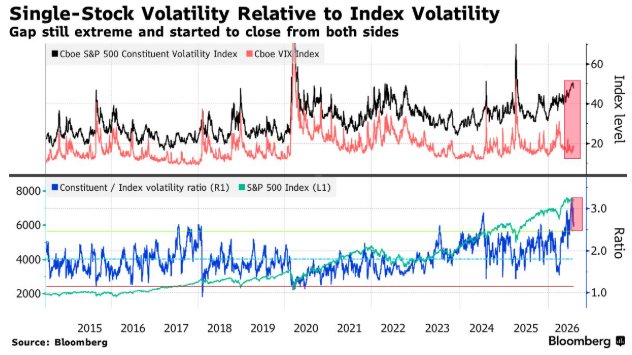
Richard Privorodsky, partner at Goldman Sachs Group, said, “All of this happened against a backdrop of Brent crude oil rising above $100, high global treasury yields, and the market still digesting two consecutive weeks of weakening in the stock market.” He believes that buying VIX call options is a good hedge against tail risk. “I think we are still in the midst of large fluctuations (chops). The implicit correlation is still near the lowest level in the past few decades, and individual stock differentiation has curbed overall market fluctuations.”
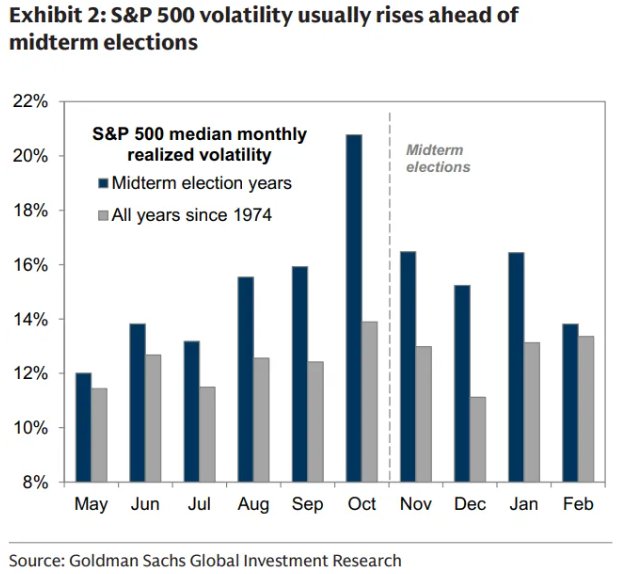
The rationale for buying VIX call options is supported by historical data. Goldman Sachs data shows that in the year of the midterm US stock elections, exponential volatility usually rises in August and continues to rise until October. More broadly, the volatility of individual stocks is still high, and the divergence in yield is the main theme this year. These extreme indicators now seem more likely to reverse rather than continue, adding to the potential for instability.
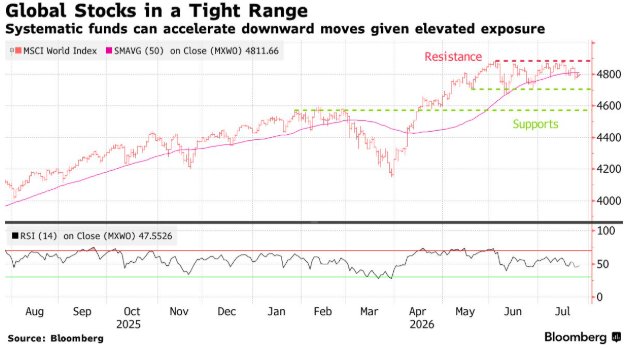
The technical side may help explain future trends. The MSCI Global Index appears to be suppressed by the ceiling at around 4885 points. Meanwhile, Deutsche Bank strategists, including Parag Tart, said that systemic investors' high positions are currently at the 70th percentile, and “if volatility rises or the stock market breaks through the range downward,” these positions may appear vulnerable.
Looking at other position data, Deutsche Bank strategists pointed out that last week was another week of drastic deleveraging/position reduction, and subjective investors drastically cut their risk exposure to the low in early April (17th percentile). This is far below what earnings reports and macroeconomic growth suggest. They added that as for the rotation of capital from giant technology stocks, the process has now been completed by about three-quarters as positions fall from a high level.
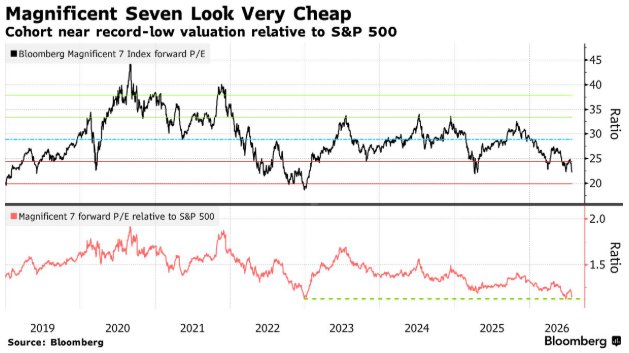
In the field of financial reporting of technology stocks with large market capitalization, everyone's eyes are on the “Big Seven.” This group has been funding transactions in AI beneficiary stocks and the semiconductor sector for several months, but when these stocks recently closed in profit, they did not benefit from it. Investors seem to remain wary of re-entering the market, and Alphabet's statement last week further fueled market concerns about capital expenditure commitments.
Despite this, the Big Seven's valuation is currently at an all-time low. Whether judged from an absolute or relative level, their forward price-earnings ratio has fallen to near the bottom of the nearly seven-year range. Since this downward valuation is driven by a combination of falling stock prices and rising profit expectations, this may provide an opportunity to buy on dips.
While concerns about huge AI investments are the focus of market attention, others are convinced that at least some hyperscale cloud service providers will be the big winners in the end. Morgan Stanley analysts, including Stephen Bird and Michelle Weaver, hold this view; they are optimistic about “smart superhighways.”
They recommend holding shares in fuel cell and energy storage companies, computing power manufacturing ecosystem companies, and hyperscale cloud service providers capable of achieving economies of scale and receiving an attractive return on their AI capital expenditure. They cited Meta, Alphabet, Microsoft, and Amazon.
The Morgan Stanley team wrote, “Given that the recent market correction has affected a range of AI infrastructure stocks, we think the present moment represents an extraordinary and very attractive buying opportunity. Fundamentally, we are very optimistic about the speed at which AI capabilities are improving, the dividends of applying AI, and the associated capital expenses.”
Other than tech earnings reports, the biggest threat to market calm this week comes from central banks. The swap market has fully taken into account the expectation that the Federal Reserve will raise interest rates in September, and there may be a second rate hike by the end of this year. Any apparent change in this pricing could affect the stock market, so Federal Reserve Chairman Walsh's remarks will be subject to extremely strict scrutiny.
Further cooling of the situation in the Middle East pushes oil prices down and will help the central bank complete its tasks, and Walsh's opposition to forward-looking guidance means that expectations of interest rate hikes will rely more on data.
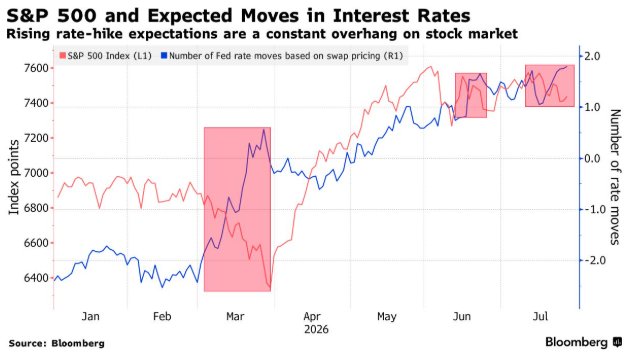
According to J.P. Morgan's market intelligence team, “For the stock market, the pace of interest rate changes is more important than its absolute level.” They pointed out that the 10-year US Treasury yield broke through the May high of 4.67% last week, and the next notable mark is the 4.79% high in January 2025. “If upcoming data or the Federal Reserve's wording supports a further upward yield above 4.8%, we will begin to see more pressure on interest rate sensitive stocks.”