
The semiconductor sector is experiencing “Black Tuesday”! South Korea plans to restrict retail investors from allocating leveraged ETFs to shift the AI bull market from a “leveraged flywheel” to a “real cash flow test”
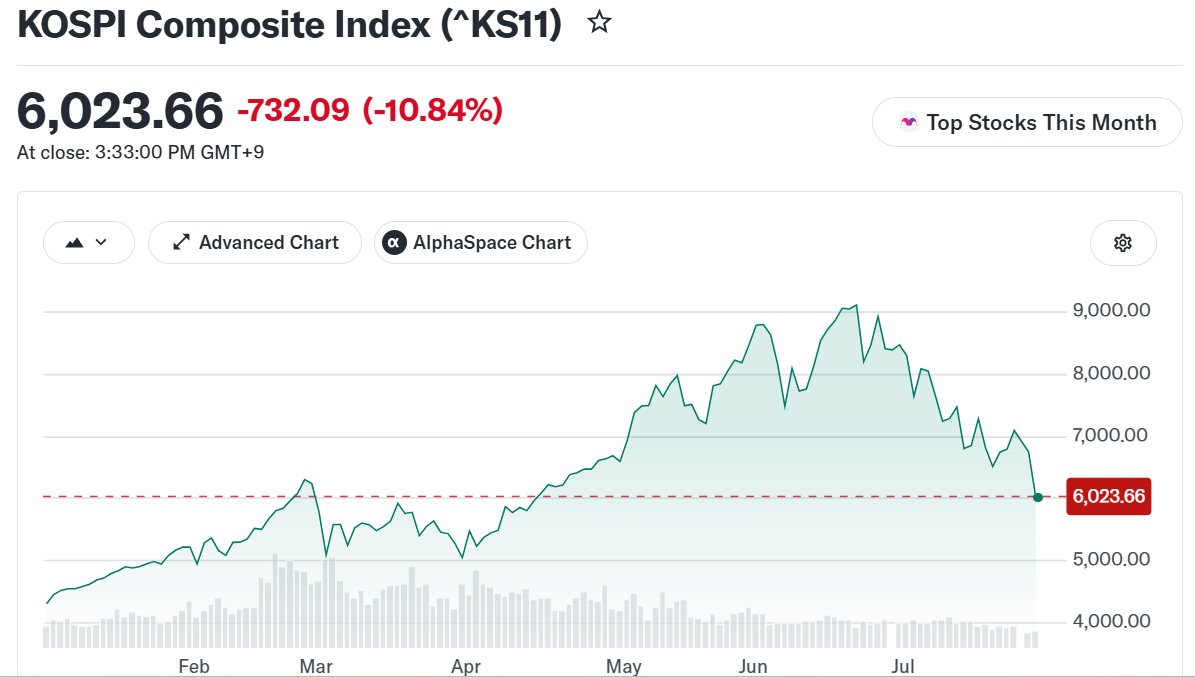
The Zhitong Finance App learned that according to local media reports in South Korea, South Korea's highest-level financial market regulator said on Tuesday that if necessary, the financial supervisory authority will consider setting an investment limit for retail investors to invest in single-stock leveraged exchange-traded funds (that is, individual stock leveraged ETFs). Tech giants are doubtful about the return on investment from huge AI capital expenses, and Nvidia's “circular AI financing” of over 750 billion US dollars has engulfed the global credit market. Combined with the listing of Changxin Technology, a leading DRAM memory chip company from China, the global semiconductor sector can be described as experiencing a “Black Tuesday”. South Korea's Kospi Index plummeted by more than 10% and experienced an eighth intraday meltdown during the year. The Japanese stock market was simultaneously under pressure. The Nikkei 225 index closed down 4%.
There are media reports that the South Korean authorities may set an upper limit on retail investment leveraged ETFs, just as the South Korean stock market, which has the title of “AI computing power weather vane”, frequently falls into upward meltdown and collapse, and the Philadelphia Semiconductor Index of the US stock market falls into a bear market. As a result, plans introduced by the South Korean authorities to raise the minimum cash threshold, suspend the launch of new products, and even set personal investment limits, which can reduce the risk appetite of the two major storage supergiants SK Hynix and Samsung for the entire Korean index and the global market Linear impact.
South Korea's plan to restrict single-share leveraged ETFs for retail investors is essentially an emergency brake on financial leverage and market microstructure that is out of control, rather than casting a negative vote on the prospects of the AI computing power infrastructure industry. Together, Samsung Electronics and SK Hynix already account for more than half of KOSPI's weight, contributing more than 80% of index trading volume on some trading days. Therefore, the Korean stock market is no longer just an observation window for AI prosperity, but has been transformed by leveraged ETFs into a “fluctuation amplifier” for global semiconductor transactions.
According to local media reports in South Korea, Korea's Financial Services Committee Chairman Lee Yi-won said at a meeting with local brokerage firms and asset management companies in Seoul that financial regulators will study and prepare to take larger measures to curb the market's overheated demand for such highly leveraged ETF product lines, such as setting a strict upper limit on the total investment of each individual/retail investor.
South Korean regulators raised the cash deposit threshold required for retail investors to invest in such ETFs last week. Most of these ETFs track and closely link South Korea's two largest stocks by market capitalization (which accounts for about 50% of Korea's benchmark stock index — the Kospi Index) and semiconductor manufacturing supergiants Samsung Electronics and SK Hynix.
Samsung Electronics' stock price plummeted by more than 10% during the Seoul trading session on Tuesday due to market concerns that the two major South Korean memory chip manufacturing giants might be seizing more market share by strong competitor Changxin Storage (CXMT) from China, and the financing risks brought about by the tech giants repeatedly reaching new high levels of AI computing power infrastructure spending.
Samsung Electronics' counterpart and largest memory chip competitor SK Hynix recently listed American Depositary Receipts (i.e. US ADR) in the US. Its stock price also fell more than 11% in Seoul on Tuesday. The American Depositary Receipt fell sharply by 10% on the NASDAQ on Monday, falling below the recent issue price of an initial public offering in the US stock market.
On Tuesday, South Korea's Kospi Index plummeted 10%. Chip stocks such as Samsung Electronics and SK Hynix led the decline, and the Korea Exchange was forced to once again activate the SIDECAR fusing mechanism on the same day. As of Tuesday, the Asia Pacific Kospi Index plummeted 10.76%, the biggest one-day decline since 1998. A sharp drop of more than 8% in the intraday period triggered the eighth fusing mechanism in the year. SK Hynix plummeted 14%; Samsung Electronics plummeted 13.58%. The Japanese market was simultaneously under pressure. The Nikkei 225 Index closed down 4%, shares of Kioxia, the world leader in NAND memory chips, fell sharply by 18%, and Japan's two major semiconductor equipment supergiants, Tokyo Electron (Tokyo Electronics) and Nikon (Nikon), both plummeted by more than 9%.
When Changxin landed on China's A-shares, SK Hynix's stock price plummeted and Nvidia's financing was questioned: the AI computing power chain faced a major stress test
The global semiconductor sector can be described as experiencing a large-scale sell-off on Tuesday. Doubts about the return on AI capital expenditure, continued market doubts about the imminent bursting of the AI bubble due to “circular AI financing” led by Nvidia, and the triple pressure of rising competition for Chinese memory chips set off a “Black Tuesday” that spread from Wall Street to the Asia-Pacific semiconductor sector.
This “Black Tuesday” is not a sudden deterioration in industry data, but rather a systemic risk reduction triggered by questioning the return on AI investment, a reassessment of the quality of infrastructure financing, the heating up of storage competition in China, and a backlash in leveraged transactions in South Korea. Together, Samsung Electronics and SK Hynix account for nearly half of KOSPI's weight. Stock prices fell 13.4% and 14% respectively in the intraday period, making the Korean market in fact a high-beta agent for global AI hardware transactions; single-stock leveraged ETFs linked to the two stocks also require daily dynamic rebalancing and mechanical sales during the decline, further amplifying fundamental concerns into peddling liquidity. As a result, South Korea's regulators are not only suspending the launch of related new products and raising the cash balance required for the transaction to 30 million won, but are also considering limiting the total investment of each retail investor — it really targets the uncontrolled microstructure of the market rather than completely denying the need for AI computing power infrastructure.
The deepest pricing shift in the market today is a shift from “how fast AI revenue is growing” to “can these increases cover the cost of capital”. Google's parent company Alphabet raised its 2026 capital expenditure guidelines to US$195 billion to US$205 billion; although Google Cloud (Google Cloud)'s quarterly revenue increased by 82%, the company recorded a negative quarterly free cash flow for the first time in history, with an outflow of 5.9 billion US dollars.
Wall Street analysts based on LSEG's forecast data show that the combined capital expenditure of the five companies Microsoft, Alphabet, Amazon, Meta, and Oracle may exceed their free cash flow by 2027, and the agreed capital expenditure forecast for this year has risen from about 485 billion US dollars at the beginning of the year to about 730 billion US dollars. As a result, strong revenue and EPS are no longer sufficient to support valuations, and capital markets are beginning to require companies to simultaneously prove AI revenue growth, profit margin expansion, free cash flow restoration, and financing sustainability.
Recently, there were media reports that Nvidia management is discussing providing a financing guarantee of about 250 billion US dollars for the OpenAI Ohio 10 gigawatt data center project, and may provide financing for chip purchases of up to 350 billion US dollars, further strengthening the market's circular concerns about “suppliers finance customers, then customers buy supplier products”; however, it must be emphasized that this is still a negotiation plan disclosed by the media, citing information from people familiar with the matter. It has not yet become a final agreement, and the media also said that it cannot be independently verified. Meanwhile, Changxin Storage rose 466% on the first day of its listing, raising capital of 57.92 billion yuan, and the market capitalization rose to about 3.3 trillion yuan, putting significant pressure on global DRAM prices and the long-term DRAM market share of South Korea's two largest memory chip dominators.
South Korea puts the brakes on leveraged ETFs: AI super bull market shifts from a “leveraged capital flywheel” to a “real cash flow test”
The more accurate meaning of this round of “Black Tuesday” collapse is not that the AI super bull market is being falsified, but rather that the pricing mechanism is shifting from retail leverage, momentum chasing, and unlimited capital expenditure to order quality, balance sheets, free cash flow, and real terminal demand. South Korea's regulations are taking away the financial amplifier of the AI market, not the computing power required for data center construction; what really determines whether the bull market can continue will be whether hundreds of billions of dollars of Capex (that is, the huge capital expenses of tech giants) can be converted into sustainable cash flow growth.
South Korea's restrictions on leveraged ETFs may weaken rebound capital and speed up the clearance of remaining positions in the medium term, but in the medium term, they will help eliminate mechanical surges and declines, allowing Samsung, SK Hynix, Micron, and even global semiconductor stocks to update iterative progress, long-term orders and supply agreements, product structures, and return on capital pricing in accordance with HBM/DRAM/3D NAND storage technology.
South Korea's plan to restrict single-share leveraged ETFs for retail investors is essentially an emergency brake on financial leverage and market microstructure out of control; it is not a negative vote on the prospects of the AI computing power infrastructure industry. Such products track double or even higher daily returns through derivatives. In order to maintain a fixed leverage ratio, they must be chased when the target rises and passively sold when it falls, forming a typical pro-cyclical feedback loop. Together, Samsung Electronics and SK Hynix already account for more than half of KOSPI's weight, contributing more than 80% of index trading volume on some trading days. Therefore, the Korean stock market is no longer just an observation window for AI prosperity, but has been transformed by leveraged ETFs into a “fluctuation amplifier” for global semiconductor transactions. Raising the minimum cash threshold, suspending the launch of new products, and even setting individual investment limits can weaken this mechanical trading cycle and reduce the nonlinear impact of memory chip stocks on the entire Korean index and global risk appetite.
Therefore, as far as short-term investment prospects are concerned, the tightening of regulations is not simply beneficial to AI asset prices: when leveraged ETFs were once an important marginal buyer of the market, limiting new capital would weaken the resilience of the rebound and force the market to return from “liquidity pricing” to “profit and cash flow pricing.”
Currently, the Philadelphia Semiconductor Index has a cumulative decline of about 20% in July, and all 30 constituent stocks have fallen below the 50-day EMA; South Korea's KOSPI also fell about 11% in a single day, leading the decline by Samsung and Hynix. Japan and other Asian chip markets are under simultaneous pressure, highlighting that the deleveraging of the Korean market has been transmitted to NASDAQ and SOX through US stock ADR, cross-border ETFs, quantitative momentum, and global semiconductor risk budgets. Regulation may speed up the clearance of positions in the early stages, but as passive upward and downward pressure declines, it is actually beneficial to reduce tail fluctuations in the medium term, allowing semiconductor sector stock prices to re-anchor orders, gross margin, and return on capital.
The collapse of the global semiconductor sector due to Korea's deleveraging and de-crowding process does not mean that the global AI data center construction cycle itself has been falsified. Mainly because Korean retail leveraged funds drive secondary market valuations and volatility, and do not directly finance AI data centers, semiconductor fabs, or power facilities of hyperscale cloud vendors. The true direction of AI computing power investment is still determined by cloud vendor capital expenses, GPU cluster utilization, HBM and server DRAM requirements, power access capabilities, and project financing costs.
However, the intense turmoil and frequent breakdowns in the Korean stock market revealed that the market previously confused “strong industrial demand” with “unlimited valuation expansion”: when competition among Chinese storage vendors, the quality of AI project financing, and the return on large-scale capital expenditure were questioned at the same time, even if corporate profits continued to grow, high congestion, high valuation, and high leverage were enough to trigger simultaneous global adjustments. In other words, the fundamentals were not immediately reversed, which does not mean that the price will not experience deep deleveraging.