
Intel Stock Fell Despite Incredible Results. History Says a $1,000 Investment Will Be Worth This Much in 3 Years
Key Points
Though Intel fell after its Q2 report, there are clear signs that the company's turnaround is here to stay.
Analysts are now expecting stronger revenue and earnings growth from the company.
The introduction of new products and Intel's focus on improving yields and reducing costs should help it beat Wall Street's expectations in the future, paving the way for more upside.
An investment of $1,000 in shares of Intel (NASDAQ: INTC) a year ago is now worth just under $4,500, as of this writing. The semiconductor specialist's multibagger returns over the past year have been driven by a remarkable turnaround in its fortunes.
When Intel released its second-quarter results on July 23, it became clear that it is becoming a more influential player in the booming artificial intelligence (AI) chip market. The company's revenue and earnings crushed Wall Street's expectations, and its outlook was well ahead of what analysts were looking for.
Missed Nvidia in 2009? This Rare Signal Is Flashing Again. In 2009, a "Double Down" signal flashed for a little-known chipmaker called Nvidia. For the first time in years, that same "Total Conviction" signal is flashing for a company 1/100th the size of Nvidia. Continue »
However, Intel stock fell nearly 8% the following day, driven by a broader sell-off in the semiconductor sector. Savvy investors, however, can consider this pullback as a buying opportunity. In fact, it won't be surprising to see an investment of $1,000 in Intel jump substantially over the next three years. Let's see why that may be the case.

Image source: Intel.
The crucial factor driving Intel's rally is here to stay
Intel's rally over the past year has been driven by its ability to substantially beat Wall Street's earnings expectations. This is evident from the following table.
Currency in USD |
9/30/2025 |
12/31/2025 |
3/31/2026 |
6/30/2026 |
|---|---|---|---|---|
EPS Estimate |
0.01 |
0.08 |
0.01 |
0.22 |
EPS Actual |
0.23 |
0.15 |
0.29 |
0.42 |
Difference |
0.22 |
0.07 |
0.28 |
0.20 |
Surprise (%) |
3162.41% |
81.51% |
2108.68% |
92.49% |
Source: Yahoo! Finance
A combination of cost cuts and sales growth has powered Intel's big earnings beats over the past year. In Q2, the company posted $0.42 in earnings per share, which was a major improvement over the year-ago period's loss per share of $0.10. Its revenue increased by 25% year over year to $16.1 billion, well ahead of the $14.4 billion consensus estimate.
What's more, the guidance suggests that Intel's phenomenal turnaround is sustainable. It expects $16.3 billion in revenue in Q3 at the midpoint of its guidance range, exceeding the consensus expectation of $15.1 billion. The non-GAAP earnings per share forecast of $0.38 is also ahead of the $0.27 per share consensus estimate.
Intel's guidance suggests that its revenue is on track to grow by 19% year over year, while earnings per share will increase by an impressive 65%. However, don't be surprised to see Intel exceeding its estimates. That's because the company's data center-focused AI chips are in terrific demand.
For instance, Intel management noted on the latest earnings call that revenue from sales of its custom AI processors almost tripled year over year. On the other hand, the company's server central processing unit (CPU) segment is now "growing faster than ever," according to CEO Lip-Bu Tan. It is easy to see why that's the case, as server CPUs are now in solid demand thanks to the proliferation of agentic AI applications.
Intel is moving quickly to capture the opportunity in server CPUs by increasing output and improving yields of its advanced 18A process node. Intel points out that it has reduced the cost of its Panther Lake client CPUs by 50% so far this year and expects to achieve another 20% cost reduction by the end of 2026. Management also added that it has "further meaningful reductions planned in 2027."
The lower wafer costs and the increase in CPU prices, which is driven by solid demand and tight supply, explain the massive improvement in Intel's bottom line. As a result, analysts are now expecting stronger earnings growth from Intel over the long run, though don't be surprised to see this semiconductor stock outpacing their expectations due to a combination of improving demand and further cost reductions.
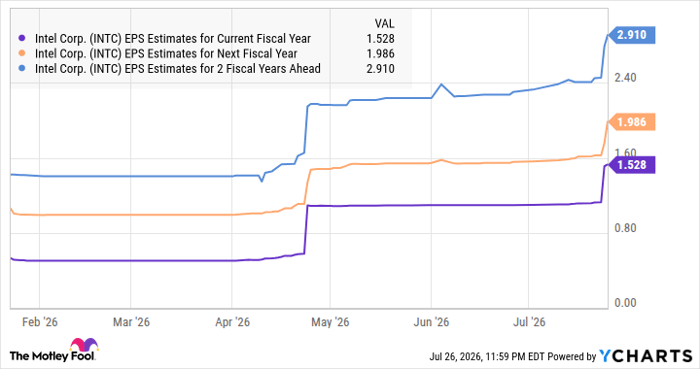
Data by YCharts
So, Intel can consistently beat Wall Street's earnings expectations. We have already seen that this has resulted in terrific upside over the past year, a trend that's likely to continue in the future as well.
A $1,000 investment in this chip stock could increase substantially in 3 years
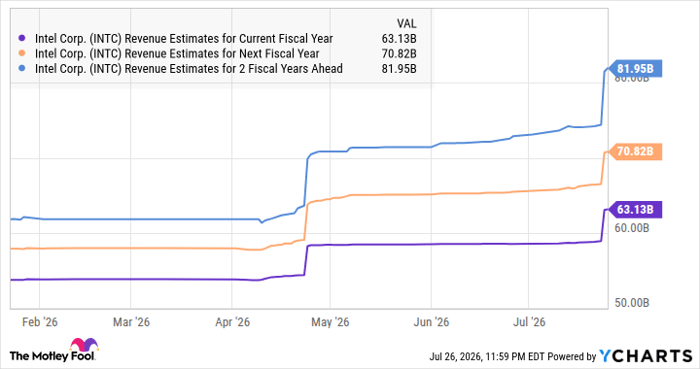
Analysts expect Intel's revenue to increase by 19% this year to $63 billion. Its growth rate is anticipated to dip slightly next year before picking up in 2028.
Data by YCharts
However, investors should note that it plans to bring the Intel 14A process node into volume production in 2028, potentially paving the way for stronger growth. The company promises that Intel 14A will deliver 15% to 20% performance gains over the 18A process node. So, there is a strong chance of Intel sustaining the impressive growth that it has been clocking so far this year through 2028, and beyond.
But even if Intel's revenue reaches $82 billion in 2028 (according to the above chart) and it trades at even 10 times sales at that time, which is a slight premium to its current price-to-sales ratio of 8, its market cap could increase to $820 billion. That's a potential jump of 75% from current levels, indicating that a $1,000 investment in Intel could be worth $1,750 in three years.
However, Intel could deliver much bigger gains, given its ability to clock stronger revenue growth, which could be rewarded with a higher sales multiple. So, if you've $1,000 in investible cash right now, buying this AI stock could turn out to be a smart move due to its growing stature in AI chips.
Harsh Chauhan has no position in any of the stocks mentioned. The Motley Fool has positions in and recommends Intel. The Motley Fool has a disclosure policy.