
750 billion dollars “left hand over right hand”? Nvidia (NVDA.US) Skyworth Deal Questioned: Revolving Financing Carnival Is Artificially Creating AI Bubbles
The Zhitong Finance App notes that Nvidia (NVDA.US) is promoting a new round of AI infrastructure transactions with a total value of more than 750 billion US dollars, further accelerating the pace of investment. However, skeptics warn that this continuous investment is artificially inflating the actual demand and valuation of the entire industry.
Nvidia said an artificial intelligence program in collaboration with the parent company of South Korean chipmaker SK Hynix is worth more than $500 billion. Additionally, as one of the largest financing deals with its customers, Nvidia is also negotiating a guarantee of up to $250 billion to help OpenAI lease computing power from a US data center project.
Although critics have been warning for months about the “circular nature” of such agreements — that companies funded and owned by Nvidia usually buy or use Nvidia's chips — these deals are progressing more and more rapidly.
The risk of such deals is that they may distort incentives for commercial activity in many industries, trigger poor decisions, and amplify losses once actual demand for AI fails to meet high expectations. According to people familiar with the matter, Nvidia is also in talks to provide financing for OpenAI to purchase Nvidia chips worth 350 billion US dollars for this US project.
Gary Tang, portfolio manager at Allspring Global Investments, said, “Although Nvidia's investment and cooperation have strengthened market confidence in long-term AI construction, investors are still concerned about 'circular financing',” and “capital is increasingly being used to fund future AI customers and infrastructure deployments.”
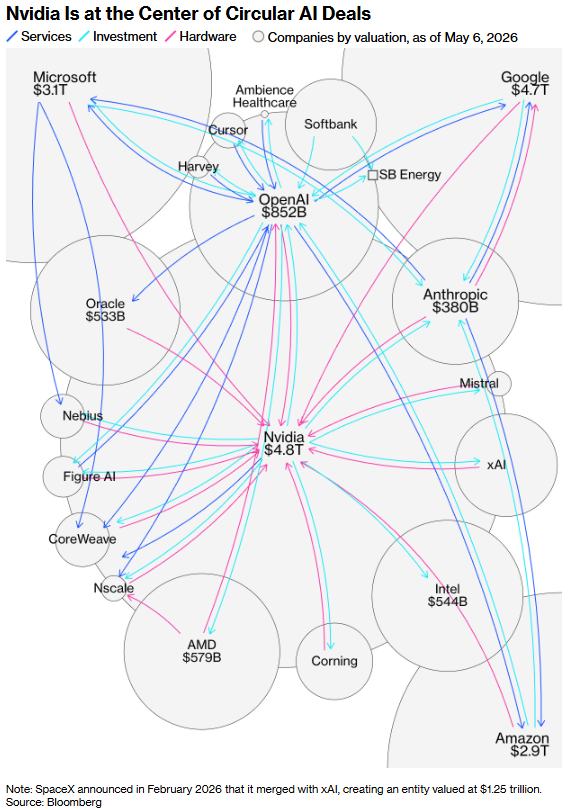
Nvidia is at the heart of circular trading
As the absolute hegemon in the AI processor space, Nvidia's latest move has further heated up the trading frenzy of the past few years across the ecosystem. The company has taken a stake in developers such as OpenAI and peer chipmakers such as Mewell Technology to drive the growth of the entire industry.
Industry peers have also chosen similar cooperation arrangements. Google, which includes AI products such as Gemini, has agreed to provide payment guarantees for five data center sites leased by Anthropic PBC to help this OpenAI competitor secure a loan equivalent to $3.5 billion.
Such deals have increasingly intertwined the interests of many AI companies, exposing the entire industry to systemic risk. One of the core concerns is also the industry's rising debt levels, and many AI companies are using increased borrowing to finance their data center and chip projects.
As part of an agreement between Nvidia and Hynix's parent company SK Group, the two companies will collaborate to build an AI data center with more than 2 gigawatts of power generation in Korea. This is roughly equivalent to the electricity needed for 1.5 million households. The first of these so-called “AI factories” will be built by SK Telecom and will open next year.
“This is Korea's golden age,” Nvidia CEO Hwang In-hoon said in an interview. “Their semiconductor business is booming, and so is their industrial business. You know, this is a country that has the power to help build the world's AI infrastructure.”
According to people familiar with the matter, a potential deal being negotiated with OpenAI will help the creators of ChatGPT to lease a $500 billion 10-gigawatt hub project being developed in Ohio by a SoftBank Group subsidiary. One of those familiar with the matter said that Nvidia could provide up to $250 billion in guarantees to the AI lab and is discussing financing for OpenAI's $350 billion purchase order. People familiar with the matter added that negotiations are still in the early stages and may break down, and the terms of financing may also change.
Billy Leung, investment strategist at Global X Management, said. “Nvidia is providing more data center debt guarantees to OpenAI, deepening the vendor financing model that has already been reviewed.” “This is both a reminder of the tight funding situation in AI construction, and a signal of demand.”
If realized, any support given by Nvidia to OpenAI could help ease creditors' concerns about financing an unlisted and loss-making business (to meet the growing computing needs of ChatGPT developers).
It also helped SoftBank founder Sun Zhengyi achieve his ambition to play a central role in AI development. Just like highly leveraged data center operations, SoftBank's business is increasingly based on an ongoing boom in AI spending. A large portion of the Japanese company's current profits depends on valuation earnings from the ChatGPT developer and the prospects for a major IPO in the future.
As of October, SoftBank has pledged to invest nearly $65 billion in OpenAI alone and signed a $40 billion bridge loan — one of the largest bridge financings in Asia Pacific history — to fund the investment. However, SoftBank's increasing chips and dependence on a company that it has limited control over is causing unease among investors.
For Nvidia, establishing closer ties with SK Group will help improve its ability to acquire memory chips. SK Hynix and its South Korean competitor Samsung Electronics are the two largest suppliers of these critical components — these chips are currently in short supply due to large-scale construction of AI data centers around the world. Nvidia will assist Hynix in designing future high-bandwidth memory chips. This work will help ensure a stable supply guarantee for Nvidia.
In an interview, Hwang In-hoon said that the total amount of the deal, worth more than 500 billion US dollars, includes the funds Nvidia used to purchase memory chips, as well as the amount of Nvidia supercomputers purchased by SK Group. “So between us, we're going to complete a business worth half a trillion dollars,” he said.
Late on Friday, Nvidia also said it would invest $1 billion in Naver Corp. to help fund its AI data center under construction in South Korea. The funding will allow internet and cloud service provider Naver to more than double the size of the facility. The site was jointly developed by Naver and US private equity firm Brookfield Corp. and will use Nvidia's AI computing hardware. Naver's stock rose more than 8% in response in Seoul.
Hwang In-hoon argued that Nvidia's investment in companies such as OpenAI and Anthropic would not only help his own business, but would also provide a return on investment. Nvidia has also invested in multi-data center companies including IREN Ltd., CoreWeave Inc., and Nebius Group NV. This year alone, Nvidia announced more than $540 billion in similar deals (not including a potential new agreement with OpenAI).
Although Nvidia is funding companies that are major buyers of its chips, Hwang In-hoon has denied the view that the deal is “circular in nature.”
“That's only a small percentage of the total amount of capital they eventually had to raise,” he said of his January investment in CoreWeave. “To think this is the idea of a circular transaction — it's just ridiculous.”