
Financial Report Preview | Meta (META.US) advertising engines are roaring, “selling computing power” opens up new ways to monetize, and AI capital spending welcomes another “vote of confidence moment”
The Zhitong Finance App learned that Meta Platforms (META.US) will release financial results for the second quarter of 2026 after the market on July 29 EST. The most high-profile earnings disclosure in this earnings season coincided with the heated AI spending controversy among tech giants — Alphabet (GOOGL.US)'s stock price plummeted by more than 7% a week ago due to an increase in capital expenditure guidelines, and the market is eagerly searching for evidence that hundreds of billions of dollars of AI investment are being transformed into real revenue growth. As of last Friday, Meta's stock price was reported at $595.19, a cumulative decline of 9.7% from the beginning of the year, and a retracement of about 25% from the 52-week high of $796.25.
Core Expectations: High increase in revenue and slight decline in earnings per share
According to Wall Street consensus estimates, Meta's second-quarter revenue is expected to be around US$60.17 billion, up 26.6% year on year; adjusted earnings per share are expected to be 7.13 US dollars, down about 0.1% year on year — the divergence between high revenue growth and slight decline in profit is a direct reflection of AI's huge capital expenditure eroding profit margins.
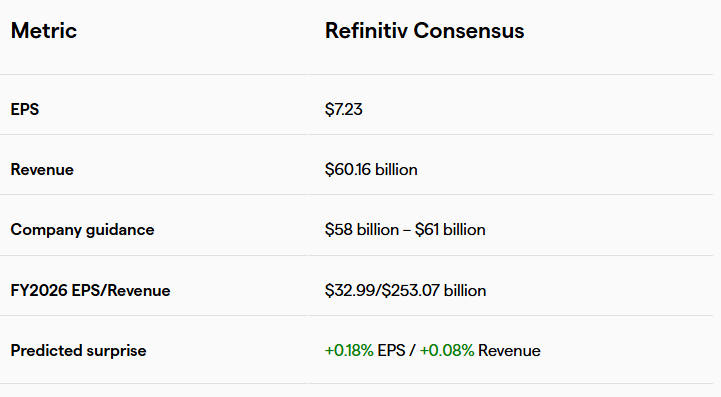
By business, advertising revenue is expected to reach US$59.01 billion, up 26.7% year on year; total app family (FoA) revenue is expected to be US$59.6 billion, up 26.4% year on year; and Reality Labs revenue is expected to be US$442 million, up 19.3% year on year. Bank of America is more optimistic. It expects Q2 revenue of US$60.6 billion and earnings per share of US$7.50, all higher than the consensus. Deutsche Bank also raised its revenue forecast to 60.5 billion US dollars, slightly higher than the Wall Street consensus.
Notably, Morgan Stanley previously predicted that Meta Q2 advertising revenue is expected to surpass Google's search ad revenue for the first time, ending the latter's long-term hegemony in the digital advertising field. If this prediction comes true, it will be a historic turning point for the digital advertising industry.
Financial Report Highlights
Advertising business: The AI-driven “profit engine” is still running at full speed
The advertising business is Meta's core infrastructure and a source of confidence that supports huge AI spending. In the first quarter, the app family's advertising revenue reached 55 billion US dollars, up 33% year on year, advertising exposure increased 19%, and the average unit price rose 12%, achieving a “sharp rise in volume and price.”
In its July 26 report, Deutsche Bank described channel inspection of the advertising business as “overwhelmingly positive” — advertisers saw stronger conversion rates and better return on ad spend, thanks to Meta's investment in AI-driven ad ranking, search, and automation. Among them, the Advantage+ automated ad product suite has become a key growth engine, and currently 82% of Meta advertisers use some form of Advantage+ automation. Annual revenue from tools such as value optimization kits has surpassed $20 billion, more than double what it was a year ago.
Wells Fargo expects the advertising business to grow 27% in the second quarter, and predicts that the Q3 revenue guidance range will be between $60.5 billion and $63.5 billion (up 18%-24% year over year).
Advantage+ AI advertising tools have reached around $60 billion in annual revenue. AI-driven ad rankings and automation are helping Meta further penetrate the digital advertising ecosystem. However, the risk of diminishing marginal returns on AI investments cannot be ignored — whether the growth in advertising revenue can continue to cover rising capital expenses is the core suspense of this financial report.
AI capital expenditure: $125 billion to $145 billion “the elephant in the room”
The real suspense is AI spending. Meta raised its capital expenditure guidance for the full year 2026 from $115 billion to $135 billion to $125 billion to $145 billion in April. The market generally expects Q2 capital expenditure to be around US$33.7 billion, double the previous year (US$16.5 billion in the same period last year).
Bank of America believes that Meta may further raise the capital expenditure cap from 145 billion US dollars to 150 billion US dollars in this financial report, for reasons including rising memory costs. Wells Fargo has raised its 2027 capital expenditure forecast from $170 billion to $181 billion. J.P. Morgan also expects capital expenditure to reach US$2020 billion in 2027, which could result in negative free cash flow of US$4 billion in 2026.
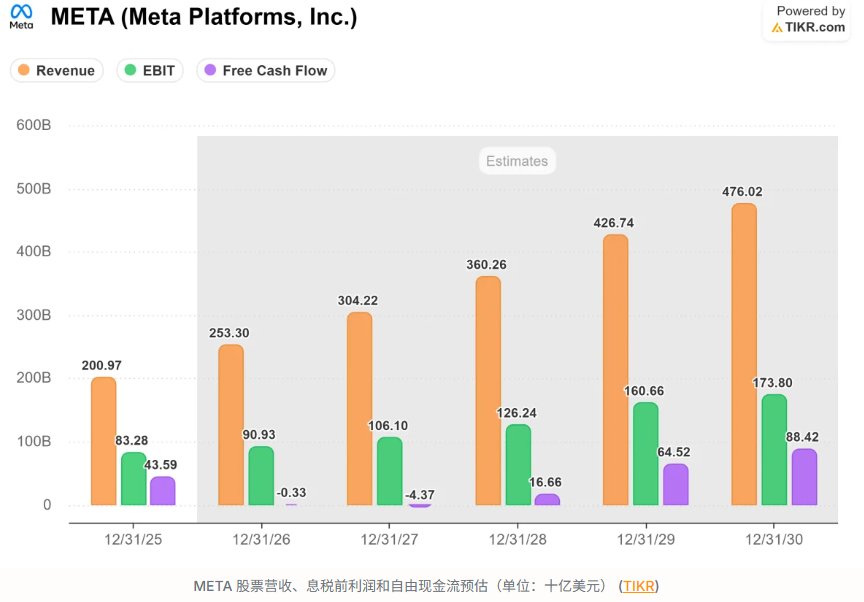
The pressure on free cash flow is investors' core anxiety. This means Meta is transforming from an “asset-light” social platform to an “asset-heavy” AI infrastructure operator. The market is concerned about free cash flow — FactSet expects Q2 free cash flow to be negative by more than $1 billion. Aggregate agency forecasts indicate that Meta's free cash flow for the full year of 2026 is likely to shrink by 95.7%, leaving only about US$1.85 billion, compared to US$43.59 billion in 2025.
Wedbush analysts pointed out that the spending trajectory will determine whether Meta's free cash flow will turn negative in 2026 or 2027. CFO Susan Li said during the Q1 earnings call: “Meta reserves the flexibility to slow down deployment or cut spending in the next few years if returns fall short of expectations.”
Meta Compute: A New Narrative of “Monetization” of AI Computing Power
Another highlight of this financial report is more details of the AI cloud infrastructure business codenamed “Meta Compute.” According to reports on July 1, Meta is planning to sell AI computing power and model access to external customers, which may include two models: one is hosting access to a full range of AI models (against AWS Bedrock), and the other is renting the underlying GPU computing power (targeting “new cloud” service providers such as CoreWeave).
This new business is seen as a key step for Meta to transform AI infrastructure from a “pure cost burden” into a revenue-generating asset. Analysts expect Meta is expected to monetize excess computing power at a price of $10 billion to $15 billion per gigawatt per year. The Bank of America stated in its July 20 report that investors will focus on AI-related initiatives during the earnings call, including advertising improvements brought about by the integration of AI models, opportunities for Muse Spark, and the potential for external computing power sales.
Bank of America analysts pointed out that this move could transform idle computing power from a “pure cost burden” into an income-generating asset. There are reports that Meta has signed a $21 billion agreement with CoreWeave and has a potential $27 billion AI infrastructure contract with Nebius.
Investors will follow the official confirmation, schedule, and commercialization path of this business during the earnings call. If Meta Compute is implemented, it will not only improve cash flow, but is also likely to reshape the market's valuation logic for Meta — a shift from an “advertising company” to an “AI infrastructure provider.”
Valuation and Market Sentiment: A Game Under 18x Price-Earnings Ratio
The current stock price is around $595, a retracement of about 25% from the 52-week high of $796. The forward price-earnings ratio is about 18 times lower than Alphabet's 25 times. The Wall Street consensus target price is around $826, implying about 39% upside. 57 buy ratings, 6 hold, 0 sell. The forecast market shows an 87.1% chance that Meta will exceed expectations for the seventh consecutive quarter.
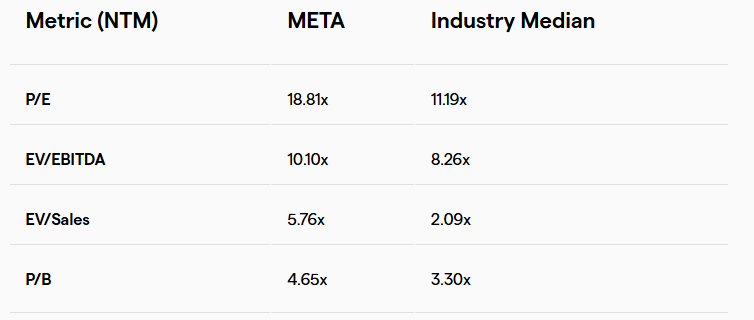
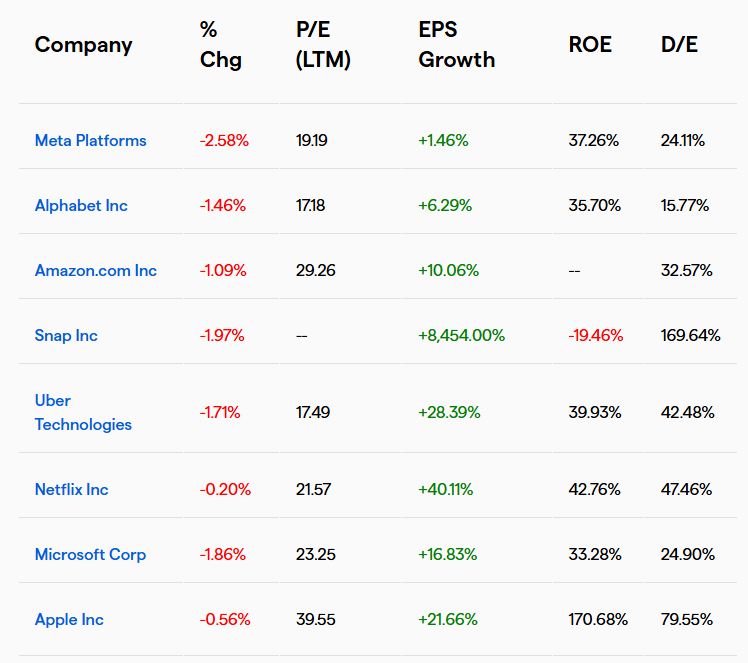
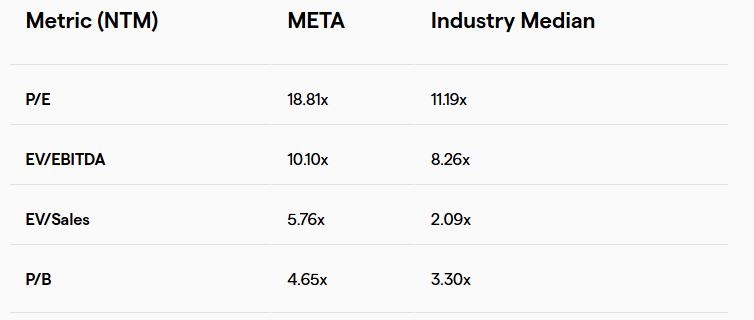
Currently, the meta interest guarantee multiplier (TIE) has decreased by 26.74% year over year to 71.5 times. Although this is not significant, it is still healthy. However, Meta is increasing its borrowing efforts to finance expansion. At the moment, this isn't a red flag, but it's worth watching. From every perspective, Meta shows a premium that far exceeds the industry average — the expected price-earnings ratio is about 1.7 times the industry median, and the corporate value/sales ratio is about 2.75 times. The market positions Meta as an AI infrastructure growth stock rather than an advertising platform. Therefore, capital expenditure guidelines are more important than earnings per share exceeding expectations. Meta's debt-to-equity ratio (D/E, 24.11%) is significantly higher than Alphabet's 15.77%, which is noteworthy given its capital expenditure path.
Bank of America gave a “buy” rating, with a target price of $835: the advertising business grew steadily, and layoffs in May boosted profit margins. Third-quarter revenue is expected to be US$60.5 billion to US$63.5 billion, up 18% to 24% year over year. Artificial intelligence aspects: content search, advertising model integration, Muse Spark, and possible Anthropologie computing deals.
Citibank expects performance to exceed expectations, and capital expenditure is the focus: capital expenditure is expected to be around US$205 billion (22% increase) in 2027, which is related to the construction of 14 gigawatts of installed capacity. The capital expenditure of the three largest hyperscale data center operators will reach $801 billion in 2027, enough for all three operators to experience negative free cash flow until 2028.
All in all, there's probably nothing wrong with the meta-ad business. The real sticking point is how much money Meta needs to invest in order to remain competitive in the field of artificial intelligence, and how well the market tolerates negative free cash flows. For investors watching Meta stock, the question before earnings are released is whether this spending is translating into the kind of return for advertisers described by Deutsche Bank, and Wednesday's report should provide a more clear answer.
Technical side: key price after earnings report
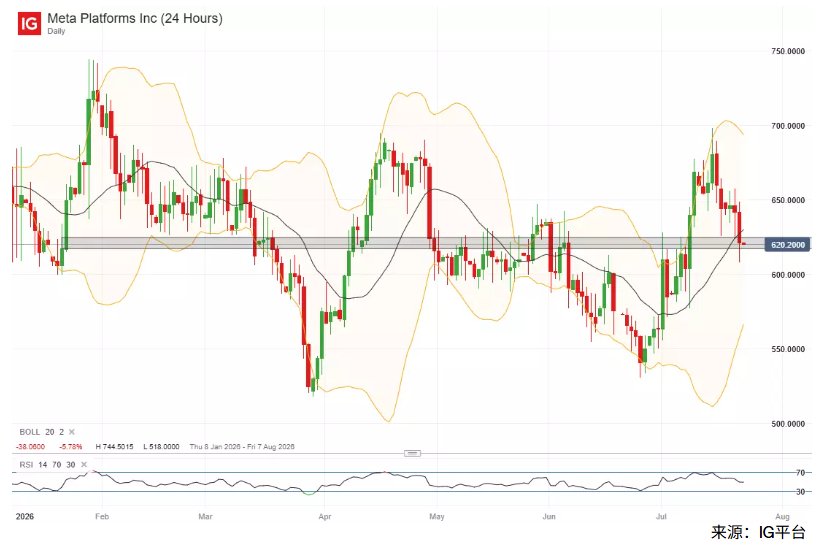
Meta's share price fluctuated about 8% after the options market pricing earnings report. Gamma options positions show that $750 is a resistance level and $550 is a support level. Technically, Meta recently tested the $650 key area near the middle of the Bollinger band. If it falls below $600 after the earnings report, the next target is in the range of $575 to $550; if the performance exceeds expectations, the first resistance level is around $675. The stock price has been supported several times between $525 and $540, but the RSI momentum indicator is forming a series of lower highs.
AI capital expenditure logic is being tested again
Alphabet's results easily beat expectations last week, but shares fell after the parent company of Google and YouTube raised anticipated spending on artificial intelligence infrastructure. Technology companies are selling stocks and borrowing funds for the construction and operation of AI data centers, causing investors to worry about whether these investments will pay off.
After Alphabet raised its spending expectations by $15 billion this year, Microsoft, Meta Platforms, and Amazon are facing new investor concerns over their debt-driven capital expenditure plans.
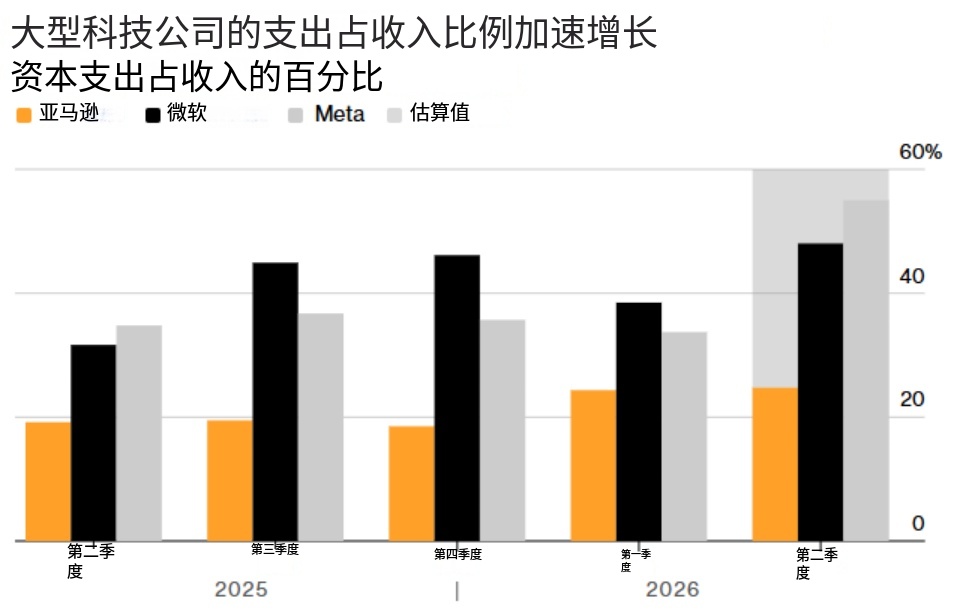
This week's earnings call will undoubtedly focus on discussing whether the surge in AI investment can bring sufficient returns in a context where the current geopolitical situation remains volatile. According to Bloomberg industry research data, among the S&P 500 index constituent companies that have published financial reports, there are more companies that raised their performance expectations than those that maintained or lowered their expectations.
Investors will keep a close eye on the progress of the “Big Seven” in commercializing artificial intelligence. According to reports, Meta, which will release its earnings report on Wednesday, is planning to launch a cloud computing business, possibly selling the social media giant's remaining computing power or access to artificial intelligence models. Meanwhile, Amazon, which will release earnings on Thursday, has raised hardware rental costs for training and running artificial intelligence models.
The capital expenditure of tech giants is also having an impact on chip, memory, and data storage stocks. These stocks have recently slowed in gains, but have been one of the best performing sectors in the stock market since this year. Meta's earnings report is essentially another vote on “trust” — do investors believe the 100 billion dollar investment in AI will eventually pay off?