
Horse racing, deepening intelligence (02723) using “double 100” growth to open up the market ceiling
After the launch, the first question faced by Deepen Intelligence (02723) was: How to turn the technology narrative into continuous growth?
The Zhitong Finance App learned that in May 2026, Shenyan Intelligence was listed on the Hong Kong Stock Exchange and became the “First Enterprise Decision AI Smart Stock” of the Hong Kong Stock Exchange. Compared to a simple AI concept, what the company wants the capital market to understand is that generative AI is changing the growth boundaries of enterprise service companies, and is also changing the commercialization radius that deep intelligence has accumulated over the past 17 years.
In an interview, Huang Xiaonan said that this is a period of “land grabbing” for the company. She is more concerned about new customer signings, new product monetization, and customer migration from buying one product to buying multiple products rather than short-term fluctuations in a single financial indicator.
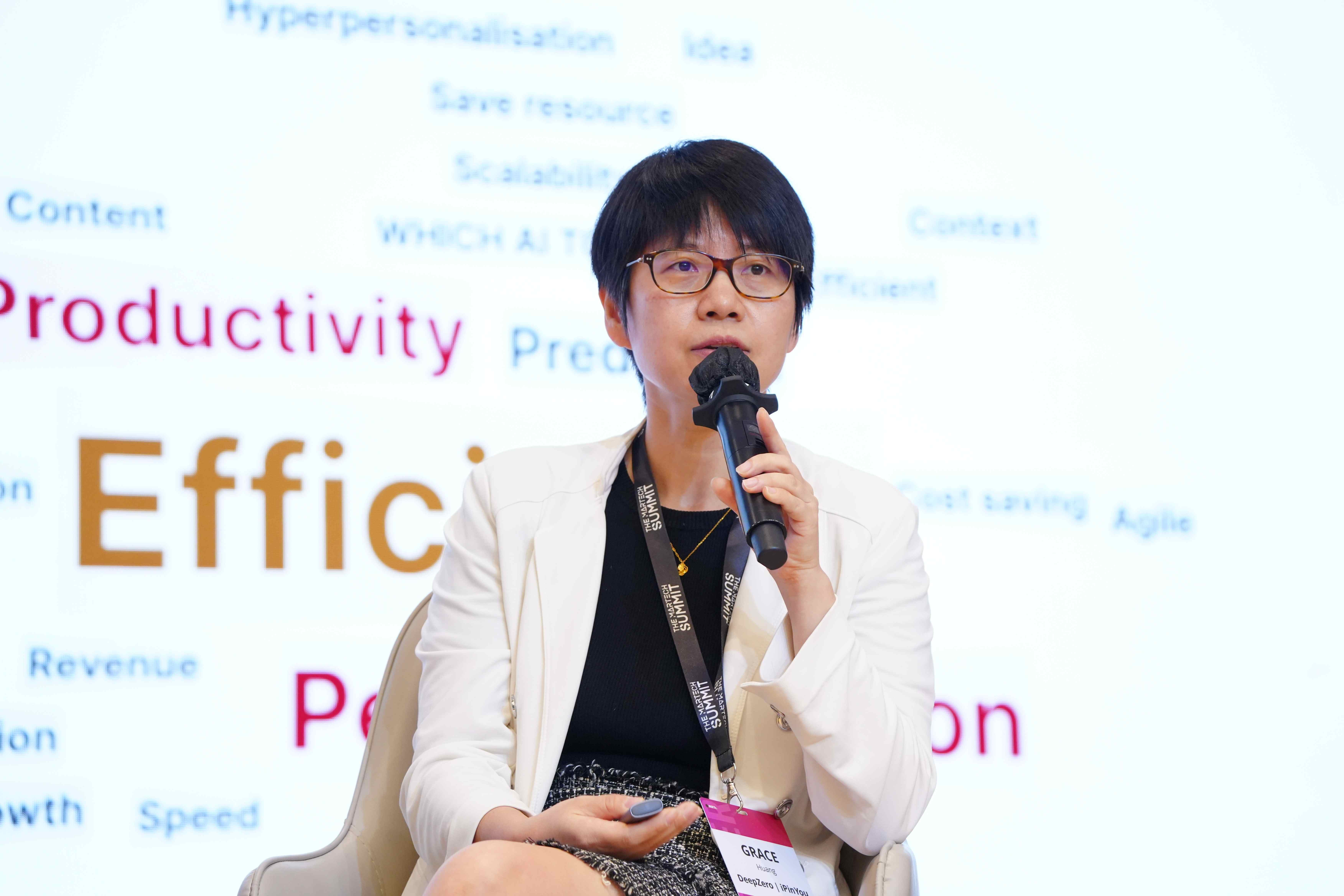
(Huang Xiaonan, founder and CEO of Shenyan Intelligence)
AI has lifted the ceiling
In the past, deepening intelligence mainly revolved around two high-value decision scenarios: digital advertising and CRM user operations. These two scenarios naturally rely on data and algorithms, and also helped the company form core platforms such as AlphaDesk and AlphaData. However, judging from commercial boundaries, the ceiling of traditional digital marketing software and intelligent delivery services is still relatively clear.
Generative AI changed that. Huang Xiaonan believes that this wave of AI is not a technological iteration, but an industrial revolution. The ability to understand, generate, and reason big models, combined with predictive models, industry models, and customer scenarios that have been deeply rooted in intelligence in the past, enables the company to expand from two scenarios to more scenarios such as product innovation, GTM, social marketing, sales training, intelligent shopping guide, customer service quality inspection, and user operation.
This is also the significance of the “Agentic Software + Agentic Service” proposed by the company for growth: the former enters the company's internal processes to replace or upgrade traditional marketing software; the latter enters the enterprise's outsourcing service budget and transforms the process originally carried by the agency or manual service into AI-driven delivery of results.
In other words, the market space for deepening intelligence is no longer just the original software budget, but also includes a broader operating budget for corporate marketing, sales, customer service, and user operations. In an interview, Huang Xiaonan said that AI has “lifted the ceiling” for deep intelligence.
100×100 growth coordinates
The growth framework proposed by Huang Xiaonan is “100 x 100”: on one end, the number of customers may increase 100 times, and on the other end, the number of products purchased by a single customer will also expand 100 times.
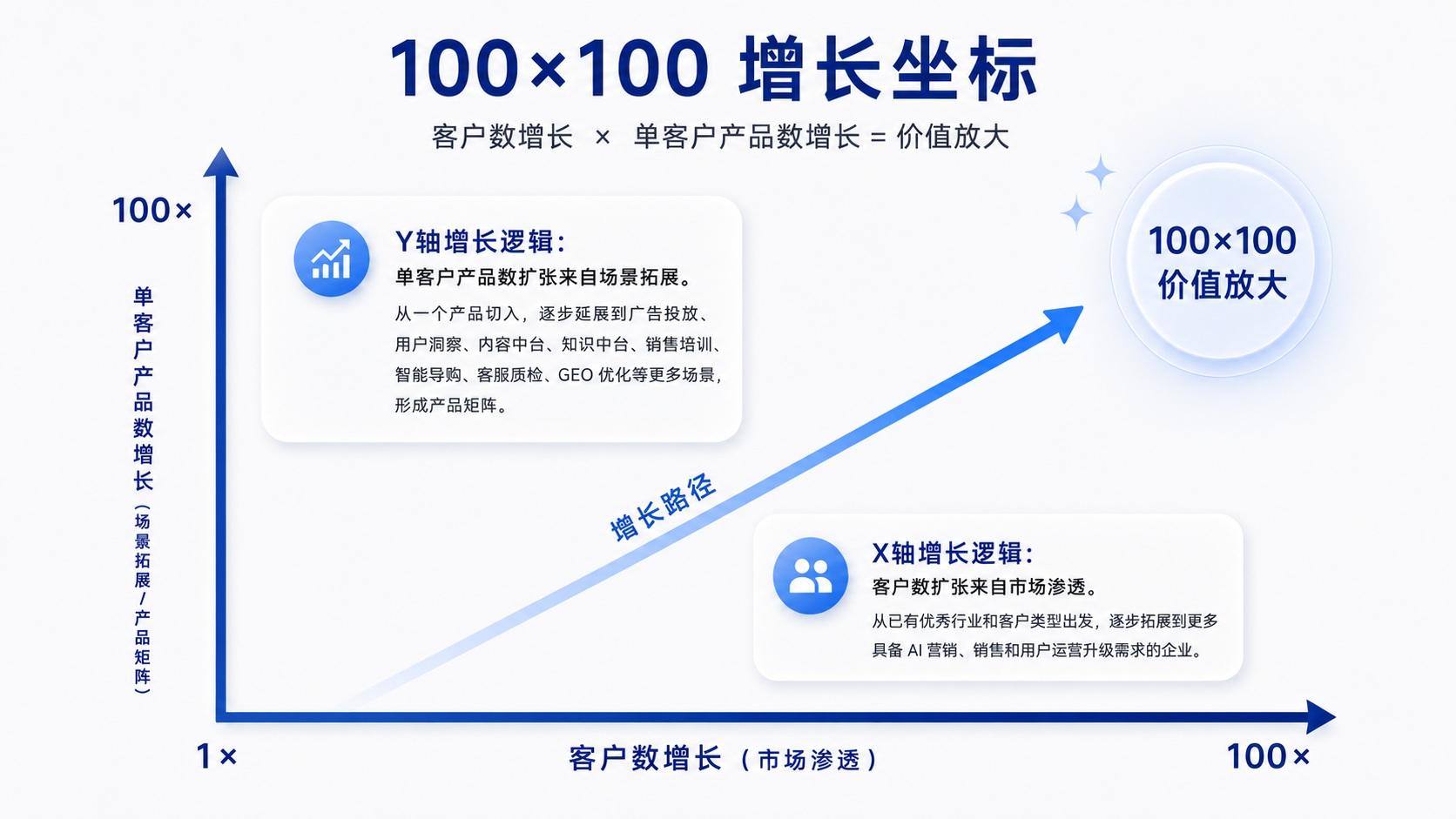
The expansion in customer numbers comes from market penetration. In the past few years, end customers that have advanced intelligent services have mainly been concentrated in large and medium-sized enterprises, and there are far more companies in China that need to upgrade AI marketing, sales, and user operations. The listing itself has also increased the probability that the company will be seen by customers. Huang Xiaonan mentioned that the number of active market leads increased markedly after listing, which enabled the company to enter an unprecedented window period.
The expansion in the number of products for a single customer comes from the scenario matrix. In the past, a customer might only purchase one product in advertising or data management; however, in the Agentic AI era, the same customer can extend advertising to multiple scenarios such as user insight, content center, knowledge center, sales training, intelligent shopping guide, customer service quality inspection, and GEO optimization.
This means that the company's growth depends not only on new customers, but also on cross-departmental and multi-level penetration within existing major customers. A brand may first move from advertising, then expand to e-commerce departments, marketing departments, sales departments, customer service departments, and user operations departments, and eventually form continuous cooperation among multiple products, multiple budget pools, and multiple teams.
For investors, the key to this growth logic is not the amount of money for a single project, but rather the ability of deep intelligence to turn “one entry point” into “multiple scenarios” and “one product” into a “product matrix.”
Mergers and Acquisitions: From customer entry to platform reuse
In this growth framework, mergers and acquisitions are viewed by Huang Xiaonan as a very important path for deepening the future of intelligence.
To-B companies naturally have the characteristics of long sales cycles, slow customer entry, and heavy understanding of scenarios. This is not only a moat for deepening intelligence, but also a constraint that the company itself must face when expanding. Therefore, building a self-built sales team and natural expansion alone may not be able to fully seize the AI Agent industry window period.
Huang Xiaonan said in an interview that the core logic of intelligent mergers and acquisitions is not simply to buy revenue, not just to buy products, but to buy customer portals, buy deep relationships, and buy collaborative business lines.
“In the past, the core of To-B mergers and acquisitions was actually buying customers and products. We basically don't need to buy products right now.” she said. The reason is that AI is significantly improving the product development efficiency of deep intelligence itself. What the company places more importance on is whether the target enterprise has entered the key departments of high-quality customers, especially those related to consumers, marketing, sales, e-commerce, customer service, and user operations.
If the target company serves scenarios such as finance, personnel, etc. that are not well related to existing capabilities, the collaborative value is limited; however, if it serves the brand's marketing department, e-commerce department, sales department, or customer operation department, it may become a new entry point for deepening intelligent Agentic Software and Agentic Service.
The imaginative space for this type of merger and acquisition is that the acquired company may have originally only served a single point of customer demand, and deepening intelligence can be deployed horizontally based on this, introducing DeepAgent, AlphaData, AlphaDesk, and a series of marketing intelligence products into the customer, and expanding from one portal to multiple products, multiple departments, and multiple budget pools.
The value of mergers and acquisitions is not only reflected at the customer level, but also at the business level. In the past, many ToB companies were struggling to grow: serving a few customers can be profitable, but once they pursue scale, they have to invest in R&D, products, and delivery, and profits are quickly swallowed up. If deep intelligence integrates such companies into the system, on the one hand, it can use their customer relationships to open up entrances, and on the other hand, it can consolidate repeated R&D and distributed product capabilities into a unified platform, and use AI-based products and delivery systems to improve efficiency.
This means that mergers and acquisitions may become an important way to unleash scale effects after intelligent listing: the front-end acquires customers and scenarios, and the back-end uses a unified AI product platform, industry model, and delivery system for reuse.
Window period for land grabbing
The window for AI applications is often short. The underlying large model is quickly iterated, and single-point tools are easily replaced. What can really stay in the corporate budget for a long time is a system that can enter processes, form a closed loop of data, and continuously review and optimize.
Huang Xiaonan judged that compared to many competitors, Shenzhan Intelligence had completed product and organizational preparations several months ahead of schedule. On the one hand, the company's customer relationships, data capabilities, algorithm models, and industry trends over the past 17 years are being transformed into assets in the AI Agent era; on the other hand, the company is also restructuring the organization, moving from traditional internet-based R&D to a small team rapid incubation model of “AI architect+AI product manager+business consultant”.
This change directly affects the efficiency of product supply. Huang Xiaonan mentioned that in the past, an enterprise-level software product might have required 50 to 100 people to polish for a long time, but now, with AI support, some products can be prototyped and commercially verified by a smaller team within a month. For an enterprise services company, this means that the speed of product matrix expansion, delivery efficiency, and M&A integration efficiency are all likely to be redefined.
From an investor's perspective, the next indicators to be observed are relatively clear: the signing and renewal of DeepAgent related products, Agentic Software's multi-product penetration rate within customers, Agentic Service's gross profit and delivery efficiency, the speed of customer expansion, and whether the company can form a wider customer portal through mergers and acquisitions.
The core of deepening the growth story of intelligence is not to chase AI hot spots in the short term, but to re-amplify decision-making AI capabilities accumulated over the past 17 years with generative AI; turn single-point products into product matrices; turn customer entry into cross-departmental penetration; and turn traditional services into AI-driven results delivery.
If this path succeeds, Shenzhen Intelligence will not only be a marketing technology company, but may become an AI operation platform in enterprise marketing, sales, and user operation scenarios.