
A single company leverages the foreign exchange market! SK Hynix went to the US to raise US$26.5 billion, triggering a chain effect, and the won appreciated 6% in July, leading Asia
The Zhitong Finance App learned that, driven by SK Hynix (SKHY.US)'s record US stock listing, the Korean won rebounded strongly, prompting the South Korean authorities to further urge exporters to return overseas capital to the country. Despite overseas investors selling off Korean stocks, the won rebounded about 6% against the US dollar in July, making it the best-performing currency in Asia.
The South Korean memory chip giant raised 26.5 billion US dollars during this listing. The market observed that the company sold a large amount of dollars, which directly promoted the subsequent strengthening of the won. Last week, South Korea's Deputy Minister of Finance, Xu Chang-wook, urged exporters to exchange more profits into Korean won and return funds stranded overseas to the country.
SK Hynix's large-scale sale of US dollars shows that a single enterprise's capital operation can change the foreign exchange market pattern. This has also strengthened the South Korean regulatory authorities' mentality: accelerate measures to stabilize the exchange rate, which have continued for several months, and use the strength of the country's leading exporters rather than just relying on foreign exchange reserves. This strategy bets that corporate cross-border capital flows can achieve results that are difficult to achieve with direct foreign exchange intervention, and at the same time avoid the high cost of intervention.
Stephen Lee, an economist at Meritz Securities, said, “Hynix's dollar sell-off has formed a chain effect and evolved into a wider wave of companies selling dollars. In addition to the dollar exchange linked to the company's American Depositary Receipt (ADR) earnings, the continued strength of the Korean won also prompted other companies that had postponed the exchange of foreign currency earnings to start selling dollars.”
Hanwha Marine sold about $2 billion worth of forward contracts in early July, and the shipbuilding company also signaled that it would increase its dollar sell-off efforts in the future. According to data from the Bank of Korea, the net sales of Korean importers and exporters in US dollar forward contracts reached 17.4 billion US dollars in the second quarter, a record high in 18 years.
Companies such as Samsung Electronics, Hyundai Motors, HD Korea Shipbuilding & Marine, and Samsung Heavy Industries have also been requested by the authorities to return funds and expand foreign exchange hedging business.
The won rebounded about 6% against the US dollar in July, after the currency hovered near its lowest point since 2009. This month, the won became the best performing currency in Asia, and the first half of the year was the worst performing currency in the region. Although foreign investors sold about 13.6 trillion won (9.3 billion US dollars) of the Korea Composite Stock Price Index (KOSPI) constituent stocks due to concerns about the sustainability of the AI spending boom, the won still appreciates strongly.
The exchange rate of the won against the US dollar rebounded in July
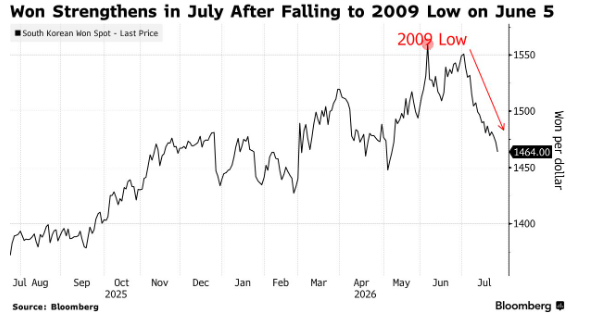
The depreciation pressure faced by the Korean won has not been completely removed: the South Korean stock market is volatile, and South Korea is advancing its $350 billion investment commitment in the US. However, the final decision on whether to continue selling dollars remains in the hands of the company itself.
According to reports, SK Hynix and Samsung are about to announce their latest results. The market expects SK Hynix's operating profit for the second quarter to reach 64.09 trillion won, a year-on-year increase of nearly 600%, which is expected to set a new historical record. Samsung Electronics has previously announced preliminary results, with operating profit of 89.4 trillion won for the second quarter.
In addition, Samsung Electronics and SK Group signed major semiconductor orders of 950 billion US dollars with US companies. Among them, SK Hynix will provide US companies with long-term memory chips worth 750 billion US dollars, while Samsung Electronics will supply chips worth 200 billion US dollars to Broadcom. Kim Yong-beom, director of the South Korean President's Office of Policy, acknowledged that these orders include “production capacity at a fab that has not yet been built.” This means that Samsung and SK Hynix will have to expand production capacity at an unprecedented rate over the next few years.
However, as far as things are concerned, South Korean officials are looking forward to the current strengthening of the Korean won. South Korea's Deputy Minister of Finance Koo Yun-chul said that the scale of the company's forward dollar sell-off in the third quarter is expected to expand further. He said that ADR earnings and similar capital flows are more like the beginning of a shift in supply and demand rather than a temporary boost.
Koo Yun-cheol added, “This is not a fleeting shower, but the rainy season has officially begun.”