
Press the “pause button” to fight between the US and Iran! Oil plummeted more than 7% to 90 US dollars, and the price of gold jumped 40 US dollars, waiting for the Federal Reserve's “life and death”
The Zhitong Finance App learned that after 13 days of continuous military attacks, the confrontation between the US and Iran suddenly hit the pause button last weekend, and the global commodity market shook violently. During the Asian trading session on Monday (July 27), the international benchmark Brent crude oil futures plummeted more than 7% after opening, falling below the integer mark of 90 US dollars per barrel; WTI crude oil futures fell more than 5% at the same time to around 84 US dollars per barrel. At the same time, spot gold opened nearly $40 higher and hit 4,096 US dollars/ounce at one point, an increase of more than 1%.
This sudden market reversal stemmed from a tacit agreement reached between Washington and Tehran over the weekend — the US suspended air strikes against Iran and Iran simultaneously suspended counterattacks. Market sentiment quickly reversed from extreme pricing of “war premiums,” but whether this rebound was a trend reversal or a fleeting bust depends on this week's intertwined game of multiple variables.
Cessation of fighting: “diplomatic window” after 13 days of continuous attacks
On July 24, US President Trump broke the practice of approving military strike plans every day for the past two weeks and ordered the US military not to launch attacks on Iran that day. Since then, the US military has not carried out a new round of air strikes for two consecutive nights. US Permanent Representative to the United Nations Mike Waltz said on Sunday that the suspension was to “leave more room” for diplomatic negotiations.
Iran simultaneously pressed the pause button. Iranian military spokesman Akraminia confirmed that since the US military did not launch an attack, Iran suspended counterattacks in accordance with the “tooth for tooth” reciprocal strategy. Meanwhile, the Omani delegation has arrived in Iran to discuss new arrangements for reopening the Strait of Hormuz. A spokesman for Iran's Ministry of Foreign Affairs said that the talks between Iran and Oman on safe shipping management in the strait were “fruitful and some progress has been achieved.”
However, the fragility of the cease-fire cannot be ignored. Iranian sources “have more doubts than optimism” about the sincerity of the US cease-fire, believing that this is more of a tactical adjustment than a real change of sincerity. Trump himself sent a two-sided signal — saying that Iran “is serious this time” and threatening that “if necessary, it could be raised to a higher level.”
A huge shock in the oil market: Brent instantly fell below $90 and is still up 30% this month
As soon as the news of the “suspension” came out, the crude oil market dived instantaneously. Brent crude oil, the global benchmark, fell more than 7% within a few minutes of opening. After falling below $90 per barrel, it then rebounded to around $92. WTI crude oil futures fell about 5.5% to $84.40 a barrel. European gas prices fell sharply at the same time, falling as much as 7.8%.
The background of this sharp drop is the previous crazy rise in oil prices — due to the spread of the US-Iran conflict from the Strait of Hormuz to the Red Sea, Brent crude oil has surged about 30% this month, breaking through $100 per barrel last week. The conflict has continued for nearly five months, raising widespread concerns about the impact of global inflation.
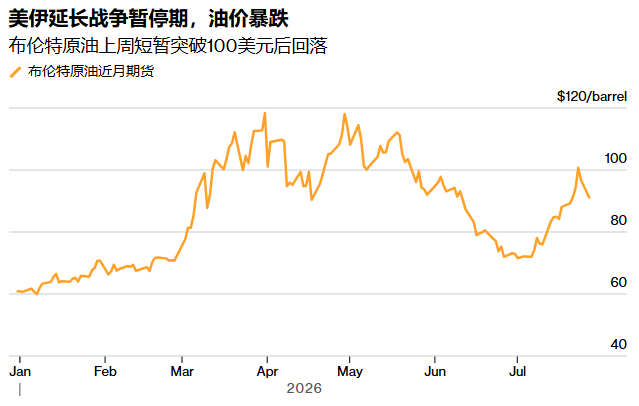
Even if the US suspends its attacks, the war in the Red Sea direction continues to spread. The Houthis in Yemen claim to have attacked three Saudi oil tankers within 48 hours and continue to impose a maritime embargo on ships linked to Saudi Arabia. Yanbu, Saudi Arabia — Saudi Arabia's main oil export port since the actual closure of the Strait of Hormuz, processes millions of barrels of crude oil every day — and Saudi Aramco's refinery and export terminal in Jizan are all threatened.
Saul Kavonic, senior energy analyst at MST Marquee, commented: “Reports of the suspension of the crackdown and progress in negotiations have raised expectations that the downgrade path will once again appear. However, all key issues, including Iran's control over the strait and its missile and nuclear programs, remain difficult to resolve, and any cease-fire will most likely only be temporary.”
Gold's rebound: from safe-haven suppression to easing inflation concerns
In sync with the sharp drop in oil prices, gold experienced a rebound after a long absence. Spot gold opened nearly $40 to $4096.33 per ounce, an increase of about 1%. Silver rallied even more sharply, rising more than 2.8% in the intraday period. The logical chain for the rise in gold is clear and straightforward: the suspension of the US-Iran conflict mitigated oil supply risks, and concerns about inflation cooled; the fall in oil prices also partially relieved the pressure on the Federal Reserve to raise interest rates. The US dollar index moved lower and fell 0.23% at one point.
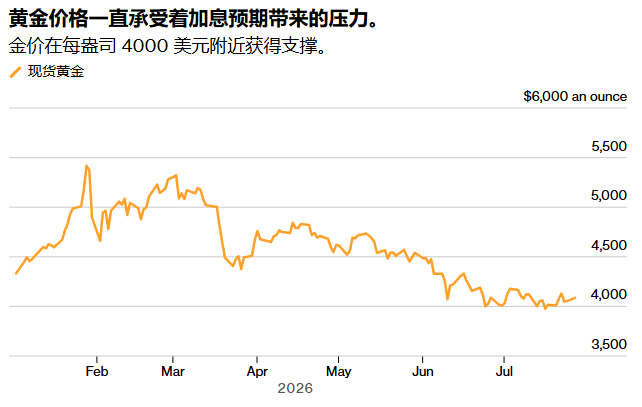
However, the room for a rebound in gold prices is still limited by multiple factors. Independent metals trader Tai Wong pointed out that although gold and silver appear to have bottomed out around $3,950 and $55, respectively, the possibility that the price will fall below these levels cannot be ruled out if the war escalates sharply. The probability that the Federal Reserve will raise interest rates during the year is still as high as 92%. Combined with Iran's sincerity about the cease-fire, the room for gold prices to rise in the short term is limited.
Since the outbreak of the US-Iran conflict at the end of February, gold has fallen by more than one-fifth from an all-time high of close to 5,600 US dollars per ounce. Near the current $4,000 mark, gold is in a continuous tug-of-war between “geopolitical inflation” and “interest rate hike expectations.”
Pricing basis: The Federal Reserve's “complex formula”
This sudden shift in geopolitics made this week's US Federal Reserve meeting even more confusing.
Just a few weeks ago — when the June CPI recorded its biggest monthly decline since April 2020 — the market's bet on the July rate hike was reduced to about 10%. However, in just a few weeks, the triple shock reversed this narrative: renewed fighting in the Middle East pushed Brent crude oil above $100, the Trump administration announced new tariffs of 10% to 12.5% on 60 countries, and the AI investment boom continued to drive demand. By the close of last week, federal funds futures showed that the probability of a 25 basis point rate hike this week had risen to about 36%.
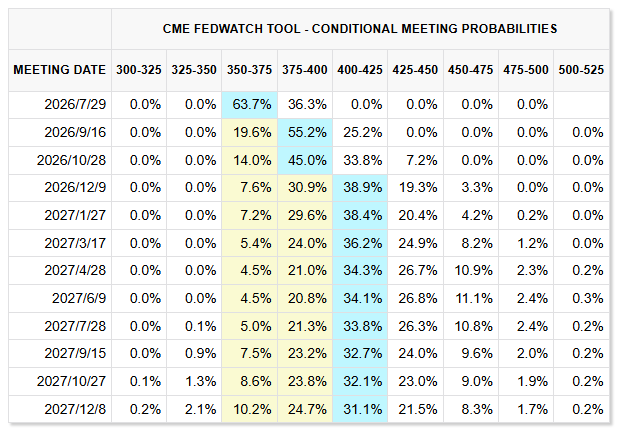
The sharp drop in oil prices on Monday certainly provided fresh ammunition for the rhetoric of staying still. But the problem is: the Federal Reserve is referring to June inflation data, not July's intraday oil price fluctuations. The previous sharp rise in oil prices has raised market concerns about the continuation of inflation, and the effects of the new round of tariffs and the AI investment boom on prices have not been fully taken into account. The analysis points out that this conference “is probably the most difficult to predict in many years.”
Hawkish power within the Federal Reserve has also accumulated to critical mass. Dallas Federal Reserve Chairman Logan and Cleveland Federal Reserve Chairman Hamak have both called for interest rate hikes, and both have the right to vote in this meeting. Citi expects that if there are more than two negative votes, it will be interpreted by the market as a stronger hawkish signal.
From July 28 to 29, the Federal Reserve will hold a policy meeting. The conference has been described by the market as “the hardest to predict in years.” Soaring oil prices and energy costs are driving up the risk of inflation, but recent US inflation and employment data are relatively moderate, which also provides a reason to keep interest rates unchanged. The upcoming interest rate decision by the Federal Reserve makes this game even more complicated. Although the sharp drop in oil prices has eased inflationary anxiety, expectations of interest rate hikes have risen sharply since oil prices have broken 100 previously. Under the intertwining of “geopolitical suspension” and “policy suspense,” global capital markets are entering the most uncertain week in recent years.