
Smart Decision Reference | Wait for the conference at the end of July to see if there are any incentives in real estate, consumption, infrastructure, etc.
[Editor-in-chief Guan Shi]
Hong Kong stocks continued to remain relatively stable last week. The background is the relative instability of A-shares and Korean stocks. It shows that venture capital favors a Hong Kong stock market with a high safety factor.
Trump suspended attacks on Iran on Saturday. Foreign media reported progress in the Strait of Hormuz negotiations. Over the weekend, Brent crude oil plummeted, falling back to 87 US dollars.
The Federal Reserve will announce the interest rate decision this Wednesday, and the market expects the federal funds rate target range to remain unchanged at 3.50% to 3.75%. We need to combine this week's latest inflation data to determine whether the Federal Reserve will make related actions in September next.
However, the most important thing this week is the Politburo meeting to be held at the end of July. According to general expectations, no major easing policies will be introduced, but it is not ruled out that there will be minor adjustments to see if there is any stimulus in real estate, consumption, infrastructure, etc.
The focus of the technology direction is Changxin Technology's listing on Monday. There is no limit on the rise or fall rate for the first 5 trading days after the IPO listing. As the latest “valuation anchor” of technology, its stability is the key, and ups and downs are not necessarily a good thing. Note that major companies such as SK, Samsung, Microsoft, and Meta will announce their results this week. With the lessons of Google last week, the market no longer anchors the increase in capital expenditure; instead, it is more focused on AI business revenue and customer order growth outperforming the pace of capital expenditure expansion, while the company's profit margin and free cash flow remain steady.
On the positive side, the San Francisco AI Summit in South Korea revealed a total five-year cooperation plan of 950 billion US dollars. Samsung Electronics and Broadcom: 200 billion US dollars, advanced storage + AI chip foundry intentions; SK Group (mainly SK Hynix) and US companies such as Nvidia, Microsoft, and Anthropic: 750 billion US dollars, HBM storage long-term supply cooperation intentions. This means that the US binds South Korea in the direction of continuing to develop AI.
On Friday, Wan Ning Wang issued a groundbreaking announcement. He plans to repurchase A-shares of 20 billion yuan to 40 billion yuan to cancel and reduce registered capital. The maximum repurchase limit is no more than 573 yuan/share, which is 49.6% higher than the current price. This is the largest stock repurchase plan in A-share history. It is quite powerful, and it is expected to trigger a good follow-up effect.
[This week's gold stocks]
Ctrip (09961)
Penalties have been implemented and are awaiting correction.
In the short term, the lodging business is in line with expectations. The front-end “Gold Special” logo was removed, but the original hotel cooperation logic has not changed much (the commission rate has not been significantly adjusted), and the new hotel no longer has exclusive channels such as low prices. Revenue expectations were lowered in 26Q2 mainly because domestic transportation business fell short of expectations due to rising fuel costs, and the lodging business was in line with expectations. Furthermore, the decline in profit margins in 26Q2 was a diluting effect of high overseas growth. The summer reservation situation is currently average, and the hotel group's RP performance is under slight pressure. The accommodation business is expected to have room for adjustment. Hotels have always had demand for Ctrip's high-quality user traffic & excellent service, and will subsequently or gradually generate revenue through innovative transaction models such as products and advertisements.
In the long run, Ctrip's competitiveness has not been fatally impacted, and there is plenty of room for growth overseas. At present, Ctrip's domestic business has reached a mature state, and the rate of increase in the online rate is slowing down. The domestic market is expected to remain slightly higher than the growth rate of the general tourism market (increased overnight stays, stable traffic, and higher outbound growth rate than domestic travel). With a domestic profit forecast of 20 billion yuan and conservative 12XPE, it can support a market value of at least HK$270 billion. The growth rate of pure overseas revenue is currently maintaining a high growth rate of 50% +, and the loss rate is shrinking. If we only look at the Asia-Pacific market according to Tianfeng Securities estimates, the profit margin for overseas business in other markets such as Europe and the US will be even greater.
[Industry Watch]
The disturbance at the Chilean mine side exceeded expectations, and non-US copper stocks were once again tight.
Inventory side: Global copper inventories decreased by 41,000 tons this week, including SHFE stocks decreased by 11,000 tons, social stocks decreased by 11,000 tons, LME copper stocks decreased by 20,000 tons, and COMEX copper stocks increased by 12,000 tons;
Supply side: A strong winter storm recently hit central Chile, causing many deaths. Bad weather has affected some large-scale copper operations, and port ship navigation has also been restricted. Chile's copper production declined by 200,000 tons year on year in January-May, mainly due to declining grade and insufficient plant selection capacity. Overall, copper production declined by more than 500,000 tons in the first half of this year, and Chile's production in the second half of the year may still not be up.
Demand side: We are entering the peak season for gold, nine, and silver. Domestic social treasury and exchange inventories have fallen to low levels in the same period of previous years. Non-US inventories are once again tense. It is not ruled out that the second half of the year will be tight.
Recommended attention: China Gold International (02099), Molybdenum (03993), China Nonferrous Mining (01258), Minmetals Resources (01208), etc.
[Data View]
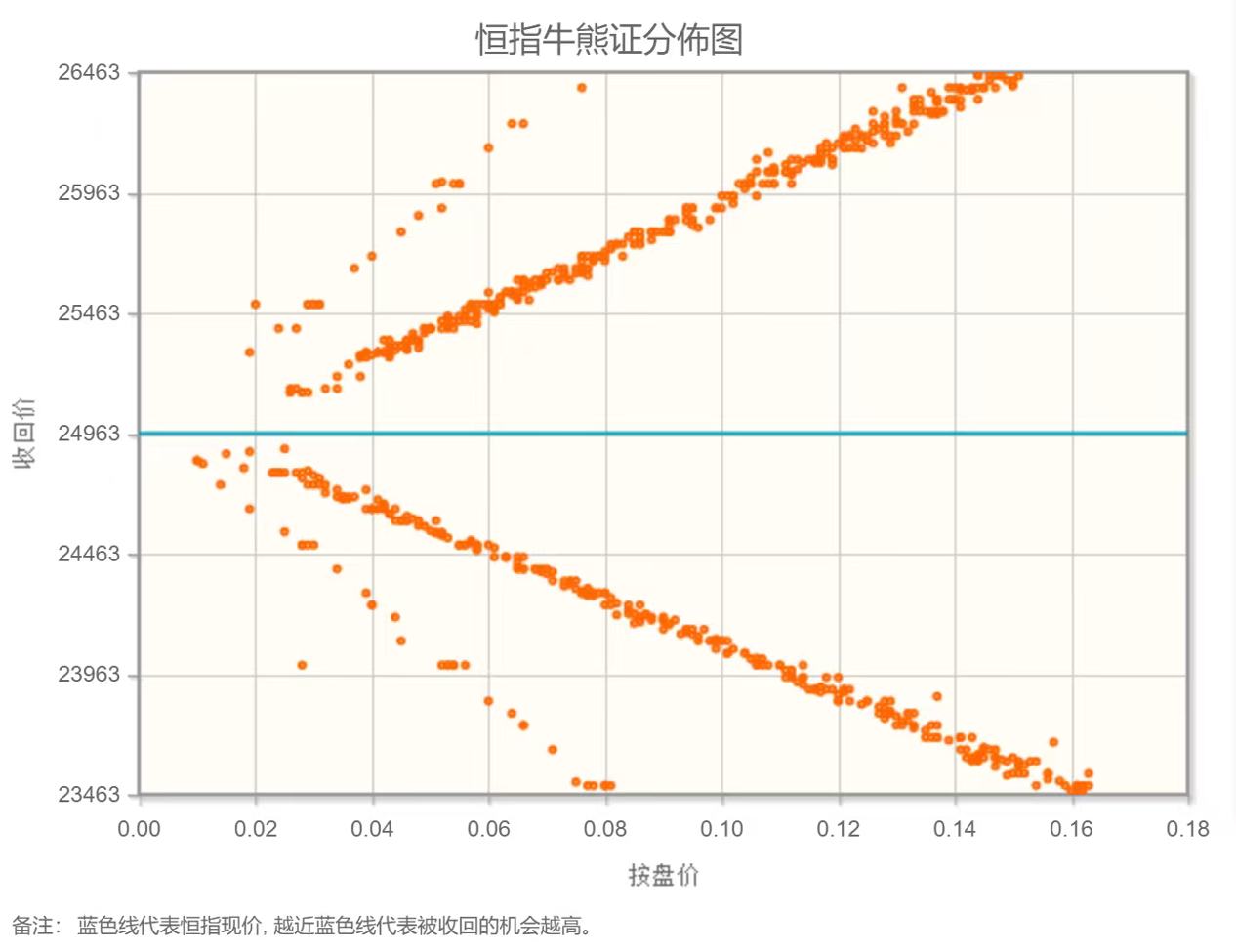
According to data released by the Hong Kong Stock Exchange, the total number of outstanding contracts in the Hang Seng Futures Index (July) was 120,460, and the net number of outstanding positions was 49,860. Hang Seng Futures refers to the settlement date of July 30, 2026.
The Hang Seng Index is at 24,963 points. The area where bullish stocks are concentrated below is close to the central axis, the upper bears deviate, and Hong Kong stocks are motivated to go short. US bond yields all hit new highs since April 2024, and sounded the alarm for financial stability. The data suggests that the Hong Kong stock Hang Seng Index is bearish this week.
[Editor-in-Chief's Testimonial]
The index continues to pull around 25,000 points. Upwards, it lacks continuous incremental capital resonance, and downwards, it is underpinned by undervalued assets and high dividend assets, making it difficult to develop a one-sided market.
The mid-reporting season is about to begin. The upward momentum of profit expectations has cooled down the first, and the market is shifting from “speculating on expectations” to “testing results.” Non-ferrous, non-silver, and electronic expectations are among the highest, and the consumer sector is still under pressure. At the same time, the biggest wave of unban lifting in history and the continued expansion of IPOs created double pressure on supply, and market differentiation further intensified: core assets with performance support can be absorbed by shareholders to absorb pressure, while pure concept stocks that lack fundamentals will continue to return in valuation.
On the capital side, south-bound capital has returned from trend tracking to take on dips, the pace of inflows of foreign capital has slowed, and the characteristics of stock games are obvious. Allocation still needs to be addressed in a balanced manner. High-dividend assets establish a firm base, and growth directions such as technology and innovative pharmaceuticals need to be confirmed by the dual signals of performance and liquidity. This week is more suitable for patient observation, waiting for the resonance signals of FOMC, PMI, and transaction volume before making directional decisions.