
Does Par Pacific Holdings (PARR) Still Look Undervalued After A 372% Run?
Par Pacific Holdings has delivered a very strong share price run over the last several years, yet the current valuation checks still lean toward the stock looking inexpensive rather than stretched.
- Over the past 5 years, Par Pacific Holdings has returned 372.5%, which puts a spotlight on whether the current share price already reflects much of the company’s progress.
- Expectations for the company’s ability to keep converting operations into cash flow can support the current valuation, while any pressure on refining margins or balance sheet strength may weigh on what investors are willing to pay.
- On Simply Wall St’s broader checks, Par Pacific Holdings screens as undervalued in 5 of 6 areas, and the value score of 5 suggests the overall picture still leans cheap rather than fully priced in.
The stock’s next move may depend on whether that strong historical return and high value score together indicate genuine undervaluation or a market that is already paying up for Par Pacific Holdings’ strengths.
Does Par Pacific Holdings Look Undervalued on Earnings?
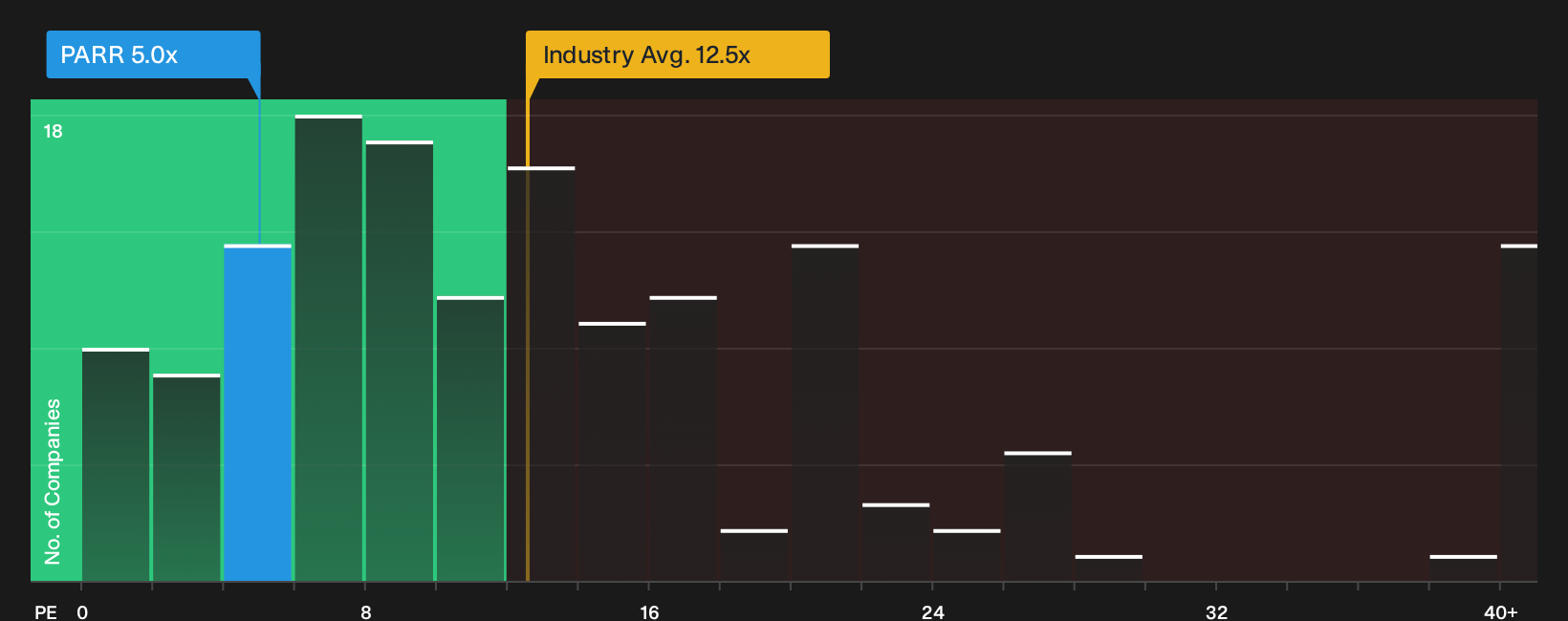
The P/E ratio is a useful way to see how much investors are paying for each dollar of Par Pacific Holdings earnings. On this measure, Par Pacific Holdings trades on about 8.5x earnings, which is well below the broader oil and gas industry average of roughly 14.3x and the peer group average of about 16.1x.
The fair P/E ratio from Simply Wall St’s model, which adjusts for the company’s growth profile, margins, size and risk, sits higher at around 12.9x. Compared with this fair multiple, Par Pacific Holdings current P/E implies that the market is applying a discount rather than pricing the stock at a premium to its fundamentals.
Overall, the relatively low P/E against both the industry and the modelled fair multiple indicates that Par Pacific Holdings stock may be undervalued on an earnings basis.
See what the numbers say about this price — find out in our valuation breakdown.
The Par Pacific Holdings Narrative: What Would Justify Today's Price?
Simply Wall St’s Narratives for Par Pacific Holdings link the valuation puzzle to specific views about where Par Pacific Holdings' growth, margins and earnings might head next, setting out clear cases in which the stock could be worth materially more or less than today’s price on the Community page. Each narrative connects its implied number to a concrete view of how growth, profitability and key risks might evolve, giving you a reference point you can revisit as new information comes through.
Community views on Par Pacific Holdings sit far apart, with one camp seeing the stock as roughly fairly valued and the other flagging it as 18% overvalued.
Bull case: roughly fairly valued
"The strategic partnership with Mitsubishi and ENEOS, along with the upcoming SAF (Sustainable Aviation Fuel) project launch, positions Par Pacific for growth in renewable fuels…"
Read the full Bull Case to see why Par Pacific Holdings could be undervalued
Bear case: 18% overvalued
"Rapid acceleration in electric vehicle adoption, especially as major automakers scale up affordable EV models, is set to sharply decrease gasoline and diesel demand in the coming decade…"
Read the full Bear Case to see why Par Pacific Holdings could be overvalued
Do you think there's more to the story for Par Pacific Holdings? Head over to our Community to see what others are saying!
The Bottom Line
Par Pacific Holdings screens as undervalued on earnings multiples, and the broader valuation checks point in the same direction rather than flagging the stock as fully rerated. After such a strong move in the share price, the key question is whether the current discount reflects lingering concern about refining cycles and long term fuel demand, or whether the market is still underestimating the company’s ability to turn its assets into durable cash flow. For now, the crux of the bull versus bear debate is whether refining margins and energy demand trends hold up well enough for that valuation gap to close rather than widen.
This article by Simply Wall St is general in nature. We provide commentary based on historical data and analyst forecasts only using an unbiased methodology and our articles are not intended to be financial advice. It does not constitute a recommendation to buy or sell any stock, and does not take account of your objectives, or your financial situation. We aim to bring you long-term focused analysis driven by fundamental data. Note that our analysis may not factor in the latest price-sensitive company announcements or qualitative material. Simply Wall St has no position in any stocks mentioned.
Have feedback on this article? Concerned about the content? Get in touch with us directly. Alternatively, email editorial-team@simplywallst.com