
CICC: AI capital expenditure spawns $3.5 trillion in financing requirements, debt repayment capacity is a key test
The Zhitong Finance App learned that CICC released a research report saying that AI capital expenditure is rapidly expanding. The capital expenditure ratio of large cloud vendors may rise from 12% in 2023 to more than 40% in 2027, generating external financing requirements of about 3.5 trillion US dollars over the next five years, mainly covered by investment-grade bonds and private equity capital. The core challenge is that AI applications need to generate an annual revenue of about 1 trillion US dollars to cover debt costs, a profit margin of about 50%, and a depreciation period of about 5 years. The bank estimates that the maturity of large cloud vendor bonds in 27-32 reached a peak, with an annual maturity scale of about 28 billion US dollars. Compared with 24-26, this is a 60% increase, and the pressure to refinance has increased.
CICC's main views are as follows:
AI infrastructure capital expenditure: from cash flow to debt
The share of capital expenditure of large cloud vendors as a share of revenue rose from about 12% in 2023 to about 23% in 2025. According to market consensus expectations, this ratio may further rise to more than 40% in 2027, approaching or even exceeding the historical capital expenditure cycle of the Internet and energy industries. Under the pressure of AI capital expenditure, cloud vendor AI investments may shift from operating cash flow to more reliance on external financing. Based on consistent market expectations for cash flow and capital expenses of large cloud companies, AI capital expenditure is expected to generate about $3.5 trillion in external financing requirements over the next five years.
Where did $3.5 trillion come from?
Under the benchmark scenario, we expect external financing of $3.5 trillion of AI capital expenditure to be covered by open market equity (USD 0.4 trillion), investment-grade bonds (USD 1.5 trillion), leveraged financing (USD 0.3 trillion), asset securitization products (USD 0.3 trillion), and private equity (USD 1.1 trillion), respectively. Among them, investment-grade bonds and private equity capital are ballast stones for financing. The former relies on cloud vendor balance sheet expansion and cash flow repayment capacity, while the latter can meet the financing needs of high-risk and large-scale projects. It can also reduce cloud vendor capital investment through off-balance sheet financing structural design and supplement financing gaps more flexibly.
The trillion-dollar question: How can AI debt be paid?
To meet debt repayment requirements and shareholder returns, assuming an ROIC of 10%, we estimate that AI applications will ultimately need to generate around $1 trillion in sustainable revenue per year. Assuming that revenue scale is reached by 2030, this means AI application revenue will need to nearly double every year for the next 5 years. What is more important than revenue size is profit margin and asset life: with a mature EBITDA profit margin of about 50%, the investment can only be expected to receive a positive return when the infrastructure depreciation period reaches about 5 years; if the profit margin is less than 20%, it is difficult to cover capital costs even if the asset life span is long.
Can refinancing replace cash flow?
Long-term bonds issued by large cloud vendors can usually reach 10-30 years, and infrastructure funds often have an investment period of 10 years or more; after the data center is put into operation, it is also possible to replace the construction period with project bonds and securitization. However, refinancing can only buy time; it cannot replace cash flow: if project utilization, profit margin, and asset life fall short of expectations for a long time, continuous rolling financing will instead drive up leverage and financing costs. We estimate that the maturity of large cloud vendor bonds in 27-32 reached a peak, with an annual maturity scale of about 28 billion US dollars. Compared with 24-26, this is a 60% increase, and the pressure to refinance has increased.
Opportunities and risks for financial institutions
Banks can earn income from equity underwriting, transactions, M&A advisors, and project finance, while private equity and insurance institutions can obtain new long-term assets. In the second quarter of 2026, the non-interest income of the six largest US banks increased 32% year on year; as of June 2026, bank loans to non-bank financial institutions increased by about 25% year on year, and AI financing was an important increase. Banks' revenue is often confirmed during the financing and construction stages, while credit risk does not become apparent until the project is put into operation and refinancing, showing the characteristics of “revenue ahead and risk behind”.
Is AI a financial “bubble”?
Currently, AI investors are still mainly large cloud vendors with strong cash flow, and equity and secondary capital can also absorb losses before banks prioritize loans. Therefore, even if the return of some projects falls short of expectations, the risk is more likely to first manifest as valuation adjustments, capital expenditure slowdown, and partial credit loss of relevant enterprises, rather than immediately turning into a financial system crisis. However, on the other hand, the rapid growth of external financing, especially private equity capital and leveraged financing, has also formed a financial spillover effect. If commercial growth continues to be slower than capital expenditure, risk will gradually shift from valuation pullback to deterioration in credit quality, and will be transmitted through channels such as revolving financing, private equity, and securitization in the financial system. The scale of financing itself is not the problem; the real test is whether a cash flow cycle can be formed before financing costs rise and assets depreciate.
Chart 1: Where did the $3.5 trillion AI funding come from?
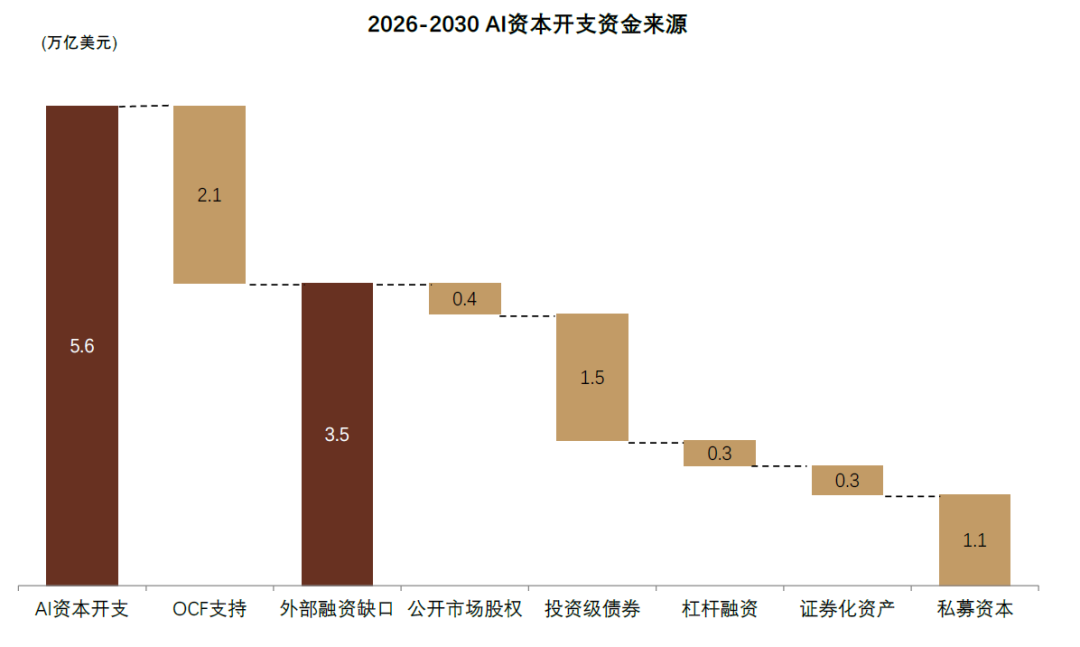
Note: AI capital expenditure and OCF support are based on consistent market expectations; assuming an open market equity ratio of 10%; investment grade bond issuance scale is based on large cloud vendor debt ratings, leverage ratios and bond concentration constraints; leveraged financing includes high-yield bonds and leveraged loans, and securitized assets include ABS and CMBS, taking into account market capacity and acceptance estimates; gaps other than the above forms of financing assume the use of private equity capital commitments, including infrastructure funds, private equity funds, real estate funds, etc. Demonstrative estimates do not represent actual predictions
Source: Listed Company Announcements, Bloomberg, CICC Research Division
risk
The commercialization of AI fell short of expectations, AI capital expenditure and financing requirements fell short of expectations, and capital market financing conditions were tightened.