
Is Eramet (ENXTPA:ERA) Cheap After Its Gabon Manganese Partnership?
Why Eramet’s Gabon manganese agreement matters for shareholders
The latest move by Eramet (ENXTPA:ERA) is a memorandum of understanding with Gabon that sets out a long-dated roadmap for processing manganese ore locally, with several industrial and infrastructure projects under study.
The plan covers potential new manganese oxide and alloy plants in Gabon, a possible revamp of the Moanda Metallurgical Complex, and supporting energy and logistics work that would be needed to process up to 700 kt of ore each year by 2031.
See our latest analysis for ERAMET.
For context, Eramet’s 1 day share price return of 1.71% sits against a weaker backdrop, with the 30 day share price return down 15.30% and the 1 year total shareholder return down 23.26%. This suggests momentum has been soft even as this Gabon agreement reshapes the medium term story.
If you are weighing Eramet’s news against other raw materials opportunities, it could be worth scanning rare earth and related miners using our screener of 29 best rare earth metal stocks
Bulls see Eramet using the Gabon roadmap and recent share price weakness to set up a value opportunity, while bears point to ongoing losses and project risk. Which side does the current valuation framework support next?
Preferred Price-to-Sales of 0.4x: Is it justified for Eramet?
Eramet’s valuation screens as inexpensive right now, with the stock trading at a P/S of 0.4x while also sitting well below some modelled fair value estimates.
The P/S multiple compares the company’s market value to its annual revenue, which can be useful for a group like Eramet that is currently loss making. It focuses attention on how much investors are paying for each euro of sales rather than earnings that are still in the red.
Based on Simply Wall St’s checks, Eramet’s current P/S of 0.4x is described as good value in several ways. It is below the peer average of 0.9x and below the wider European Metals and Mining industry average of 1.1x. This implies the market is pricing Eramet’s €2,789.0m revenue at a discount to similar stocks. The stock is also assessed as good value relative to an estimated fair P/S ratio of 2.3x. This suggests there is a substantial gap between where the market is today and a level the ratio could move towards if sentiment or results shift.
In addition to that multiple-based view, the SWS DCF model values Eramet at €83.52 per share based on projected future cash flows, compared with the last close of €42.90. That framework also indicates Eramet is trading at a 48.6% discount to an internally estimated fair value, and analysts are in broad agreement with a €53.00 price target that sits above the current price. Readers should always review the underlying assumptions for themselves.
Explore the SWS fair ratio for ERAMET
Result: Price-to-Sales of 0.4x (UNDERVALUED)
However, Eramet’s current losses and the long timeline to potentially process 700 kt of ore in Gabon create execution and profitability risks that could challenge the bullish case.
Find out about the key risks to this ERAMET narrative.
Another View on Eramet’s valuation
The P/S ratio presents Eramet as relatively inexpensive, and the SWS DCF model also points to value, with an estimated fair value of €83.52 per share versus a market price of €42.90. Both methods indicate potential undervaluation, so the key question is whether future cash flows will materialise as expected.
Look into how the SWS DCF model arrives at its fair value.
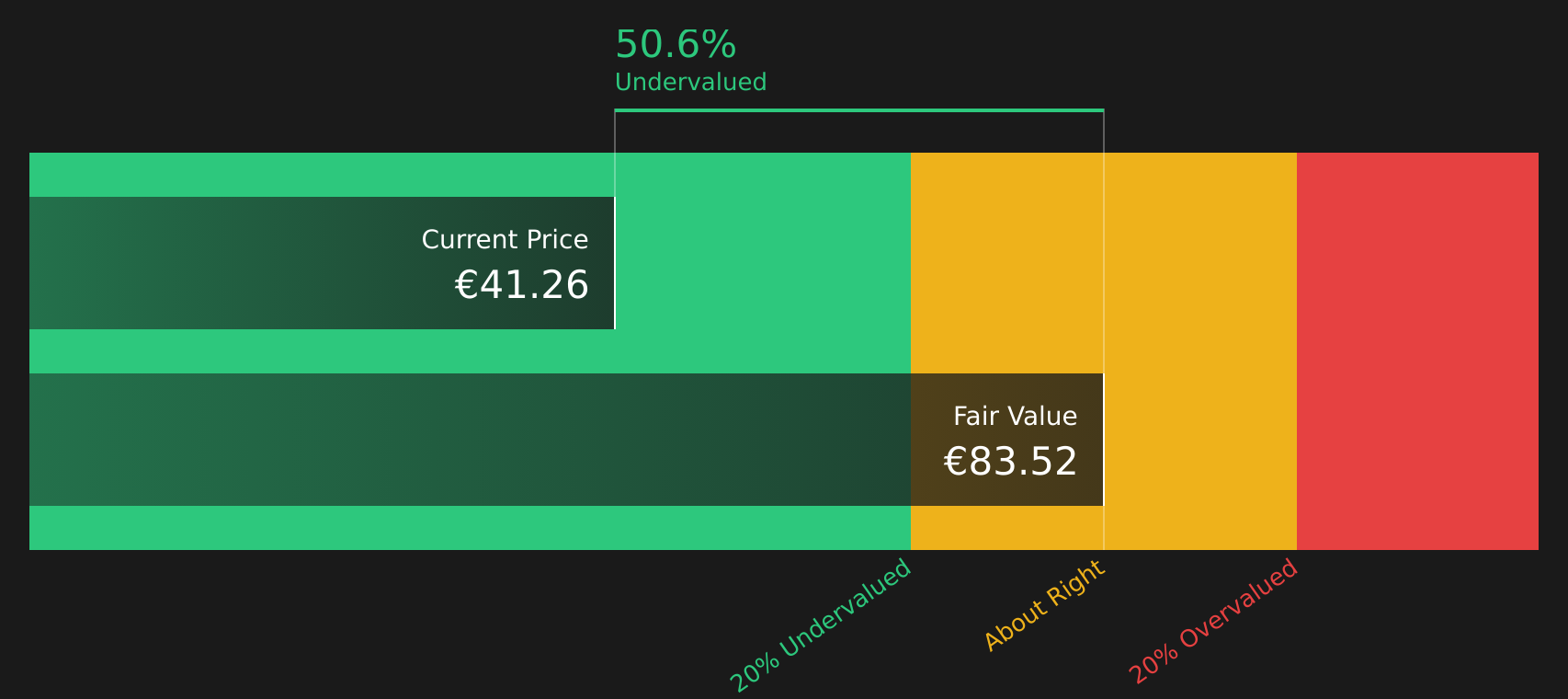
Simply Wall St performs a discounted cash flow (DCF) on every stock in the world every day (check out ERAMET for example). We show the entire calculation in full. You can track the result in your watchlist or portfolio and be alerted when this changes, or use our stock screener to discover 235 high quality undervalued stocks. If you save a screener we even alert you when new companies match - so you never miss a potential opportunity.
Next Steps
Given the mixed signals around Eramet’s valuation and project risks, it may be useful to promptly review the underlying figures, starting with the 4 key rewards and 1 important warning sign.
Looking for more investment ideas beyond Eramet?
If Eramet has sharpened your focus on valuation and risk, it can be useful to broaden your watchlist with other stocks that line up with your goals.
- Target potential mispricings by scanning companies that combine quality fundamentals with appealing valuations through the screener containing 512 high quality undiscovered gems.
- Prioritise resilience by reviewing the 294 resilient stocks with low risk scores built to spotlight stocks with lower overall risk profiles.
- Focus on balance sheet strength by using the solid balance sheet and fundamentals stocks screener (420 results) to highlight companies with sturdier finances.
This article by Simply Wall St is general in nature. We provide commentary based on historical data and analyst forecasts only using an unbiased methodology and our articles are not intended to be financial advice. It does not constitute a recommendation to buy or sell any stock, and does not take account of your objectives, or your financial situation. We aim to bring you long-term focused analysis driven by fundamental data. Note that our analysis may not factor in the latest price-sensitive company announcements or qualitative material. Simply Wall St has no position in any stocks mentioned.
Have feedback on this article? Concerned about the content? Get in touch with us directly. Alternatively, email editorial-team@simplywallst.com