Earnings Preview | Alphabet (GOOGL.US) kicks off the “Big Seven” Q2 earnings season, can 100 billion AI gambling reap the rewards?
The Zhitong Finance App learned that Google's parent company Alphabet (GOOGL.US, GOOG.US) will announce its second-quarter earnings report after the US stock market on July 22 (Wednesday) EST, and Tesla (TSLA.US) will announce its results on the same day, kicking off the “Big 7” earnings season for US stock technology.
As one of the “supercloud service providers” with the largest investment in AI infrastructure in the world, Alphabet's performance and capital expenditure guidelines are seen as a key weather vane for observing the direction of global AI transactions. Currently, the AI sector of US stocks is expected to be clearly divided, and the main line of the market game is shifting from the previous “shortage of computing power” to “hidden worries about overcapacity.” Investors are highly wary of whether Alphabet will send a signal to cut AI investment budgets; any such adjustments could trigger a chain reaction throughout the AI industry chain.
In terms of performance, the market currently generally expects Alphabet Q2 revenue to be US$116.98 billion, up 21% year on year; earnings per share will be 2.91 US dollars, up 26% year on year. Alphabet's profit for the last quarter greatly exceeded expectations, but it included a large amount of non-operating investment income. The market expects this financial report to provide a more clear path for core business growth.

The search and cloud business remains Alphabet's core growth driver. According to Zacks data, the market expects Q2 advertising revenue to be US$81.68 billion, up 14.5% year on year; cloud business revenue is US$22.79 billion, up 67.3% year on year.
The biggest question in the market: Can a 100 billion dollar gamble bring rewards?
The core anxiety of the market is centered on how Alphabet's unprecedented AI capital expenditure matches its ability to deliver return on investment. The company has raised its capital expenditure cap to $190 billion for the full year of 2026, and management has made it clear that the 2027 capital expenditure scale will increase significantly from this year.
Unlike Microsoft and Meta, where revenue and profit did not improve simultaneously after capital expenditure was raised, Alphabet's high investment in the first quarter has already achieved a double increase in revenue and profit margins. According to the data, Alphabet's revenue for the first quarter was US$109.9 billion, up 22% year on year, achieving double digit growth for the 11th consecutive quarter; operating profit was US$39.7 billion, up 30% year on year, and operating margin expanded from 33.9% to 36.1%.
Despite this, market concerns are growing. On the one hand, the supply of computing power in the industry continues to expand, and the “computing power shortage” narrative recedes, and the market is beginning to worry about the risk of overcapacity in AI computing power; on the other hand, recent market rumors suggest that the release of Gemini 3.5 was delayed due to code capacity flaws, compounding the industry's power and memory hardware bottlenecks to drive up cost inflation, further amplifying investors' concerns about the efficiency of AI investment. Previously, the risk that the market was most concerned about was excessive investment in AI. Once this financial report shows signs that capital expenditure is shrinking and AI transformation falls short of expectations, the valuation of the entire AI industry chain will be under pressure.
Investors no longer only focus on revenue growth, but also urgently need implementable and verifiable evidence of AI return on investment: whether high computing power investment can continue to be converted into incremental revenue for advertising and cloud businesses; whether backlog orders can be successfully converted into revenue after the new computing power production capacity is launched, and the expansion of operating leverage and profit margins continues to be maintained. Only if the search and cloud sectors simultaneously verify AI commercialization dividends can dispel the market's doubts about the return on 100 billion AI investment and open up room for upward valuation.
Advertising business: AI reshapes the search moat and transforms the crisis into a revenue engine
The past year has seen a fundamental shift in the market's assessment of AI-related risks in Alphabet's core search advertising business. Previously, the market had long feared that generative AI would divert search traffic and erode advertising revenue, but now the core question has become: can AI raise the overall economic efficiency of search platforms from the bottom up and broaden monetization boundaries.
According to the data, Alphabet's search and other advertising revenue in the first quarter was US$60.4 billion, up 19% year over year. Strong data has largely dispelled the market's initial concern: generative AI won't disrupt the Google search ad moat from the bottom up.
Alphabet search and other ad revenue
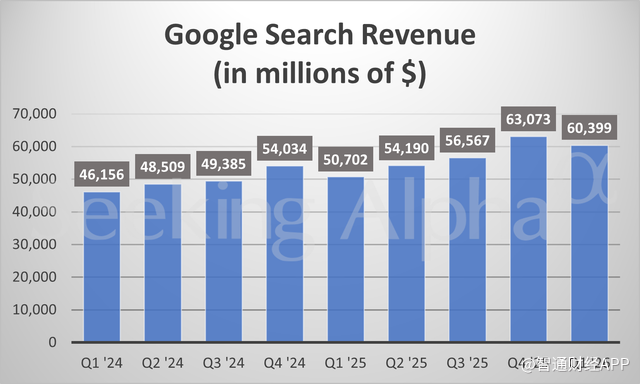
Brilliant data mainly comes from AI overviews in native search and the popularity of AI search models, and users can initiate more complex and personalized search requirements. This also allows Google to push ads with a higher degree of matching, and advertisers' conversion rate and return on advertising investment (ROAS) simultaneously increase. These two metrics are the core standards that advertisers value the most.
As a result, before the second-quarter earnings report was released, the core question of the market had completely changed: no longer struggling with whether AI would divert revenue from the search business, but rather focusing on whether AI could fundamentally raise the overall profit level of search platforms.
Google management recently revealed that after the implementation of the AI function, the total number of personalized search requests continued to rise, and users' demand for intelligent search tools surged. This has also created a new opportunity for Google to capture more search requests with commercial conversion intentions. According to the latest industry data, the AI search model has carried nearly one-third of Google's commercial search needs. Relying on AI's in-depth analysis of users' real needs, Google has drastically shortened the link between users “discovering products” to “completing order conversion”, which is expected to continue to increase advertisers' advertising returns and consolidate Google's share advantage in the continuously expanding digital advertising market.
In addition to revenue growth, investors will also be concerned about whether AI can reduce costs and increase the efficiency of the search business. The AI search function will bring additional computing power and electricity costs, and this problem is becoming more and more critical. However, Google has achieved large-scale efficiency optimization. This is directly evidenced by the fact that the operating profit margin of the Google service sector has continued to rise month-on-month and year-on-year in recent quarters. The steady increase in profit margins also reflects the cost optimization dividends brought by AI.
Management revealed that since the AI overview and AI search model were upgraded to the Gemini 3 major models, the cost of a single AI search response has been reduced by 30%. Relying on self-developed hardware and model iteration, the profit growth of Google's core search business is continuously supported.
Monetization channels have been broadened and superimposed costs have been continuously optimized, and artificial intelligence has further strengthened the Google search advertising moat. The track has plenty of room for long-term growth: digital advertising currently accounts for 69% of total global advertising spend. Although the industry predicts that search ad revenue growth will fall back to the middle single digit range by 2027, AI can help Google break into high commercial value circuits such as retail media. Retail media ad spend is expected to maintain a low double-digit growth rate through 2027, making it one of the fastest growing segments in the digital advertising sector.
Cloud business: Can the in-depth layout of full-stack AI steadily increase the overall return on investment?
Although the search business is still Alphabet's core profit pillar, the growth of the cloud business is the most intuitive reflection of the incremental revenue and commercialization brought about by AI transformation.
The fundamental performance of the cloud business in the first quarter was impressive: operating profit tripled year on year, profit margin increased to 32.9% from 17.8% in the same period last year, while revenue exceeded 20 billion US dollars, a year-on-year growth rate of 63%. At the same time, the backlog of orders also doubled month-on-month, surpassing 460 billion US dollars. Additionally, the number of new cloud customers has doubled, and high-value transactions with contract amounts between $100 million and $1 billion have also doubled from the previous year.
Alphabet's cloud revenue surpassed $20 billion in the first quarter
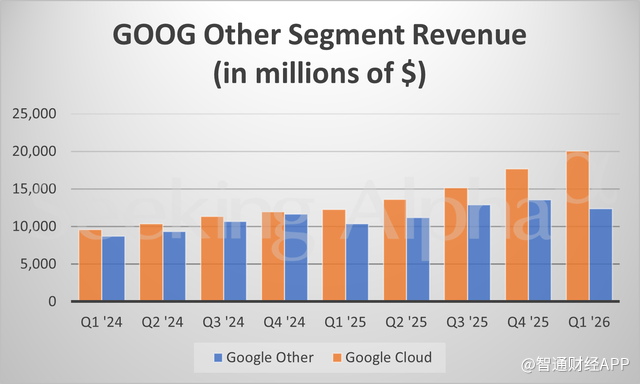
Alphabet's unique full-stack self-developed AI system builds core barriers: the infrastructure layer covers the Gemini closed-source cutting-edge model and the Gemma open source model; the enterprise application layer is equipped with the Gemini enterprise version. The entire industry chain realizes integrated optimization of computing power, models, and applications. It has significant unit cost advantages in large-scale intelligent agent inference scenarios, which is different from general third-party computing power vendors.
The core question in the current market is whether Alphabet's cloud business can continue to have high growth and high profit margins. Previously, strong cloud business orders were essentially constrained by the supply of computing power. As the company's capital expenditure of 100 billion dollars released a large amount of additional computing power, whether backlog demand can continue to be fulfilled and whether order conversion can steadily drive revenue and profits will directly determine the long-term visibility of AI investment returns. At the same time, the deployment of industry computing power clusters is facing bottlenecks in the supply of electricity and memory, and hardware costs continue to rise. Management is also warning that AI-related operating costs and depreciation pressure will rise. Whether the cloud business can withstand cost pressure and maintain the continuous expansion of profit margins is a top priority in this financial report.
If cloud business revenue and profit margins continue to exceed expectations in the second quarter, it will effectively hedge against market concerns about excessive AI production capacity and insufficient return on investment, and become a core catalyst supporting stock valuation.
Summary: The market is waiting for Alphabet to respond, and Wall Street analysts are still optimistic
Alphabet's stock price has risen nearly 14% since this year, continuing to outperform its peers and the market of hyperscale cloud vendors. The core support comes from the continued high growth in the cloud business and the resilience of the traditional search base market.
However, Alphabet's annual capital expenditure of up to 190 billion US dollars is a double-edged sword: the full-stack AI product matrix is expected to continue to broaden the advertising and cloud business growth ceiling, but huge investment also brings potential risks of overcapacity and falling short of expectations. Combined with competitive pressure that Gemini's iteration schedule falls short of expectations, this financial report has become a key verification window.
If revenue growth and profit margin improvements are realized simultaneously, it will fully prove that 100 billion AI investments have sustainable commercial returns and drive valuations to rise again; conversely, if AI commercialization data weakens, the market may reprice AI investment risks.
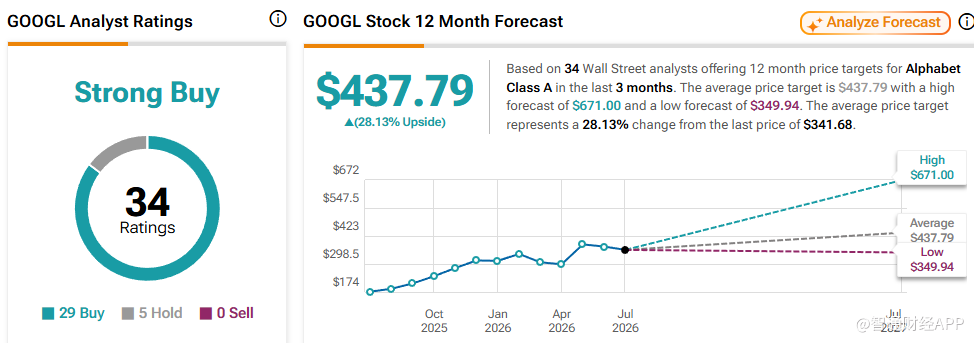
Overall, Wall Street analysts are still optimistic about Alphabet, giving it a “strong buy” rating. The average target price is 437.79 US dollars, which is 28% higher than the latest closing price.