
HSBC warns global stock market momentum trading faces a greater pullback and is optimistic about consumer, banking and cyclical stock rotation opportunities
The Zhitong Finance App learned that the latest strategy report released by HSBC indicates that momentum trading, which has dominated global stock market performance since this year, is facing the risk of a larger correction, and the future market style is expected to rotate further towards cyclical stocks and value stocks. The bank advises investors to increase the allocation of US optional consumer, banking sector, and European and emerging market cyclical stocks.
HSBC said that the global multi-air momentum factor it is tracking has dropped 15% cumulatively in the past three weeks, but historical experience shows that after a cumulative increase of 20% in the momentum factor, the relevant pullback usually lasts for about six months, so the current deceleration process may not be over yet.
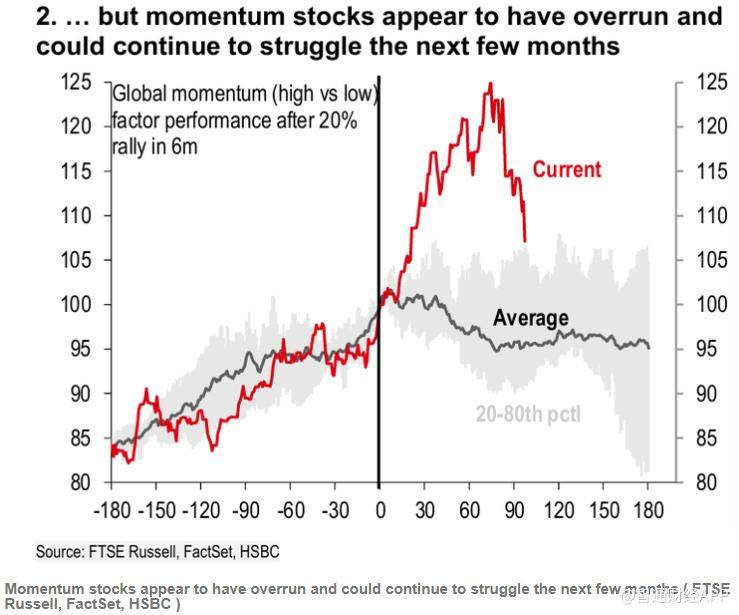
The report points out that this round of the market is particularly special. After rising 20%, the momentum factor surged further by about 25%, making it one of the strongest increases in history, making it more likely to experience a continuous and larger correction.
However, HSBC believes that although the concentration of global stock market indices is still close to historic highs, the market breadth is improving. Since this year, weighted indices such as the US S&P 500, weighted indices such as emerging markets, and weighted indices such as Europe have risen by about 12%, 5%, and 10%, respectively, indicating that the upward trend has gradually spread from a few tech giants to more industries.
HSBC believes that this market rotation is expected to be supported by the “five pillars”, including corporate profits, central government policies, capital expenditure, consumer demand, and capital inflows.
In terms of corporate profits, HSBC notes that the market has underestimated the possibility that profit growth will spread to more industries. Although the market generally expects the S&P 500's profit to increase 23% year-on-year this year, and the growth is mainly concentrated in the technology and energy sectors, the increase in profit expectations of US companies has risen to 73%, the highest level since 2021, and is in the top 20% ranking in history since 2000, indicating that the market still has early economic cycle characteristics.
In terms of monetary policy, HSBC believes that the current market has basically absorbed the Fed's further hawkish policy expectations. The pricing probability for future interest rate hikes of 25 or 50 basis points is about 35%, and there is limited room for further hawkish expectations to heat up, which will benefit cyclical sector performance.
Consumer demand is also an important support for market rotation. HSBC pointed out that the US job market is still stable, consumer confidence in high-income groups has improved markedly, and the upcoming FIFA World Cup is expected to further stimulate consumer activity.
On the financial side, HSBC believes that the market has sufficient liquidity to absorb record IPOs and financing volumes. Since this year, US listed companies have announced about 850 billion US dollar share repurchase plans, while US ETFs have attracted a total inflow of about 550 billion US dollars. HSBC predicts that in 2026, the net share repurchase scale of US companies is still expected to reach about 700 billion US dollars, which is basically the same as in 2025.
In terms of specific configuration, HSBC is optimistic about the US optional consumer sector (XLY.US), and points out that after excluding Amazon (AMZN.US) and Tesla (TSLA.US), the expected price-earnings ratio for the next 12 months is only 16.6 times, which is the lowest 10% in history since 2015.
In addition, HSBC is also optimistic about the Bank of America sector, which has benefited from strong performance, and European cyclical industries that have previously underperformed, including aviation, hotels, luxury goods, and defense sectors.
In terms of emerging markets, HSBC focuses on recommending investment opportunities in South Africa, Chile, and Central and Eastern European markets that benefit from the recovery of the economic cycle. At the same time, it believes that the Brazilian and Turkish stock market valuations are highly attractive. Recent performance is clearly weaker than fundamentals, and there is room for value restoration.