
The New Zealand Federal Reserve's interest rate hike made it difficult to stop the bears: the recovery in oil prices added economic headwinds, and hedge funds pushed the NZD net short position to a record high
The Zhitong Finance App learned that the New Zealand Federal Reserve's hawkish interest rate hike failed to stop hedge funds' bearish bets on the New Zealand dollar from reaching a record high. For the week ending July 14, the US Commodity Futures Trading Commission (CFTC) data showed that leveraged funds' net short positions against the New Zealand dollar increased to 29,582 contracts, an increase of 1,907 over the previous week, the highest since the agency began publishing relevant data in 2006. Although asset managers cut their net short positions during the same period, their overall bearishness is still close to the high level since December last year.
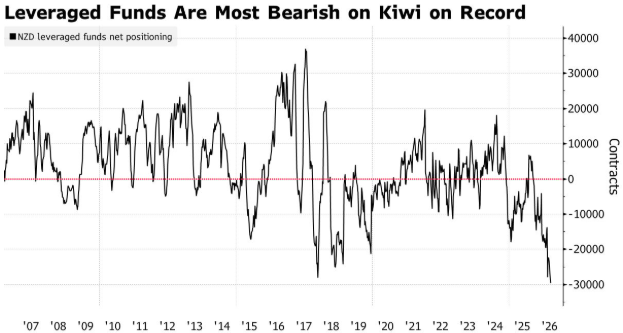
The formation of this extreme short position is in stark contrast to the recent rebound in the New Zealand dollar exchange rate. On July 8, the New Zealand Federal Reserve raised the official cash rate by 25 basis points to 2.50% in a hawkish manner. This is the first time the bank has raised interest rates since May 2023. Since then, the New Zealand dollar has accumulated a cumulative increase of about 3% against the US dollar, trading around 0.5850 during the Asian session on Monday (July 20). Over the same period, the New Zealand dollar recorded gains against all G10 currencies.
Oil prices return to $90: dependence on energy imports has become the biggest “weakness”
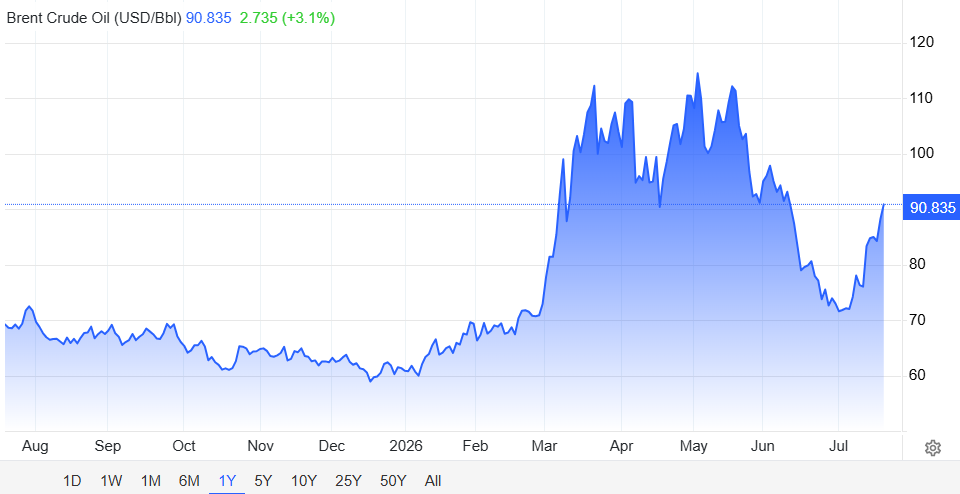
The core logic of bears' bets is the potential impact of the recent rebound in global oil prices on New Zealand's energy-importing economy. As the tension between the US and Iran continues to escalate, Brent crude oil has returned above $90 per barrel. As a country that depends entirely on oil imports, the rise in oil prices is “equivalent to a negative terms-of-trade shock” for New Zealand. Andrew Ticehurst, senior interest rate strategist at Nomura Securities in Sydney, said, “The New Zealand economy seems to have stagnated in the second quarter. The recent recovery in oil prices is another macro headwind.”
This concern is partly reflected in the latest economic data. New Zealand's trade surplus narrowed sharply in June from 160 million New Zealand dollars in the same period last year to only 20 million New Zealand dollars, far below market expectations of 250 million New Zealand dollars, the smallest surplus value since the deficit appeared in February. The import growth rate (27.8%) far exceeded exports (24.8%), and the rise in energy import costs was one of the main drivers. Among them, imports of petroleum and petroleum products surged 100% year on year, making it the biggest driver of the surge in imports. Meanwhile, retail card spending in New Zealand fell 1.4% month-on-month in June, indicating that domestic demand and external balance were under pressure at the same time.
The June inflation data will be released on July 21, and the market generally expects it to break through 4.0%, a two-year high. The main driving factor is the increase in fuel costs driven up by the Middle East conflict.
Paul Conway, chief economist at the Federal Reserve Bank of New Zealand, also recently warned that supply shocks brought about by the Middle East conflict have drastically raised the upward risk of inflation forecasts. Citi expects New Zealand's second-quarter inflation to hit its strongest quarterly increase in nearly four years.
The “counterintuitive” dilemma of the rate hike cycle: Why can't hawkish positions stop bears?
The formation of extreme short positions highlights the market's deep doubts about the effectiveness of the New Zealand Federal Reserve's policy.
On the one hand, the Federal Reserve of New Zealand clearly stated in its July statement that the current level of inflation is still above the target range, economic activity is expected to increase, and “monetary stimulus measures may be further reduced” to push the inflation rate back to the target midpoint of 2%. UOB analysts pointed out that if inflationary pressure is proven to be more continuous or external shocks reoccur, risks will still tend to tighten further.
On the other hand, the oil price shock is putting pressure on the New Zealand dollar from two directions simultaneously: while driving up import costs and worsening trade balance, it is also increasing domestic inflationary pressure, leaving the central bank in a dilemma between “raising interest rates to fight inflation” and “raising interest rates to suppress the economy.”
Ticehurst pointed out that the current high level of short positions is still somewhat surprising — “the market originally expected that some of the bets on the New Zealand dollar would be paid back after the New Zealand Federal Reserve confirmed the start of the interest rate hike cycle.” However, in reality, the opposite is true. Not only did the bears not make up, but instead continued to rise to record highs.
Global context: Geographic risk resonates with safe-haven dollars
The external environment is also unfavorable to the NZD. The US military has launched air strikes on Iranian targets for many nights, and Iran announced that the cease-fire agreement has essentially been abandoned. As the world's most important oil transportation gateway, the Strait of Hormuz accounts for about 20% of global crude oil shipments. The current tense situation has directly boosted international energy prices.
In this context, the safe-haven nature of the US dollar has been significantly strengthened, and investors are pouring into US dollar assets one after another. J.P. Morgan pointed out that the continued narrowing of New Zealand's trade surplus and the slowdown in domestic economic growth will weaken the fundamental support of the New Zealand dollar, while the expectation that the Federal Reserve will maintain high interest rates due to inflationary stickiness will continue to widen the spread between the US and Singapore. The Bank of America also believes that the New Zealand Federal Reserve's policy space is limited, and the spread between the US and Singapore will continue to weigh on the New Zealand dollar.
When the New Zealand Federal Reserve's hawkish interest rate hike collided with the deterioration in terms of trade caused by a rebound in oil prices, the New Zealand dollar was falling into a tug-of-war between “favorable policies” and “bad fundamentals.” Short positions have reached a record high, meaning that the market is voting with real money — in their opinion, energy imports rely on this structural shortcoming, which can determine the direction of the New Zealand dollar in the short term far more than interest rate hikes.