
Squeezed out of the AI core circuit? Wall Street bullies defy, advising retail investors not to blindly “undercut” IBM (IBM.US)
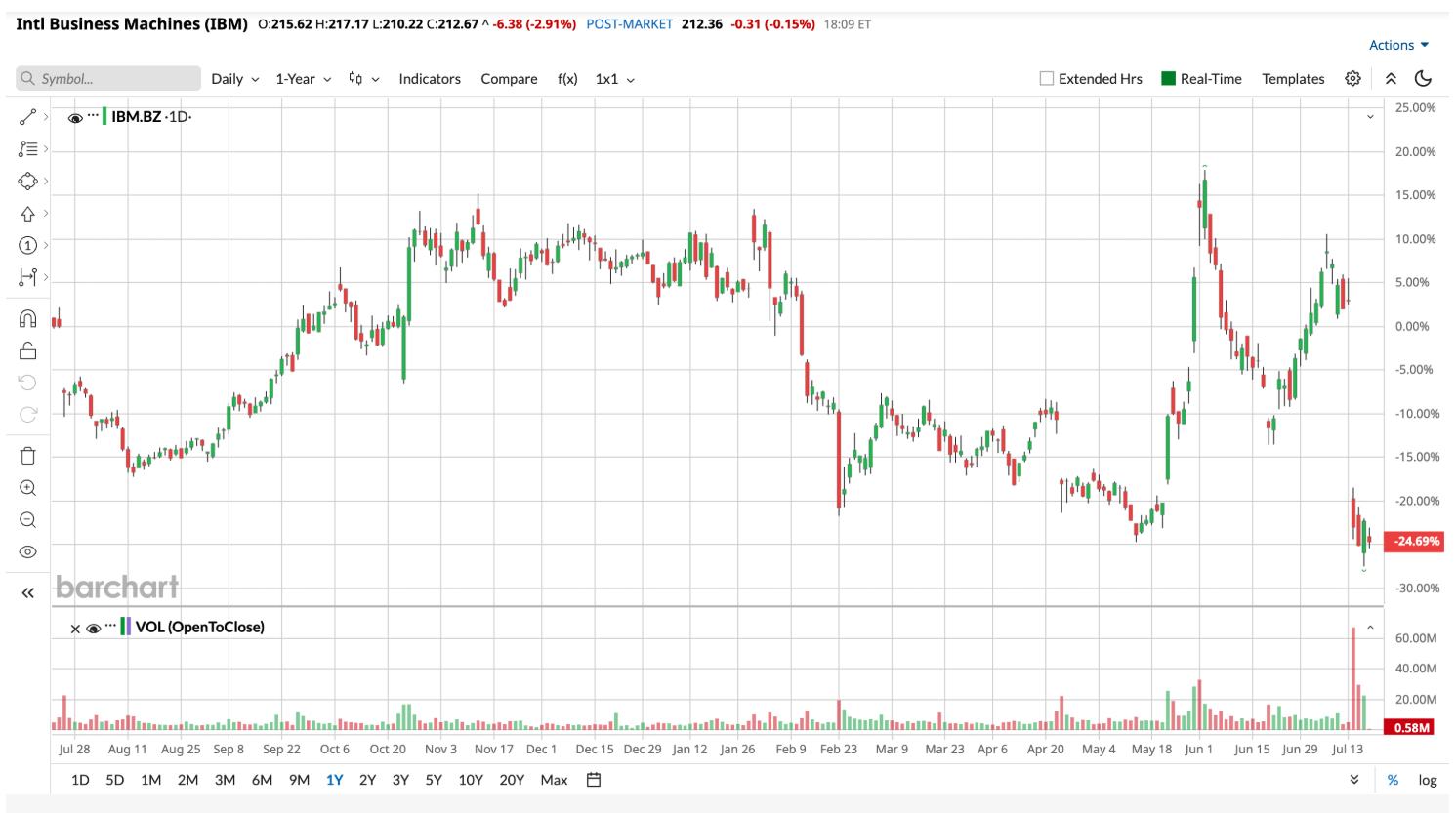
The Zhitong Finance App noticed that IBM (IBM.US) had just experienced a trading day that made it necessary to re-examine this stock. The stock fell sharply by 25.2% in a single day, evaporating tens of billions of dollars in market value, the worst single-day decline in the company's history in recent years.
This sharp decline not only hurt everyone who bought when it was close to a high point, but also forced the market to re-examine IBM's true value. Subsequently, the tone of the market became more severe.
Oppenheimer, who had been singing high-profile IBM until now, immediately proposed a demotion operation, fueling this shift in mood. This adjustment followed a wave of sell-offs triggered by financial reports, turning a bad day into a moment more like a turning point.
So an unsettling question now looms over this stock: Is Oppenheimer's downgrading, which followed a sharp decline after IBM's earnings report, a real warning that the company's growth story is beginning to unravel?
IBM after the crash
IBM is a technology and consulting company with a market capitalization of $205.9 billion, known for its work in hybrid cloud, enterprise software, and IT infrastructure. The stock has fallen 28.2% since this year, and has fallen 24.6% in the past 52 weeks.
IBM pays an annual forward dividend of $6.76 per share, which translates to a dividend rate of 3.20%. Its valuation is currently significantly lower than that of the same industry sector, with a rolling price-earnings ratio of 18.44 times (industry median of 25.91 times) and a price-to-cash flow ratio (price-to-cash flow ratio) of 14.71 times (industry median of 18.79 times).
However, the more immediate focus is on preliminary results for the second quarter of 2026, which was released on July 14 — this predates the full report and conference call scheduled for July 22. Revenue for the period was US$17.2 billion, up only 1% year over year, far short of analysts' expectations of close to US$17.9 billion. Non-GAAP earnings per share are expected to be $2.93 (up 5%), which is lower than the general estimate of approximately $3.01. The performance of the business segment showed a 5% increase in software revenue, a 5% increase in consulting (1% increase at a fixed exchange rate), and a 7% decline in infrastructure.
In a letter to investors, CEO Arvind Krishna explained why the performance fell short: in the last few weeks of June, customers drastically adjusted their capital spending priorities to shift to servers, storage, and memory to lock down contracted infrastructure before AI demand triggered anticipated price increases. IBM's balance sheet is still growing. As of March 2026, total assets were US$156.229 billion, an increase of 2.86%, which left room for the company to invest. Total liabilities were $123.174 billion, an increase of 3.39%. The rise in debt indicates that debt and obligations are quietly increasing.
IBM's new AI toolkit may still be important
Just as IBM is experiencing downgrades and stock price declines, the company is rolling out some of the biggest product updates in years. In mid-July, IBM introduced new Power Systems hardware and software designed to handle large enterprise workloads.
Its Power Autonomous Operations (Power Autonomous Operations) software is designed to find and fix capacity issues up to 15 times faster than manual inspection. The product lineup also includes an entry-level Power S1112 server for compact, AI-enabled edge computing, and a new Power Virtual Server (Power Virtual Server) option.
Beyond hardware, IBM has been deepening its AI tools with Bob, its software development AI platform. Its Bob Premium Suite adds targeted modernization capabilities to Java, IBM i, and IBM Z environments.
Trust and Safety covers recent news. In late May and early July, IBM and Red Hat (Red Hat) expanded Project Lightwell, a $5 billion project supported by more than 20,000 engineers to make open source software more secure for large organizations. The new Lightwell products are designed to protect the software supply chain and build a stronger “trust infrastructure” as companies rely more on open source in AI-intensive systems.
Taken together, these product initiatives suggest that IBM is trying to transition to artificial intelligence, modernization, and security rather than just relying on old infrastructure.
Wall Street's disagreement over IBM
Oppenheimer's attitude trajectory at IBM largely explains how its growth story has changed. The agency previously rated the stock as “outperforming the market,” but this view has now been reversed.
Oppenheimer's analysts have downgraded the rating to “the same level as the market” and completely eliminated the $350 price target. Param Singh, the analyst behind this move, emphasized that IBM's latest performance in every sector falls short of Oppenheimer's and the broader market's general expectations.
This downgrade coincides with another critical moment for IBM. The main earnings report will be released after the US stock market on July 22, and Wall Street is looking for signs of earnings of $3.02 per share for the June 2026 quarter. In comparison, it was $2.80 in the same period last year, which represents an expected increase of 7.86%.
Oppenheimer isn't the only one advising caution. Well-known analyst Jim Cramer has made it clear that he disapproves of retail investors trying to “buy on the dips” of IBM just because the chart looks cheaper. In his view, IBM is on the negative side of a major shift in enterprise technology budgets, as spending now flows more towards AI-centered projects.
Even so, the broader group of analysts hasn't given up on the company. Among the 22 analysts currently rating IBM stock, the consensus fell on a “moderate buy” rating for IBM. The average price target is around $293.95, which means there is room for a 38.2% increase.