
Dollar fluctuations hedge costs to the lowest level in the year, traders downplay geopolitical shocks
The Zhitong Finance App learned that the cost of hedging dollar fluctuations has fallen to its lowest level this year, indicating that although the outlook for the Federal Reserve's policy is still uncertain and the Middle East conflict heats up again, traders still believe that it is unlikely that there will be major catalytic factors that can significantly disrupt the world's major reserve currencies in the short term.
This week, the one-month implied volatility of the Bloomberg Dollar Spot Index fell to its lowest level since December last year, a sharp drop from the high volatility that occurred after the outbreak of the Iran war in March.
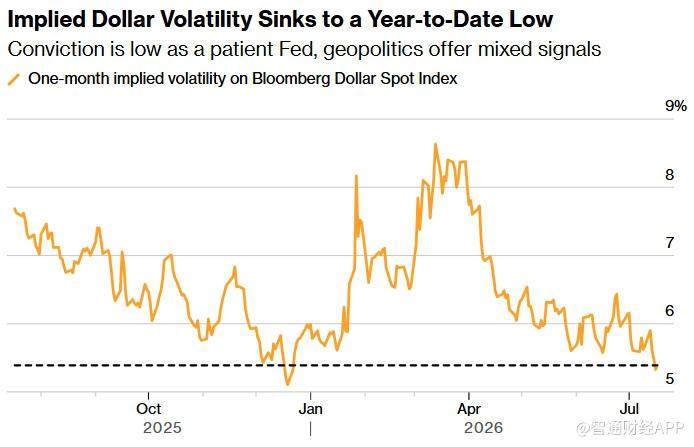
The volatility of the US dollar continues to decline, further strengthening one of the important trading logic of this year's market: the US stock market showed strong resilience, while the foreign exchange market fluctuation remained low, driving investors to increase their allocation to arbitrage trading. Arbitrage trading mainly benefits from interest spreads between different currencies, and generally performs better in an environment where exchange rates are stable and risk appetite is strong.
Francesco Pesole, foreign exchange strategist at ING (ING), said on Friday that the decline in dollar volatility was “very significant.”
He pointed out that the resilience of the US stock market, driven by the boom in artificial intelligence, still provides stable support for the foreign exchange market and helps maintain a self-reinforcing environment of low volatility and arbitrage trading. The appeal of arbitrage trading is expected to continue even with adjustments in technology stocks, such as the fall of chip stocks on Friday.
Investors have clearly increased their bets on this market environment. According to a recent Bank of America survey, global portfolio managers are bearish on the yen to the highest level in about four years. Since interest rates in Japan have been low for a long time, yen is generally regarded as an important financing currency for arbitrage transactions.
Meanwhile, data from the US Commodity Futures Trading Commission (CFTC) as of July 7 shows that leveraged funds, asset managers, and other speculators hold net long positions in the US dollar of more than 40 billion US dollars, reflecting that the market's bullish bets on the US dollar are still concentrated.
Geoffrey Yu, senior market strategist for Europe, Middle East and Africa at Bank of New York Mellon (BNY), said this week that the escalation of the situation in the Middle East has not dominated the pricing of various assets, mainly because the energy market has absorbed the initial impact.
He pointed out that at present, economic growth is still being verified by data, foreign exchange arbitrage transactions are working well, and corporate profits are also supporting the economic cycle. However, at the same time, he warned that the market may be underestimating geopolitical risks.
Judging from seasonal factors, arbitrage trading is still receiving some support. Citigroup analysts Luis Costa, Alexander Rozhetskin, and Bhumika Gupta pointed out on Friday that judging from historical risk-return performance, July is usually a favorable month for arbitrage trading.
However, Citi also warned that August is often a turning point in the market environment. As macro volatility picks up, the current increasingly crowded arbitrage positions may be more vulnerable to breaking news.
The current low volatility environment is still driving capital to continue to chase interest spreads, but once the Fed's policy expectations, technology stock performance, or the situation in the Middle East change beyond expectations, crowded arbitrage transactions may face the risk of a rapid reversal.