
US stock outlook | Futures of the three major stock indexes fell sharply, and the panic index soared, and Federal Reserve officials intensively “set off eagles”
Pre-market market trends
1. On July 17 (Friday), the futures of the three major US stock indexes fell sharply before the US stock market. As of press release, Dow futures were down 0.56%, S&P 500 futures were down 0.84%, and NASDAQ futures were down 1.79%.

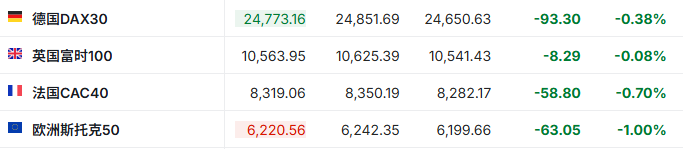
2. As of press release, the German DAX index fell 0.38%, the UK FTSE 100 index fell 0.08%, the French CAC40 index fell 0.70%, and the European Stoxx 50 index fell 1.00%.
3. As of press release, WTI crude oil rose 2.44% to $80.88 per barrel. Brent crude rose 2.17% to $86.06 per barrel.

Market news
NASDAQ futures fell sharply, and the decline in the chip sector spread globally. On Friday, NASDAQ 100 futures fell sharply, and global chip stock sell-offs continued to accelerate. Meanwhile, the VIX panic index hit a new high in more than a week. Traders are pulling out of stock positions that have driven the stock market up this year, but valuations are getting higher and higher. Currently, chip makers are facing increasingly serious scrutiny: whether the huge increase driven by AI infrastructure construction has gone too far to support current high valuations. The core question is whether AI hyperscale enterprises can ultimately bring huge returns and continue to maintain strong demand for chips. Another outbreak of attacks and counterattacks in the Middle East has also dampened market sentiment.
Inflation concerns have reignited, and Federal Reserve officials are intensively “setting up hawks.” As the labor market shows more signs of stability, discussions among Federal Reserve officials have focused on the issue of inflation. The pressure brought about by tariffs has abated, but energy prices affected by the situation in the Middle East are still worrying. At the same time, market demand brought about by the development of AI has become a new focus. Federal Reserve Vice Chairman Philip Jefferson said on Thursday that if inflation does not cool down quickly, the Federal Reserve should consider raising interest rates, but at the same time, he said that the current monetary policy situation is good. Jefferson also said that the implementation of artificial intelligence (AI) promotion compounded the energy disturbances brought about by the Iran war, causing the Federal Reserve's policy to fall into a dilemma. On the same day, two other Federal Reserve officials also expressed stronger concerns about rising prices. In 2026, FOMC voting committee and Dallas Federal Reserve Chairman Lori Logan became the first US Federal Reserve official to call for interest rate hikes, saying that inflation does not seem to continue to return to the Fed's 2% target level. Kansas City Federal Reserve Chairman Jeff Schmid said that since the risk of inflation is likely to increase further in the next few months, inflation is his biggest concern right now. Although the US inflation data for June was better than market expectations, Schmid warned that it was too early to determine that inflation would start a downward trend.
“The person who knows the company best” left the market faster: US stock executives cashed out $77.6 billion in the first half of the year, setting the second-fastest record in more than 20 years. In the first half of this year, the rate at which US corporate executives reduced their holdings was the second fastest in more than 20 years. For some investors, this is a classic red flag — because it means that those who know the company best are uneasy about the future of the market. According to EPFR global market intelligence data, in the first half of 2026, US corporate insiders sold a total of 77.6 billion US dollars of stocks, an increase of 20% over the same period last year. This sell-off wave is second only to 2021 — when the market was flooded with capital due to the stimulus policies of the pandemic. In stark contrast to this, the stock buying behavior of corporate insiders continues to be sluggish. In the first half of the year, they only bought shares worth 6.9 billion US dollars, which is only slightly higher than the seven-year low of 6.7 billion US dollars set in the same period last year.
Mutual attacks between the US and Iran escalated, traffic volume in the Strait of Hormuz plummeted, and many countries in the Gulf were involved in the flames of war. The military confrontation between the US and Iran has intensified markedly. The US military has expanded the scope of air strikes on Iran's critical infrastructure, while Tehran has responded by firing missiles and drones at several US allies in the Gulf. The spillover effects of the conflict are showing at an accelerated pace. The latest round of attacks has affected bridges, military facilities, and important infrastructure near the Strait of Hormuz. As one of the busiest oil transportation routes in the world, the navigation safety situation has deteriorated dramatically, and commercial vessel traffic has declined sharply. Iran's retaliation targets include facilities linked to the US in countries such as Bahrain, Kuwait, Qatar, and Jordan. Regional tension has fully escalated, and many governments have entered a state of high alert, fearing that the flames of war will spread further. The prospects for a diplomatic breakthrough are once again bleak. Both sides continue to carry out retaliatory actions, the risk of disruptions in the energy supply chain and fluctuations in oil prices remains high, and the overall stability of the Gulf region is facing a severe test.
Following the Minister of Finance, the Prime Minister spoke out again! Takaichi Sanae emphasized that GPIF should increase the allocation of Japanese assets. Japanese Prime Minister Sanae Takaichi emphasized the importance of encouraging households and government pension investment funds (GPIF) to increase investment in Japanese financial assets, which further strengthened the market's expectations that the fund might adjust asset allocation. Takaichi said during the parliament session, “As the stock market continues to perform steadily, we believe it is important to take measures to encourage households and pension funds, including government pension investment funds, to further increase investment in Japanese financial assets, so that the public can share the results of Japan's economic growth.” “By doing this, we aim to create a virtuous cycle between economic growth and household asset accumulation,” she added.
Individual stock news
Meta (META.US) will hire Amazon (AMZN.US) cloud executives to accelerate the deployment of data centers and cloud computing. According to reports, a senior Amazon Web Technology (AWS) executive plans to join Meta Platforms within the next few weeks. This change shows that social media giant Meta's ambitions in building data centers and computing resources are growing. People familiar with the matter revealed that Dave Brown (Dave Brown), one of Amazon Web Technology's top executives, will join Meta with nearly 20 years of industry experience and report to the head of Meta's infrastructure. Meta CEO Zuckerberg said at the annual shareholders' meeting in May that building a cloud computing business is “definitely within the scope of consideration.” He said companies contact Meta “almost every week” hoping to get permission to use its artificial intelligence model or pay a premium for using its idle computing power.
Micron (MU.US) and Qualcomm (QCOM.US) and others signed a long-term agreement to lock down the supply of AI vehicle storage. Micron Technology is extending the reach of AI chip demand from data centers to the automotive sector, locking in customers and stabilizing revenue sources with long-term supply agreements. Micron announced on Thursday that it has signed long-term agreements with a number of automotive suppliers, including chip designer Qualcomm, audio product manufacturer Harman, and auto parts suppliers such as Visteon, JOYNEXT, DENSO, Astemo, and Hyundai Mobis. The agreement aims to provide a stable supply of storage and storage components for AI-enabled vehicles, and help partners optimize production plans and investment decisions for future advanced vehicle platforms by locking in prices.
You can get a sneak peek at Trump's posts for money. According to reports, the Trump Media and Technology Group (DJT.US) under US President Trump recently launched a paid license data interface that will provide the “fastest” access to posts from leading accounts on the “Truth Social (Truth Social)” platform — including Trump's own account. Allegedly, this product, called “Truth API (Truth API),” was officially launched on August 1. It will transmit the updates of the platform's 10 most influential accounts to customers in real time, far exceeding the speed of regular push notifications on “real social networking” platforms. A company spokesperson said the product was specially designed for institutions “most affected by the cost of information delays” such as algorithmic trading companies. “Previously, agencies that paid close attention to popular “real social” posts could only rely on manual tracking.
From the February trial to the $53 billion hunt, PayPal (PYPL.US) refused to be Stripe's “discount prey”! The battle for “full-stack supremacy” of digital payments is heating up. Some media quoted information revealed by people familiar with the matter as reporting that the board of directors of PayPal, one of the world's largest digital payment service providers, believes that the $53 billion purchase offer proposed by Stripe, a major fintech infrastructure platform for enterprises and developers, and that the company's overall value is underestimated by the company's overall value, and that it will face global antitrust regulations and financing barriers in the future. PayPal spokespersons and representatives have yet to provide an official response to the proposal. According to media reports, PayPal's board of directors is weighing this offer — and the possibility of other offers, against management's business reversal strategy.
Performance guidance fell short of expectations, and the stock price of US streaming giant Netflix (NFLX.US) dived in a straight line. Affected by performance guidelines falling short of expectations, the stock price of US streaming giant Netflix dived in a straight line during pre-market trading of US stocks and plummeted by more than 10% at one point. The company expects revenue for the third quarter of 2026 to be US$12.9 billion and earnings per share of 0.82 yuan, both lower than expected. Netflix also narrowed its annual revenue forecast range to 51 billion to 51.4 billion US dollars. Previously, the estimated range was 50.7 billion to 51.7 billion US dollars. This has heightened investors' concerns that the company's growth is peaking. A Wall Street agency analysis indicates that currently investors generally believe that Netflix's business is deteriorating. Goldman Sachs cut Netflix's target share price from $110 to $94. Société Générale also lowered Netflix's target share price from $100 to $95.
Key economic data and event forecasts
20:30 Beijing time: The initial monthly rate of construction permits in the US in June and the annualized monthly rate of new housing starts in the US in June.
21:15 Beijing time: The monthly rate of US industrial output in June.
22:00 Beijing time: The initial value of the US Consumer Confidence Index for July at the University of Michigan.