
It's not about the AI bubble going to burst, it's about escaping the crowds! Wall Street's strategic trend changed from “AI computing power beta” to “cash flow alpha”
The Zhitong Finance App learned that as the Korean stock market, which has the title of “AI computing power weather vane”, frequently falls into upward and plummeting breakdowns recently, the Philadelphia Semiconductor Index of the US stock market has plummeted nearly 19% from the June high, only one step away from the technical bear market. In addition, global AI computing power-themed stocks and the semiconductor sector have fallen into extreme drastic sell-off due to overcrowded and highly leveraged multiple positions. The strategic trend of top Wall Street strategist teams such as Citi and Morgan Stanley has changed from “AI Computing Infrastructure” (AI Computing Infrastructure) That is, AI computing power beta) full shift High quality, low momentum, and abundant cash flow with alpha potential, and strong fundamental cyclical sectors and defensive stocks whose gains this year were far less than those of technology stocks.
Beata Mantai, head of European stock strategy from Wall Street financial giant Citigroup, said in an interview with the media on Friday that the bullish outlook for the global stock market in the next six months is still optimistic, but as the rise in the global stock market spreads beyond the AI-related technology sector, intense stock position rotation is indispensable. Mantai's views are almost consistent with Wall Street financial giants Jefferies (Jefferies) and Morgan Stanley. That is, as AI semiconductors' and other AI computational power-themed momentum transactions cool down, capital will shift from high-leverage computing power beta to low-pressure quality stocks, and the market's leading forces are expected to spread from semiconductors to consumption/cycle/healthcare/big finance defensive assets with abundant cash flow with the next round of alpha potential.
Jefferies said that in the future, sharp market fluctuations surrounding AI computing power-related technology stocks will continue. Perhaps it is time for investors to rebalance their portfolios that have become overly focused on AI-related high-valuation technology stocks — that is, “the main AI line has not yet stopped, and the bull market is beginning to spread and rotate towards non-AI technology.”
The so-called “alpha” is defined as the actual return on investment far exceeding the “beta return” — that is, the simultaneous return on investment data that far exceeds that achieved by tracking the benchmark stock index. The simultaneous return achieved by tracking the benchmark index is also known as “beta return” (beta return).
Yung-Yu Ma, chief investment strategist at Wall Street asset management giant PNC Asset Management (PNC Asset Management), said that PNC has changed its investment position on popular AI-related technology stocks from “actively increasing holdings” to “neutral”. The core reason is that the AI computing power trading theme is “quite fully priced” at the current level. “Many investors may now have seriously overallocated their allocation exposure to technology stocks. Their return on investment is good, but we think now is the time to broaden our horizons and look at other relatively underdeveloped areas in the market.” He suggested.
According to Morgan Stanley senior strategist Michael Wilson (Michael Wilson), the “AI bull market spread” market is not the end of the AI technology main line, but the pullback in popular AI-related technology stocks may become a trigger for capital to spread from extremely congested technology leaders to profit repair sectors such as classic cycles, consumption, healthcare, industry, finance, and transportation; this is consistent with Yardeni's “profit-driven growth” and J.P. Morgan Chase's logic of revising S&P's goals: the super bull market is far from over, but the next stage may no longer be just AI technology Driven by a single engine, it enters a multi-engine bull market where “AI-driven labor productivity spills over into various fields+corporate profit improvement+market breadth expansion”.
As global stock markets usher in a period of high volatility and rebalance, Citi advises investors to switch from AI to the financial sector
Mantai, head of European strategy from Citi, said in an interview that the current weakness in global technology stocks reflects capital switching between sectors rather than the overall collapse of the market. Mantai pointed out that, for example, in the US stock market, popular stocks with AI computing power, such as Micron and Western Digital, have plummeted, and at a time when the Philadelphia Semiconductor Index has almost fallen into a bear market, the benchmark stock index for US stocks, the P500 Index is still on an upward trajectory.
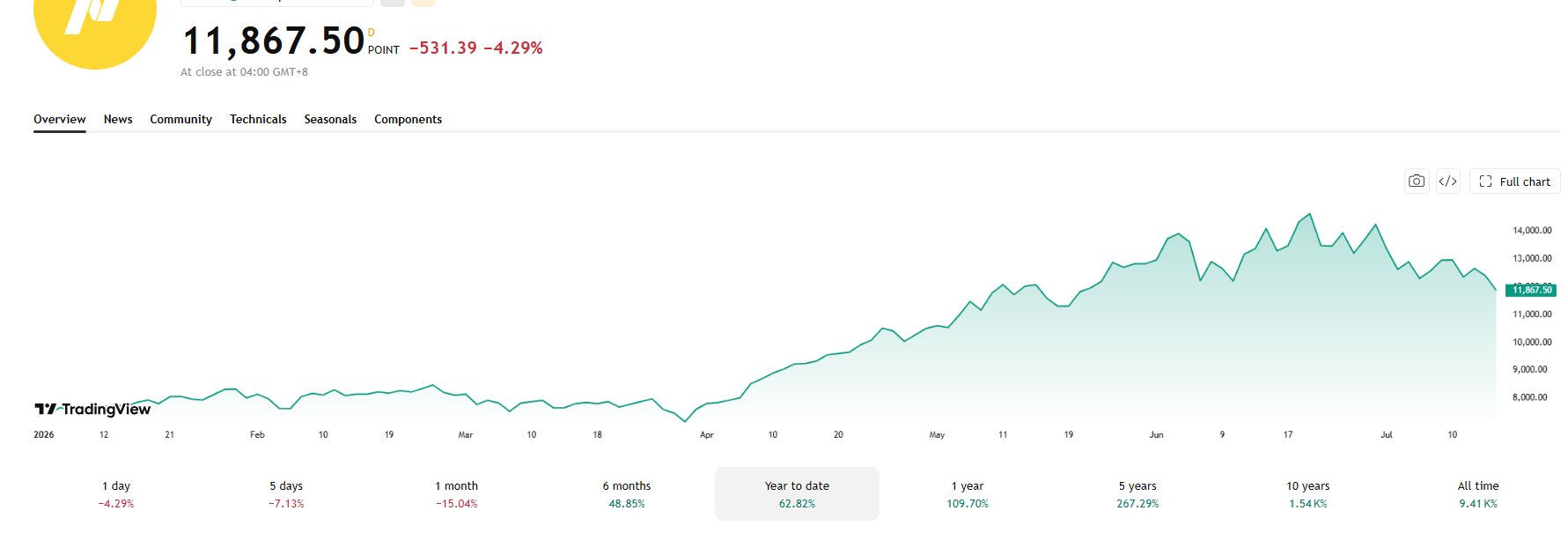
Furthermore, Mantai also said that despite continuing negative news about the recent boom in artificial intelligence investment, the global stock market still rose 10% in the first half of this year, and major stock indexes also reached record highs.
The head of European equity strategy at Citibank said, “The market is already expecting this long-overdue market to spread on a large scale. To achieve this, there must be a degree of position rotation, and sometimes rotation often happens in a very drastic way — this is exactly what we are seeing so far.”
Mantai said that European financial stocks, especially large European bank stocks, are one of the most attractive investment segments in the spread and rotation of the stock market. She called Citi's overmatch position on European bank stocks a “anti-AI style hedging transaction,” and said that regardless of the overall market trend, these European banking supergiants have reasons to further achieve the upward pace of the bull market with their own fundamentals.
She said that if the sharp fluctuations in the overall stock market are ignored, then the answer to the question of whether investors should hold stocks for the next 6 to 12 months is “most likely yes.”
The strategist listed three reasons why he is more optimistic about the European stock market, especially the European financial sector: bank stock profit forecasts have risen close to the highest level in history, 80% of the European stock market sector has seen an increase in profit expectations, and analysts continue to improve their predictions for the European benchmark stock index.
From the AI computing power beta theme to a “buy cash flow defense and market breadth” strategy! The cycle and defense sector is expected to take over the summer market
According to the latest fund manager survey report released by Bank of America (BofA), investors' extreme optimism about AI technology topics, bullish stock positions and strong profit expectations, and continued valuation expansion have seriously overdrawn the fundamental growth prospects for the next 1-2 years or so, causing the marginal risk-return of these risky assets to deteriorate significantly, which is reflected in the sharp drop in fund managers' cash share from 4.1% to a very low level of 3.6%, as well as the pessimistic score of 9.4 out of 10.
The Bank of America fund manager survey report also showed that global fund managers' share asset allocation rose slightly from 38% net overallocation last month to net overallocation of 42%. Some institutional investors have begun to increase their exposure through blue-chip stocks such as healthcare, industry, and non-essential consumer goods, which have outperformed technology stocks since this year, with long-term low fluctuations and high quality, and long-term stable cash flow, while reducing their holdings in energy, communications, and essential consumer goods, and technology stocks.
Jefferies (Jefferies) advises investors to hold high-quality, high-cash flow stocks with low profit settlement pressure and low congestion in order to survive the likely summer tech stock pullback, mainly because of the AI semiconductor congestion transaction clearance and deleveraging crisis related to the AI investment boom and growing concerns about AI revenue generation paths. As the AI semiconductor theme fell back due to position congestion and high leverage, capital began to shift from overcrowded AI computing power beta to cash flow defense, and the main line of Wall Street strategy also spread from AI computing power infrastructure to a wider range of high-quality fundamental assets that significantly outperformed technology.
In the portfolio chart below given by Jefferies (stock codes in capital letters below), ABBV and SYK are biased towards health-care quality assets, PEP, PG, and MCD are biased against consumer cash flow, AXP, HD, and LOW are biased towards consumption and cycle recovery, SPGI is a high moat financial data/index service, and NFLX is a media technology asset with high profit quality but not an AI capital expenditure hardware chain. The agency's latest strategy can be described as consistent with the views of Morgan Stanley's chief stock strategist Wilson, which is to phase out “high congestion, high leverage, and high momentum” AI computing power trading and embrace a wider market breadth, especially defensive themes such as finance and healthcare, non-essential consumption, industry, and undervaluation cycle sectors such as transportation and regional banks.
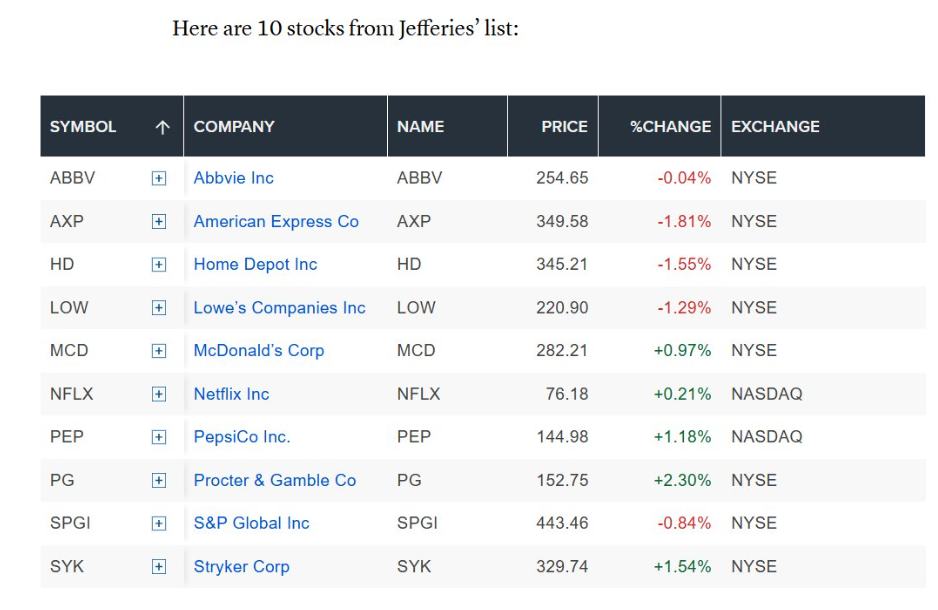
This list highlights that the Jefferies team's latest investment strategy focuses on “high quality, low pressure, low momentum, and cash flow defense” investment strategies. At a time when AI capital expenditure disputes are heating up, token costs are rising, and discussions on potential excess computing power are spreading, reduce single-point exposure to high-beta AI computing power chains and shift to assets with high profit quality, good return on free cash flow, unextreme valuations, and not previously overchased by passive capital.
Wilson's latest sector rotation framework also points in the same direction: market leadership should spread from direct beneficiaries of AI capital expenditure such as semiconductors to sectors such as hyperscale cloud vendors, consumer options, transportation, regional banks, and biotechnology. The latest opinion of the Morgan Stanley team led by Wilson emphasizes that the breadth of investment in the US stock market should continue to improve, and continue to prefer consumer products, transportation, and regional banks, while incorporating biotechnology into the main line of rotation; the core strategy of the Daimo strategist team led by Wilson is not “the end of the AI super bull market”, but rather that the valuation and positions of AI capital expenditure beneficiaries are overheated, and the market needs to spread from momentum trading dominated by AI semiconductor themes to a cycle and defense sector with more reasonable valuations.