
Car delivery is the foundation, and physical AI is the engine of the bull market! Tesla (TSLA.US) performance hits, and Damo keeps an eye on Robotaxi, Optimus Prime, and energy storage “three arrows go hand in hand”
The Zhitong Finance App learned that Wall Street financial giant Morgan Stanley is cautious about the valuation prospects and target stock price expectations of Tesla (TSLA.US), a leader in electric vehicles, AI, autonomous driving, and robotics in recent years when the South Korean stock market, which has the title of “AI computing power weather vane,” has recently fallen into extreme sell-off due to overcrowded and highly leveraged multiple positions. The analysis team led by senior Daimo analyst Andrew Percoco said that Tesla's target price was slightly raised from $415 to $417 and continued to give it an “Equal-weight (hold/equal to the market)” rating. By contrast, Tesla shares closed at $391.06 on Thursday.
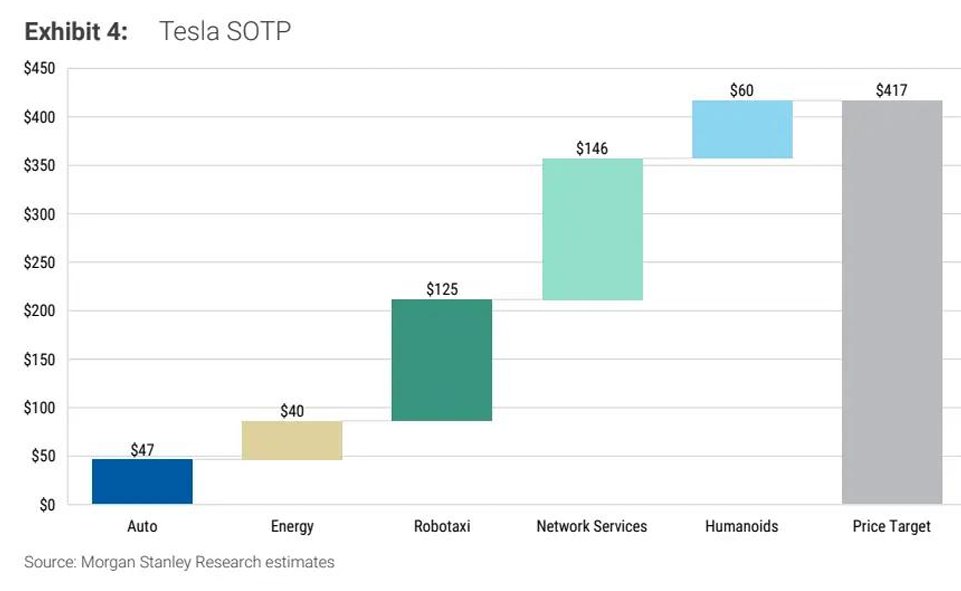
According to Damo's valuation framework, the electric vehicle business only contributed $47 in target value, and Robotaxi, network services, and humanoid robots contributed a total of $330; recent delivery of 481,000 vehicles and 13.5 GWh energy storage system deployment (these energy storage scales may be closely linked to AI data centers) have strengthened Tesla's AI fundamental chassis, but the increasing AI capital expenditure of over $25 billion, continued negative free cash flow, and the speed of Robotaxi demand and production capacity expansion, and the mass production of Optimus (Optimus) humanoid robots The schedule and pace of demand expansion are still a core stress test of whether extremely optimistic market valuations closely linked to AI computing power infrastructure clusters, AI applications, and physical AI systems built exclusively by Tesla can be fulfilled.
According to reports, the Daimo analyst team's core judgment logic on Tesla's target stock price expectations, which is one of the Big Seven (the Magnificent Seven), is very clear: the electric vehicle delivery business, which is stronger than expected, has improved the recent lower profit limit, but what determines whether Tesla can re-grade is not selling tens of thousands more cars, but whether Robotaxi, FSD, and the huge energy storage system related to Optimus and AI can prove that Tesla's unique physical AI system has entered the large-scale commercial stage.
$417 is a highly “AI” valuation, not a car valuation: automobile recovery is only the chassis; physical AI is the engine of the stock price bull market
Tesla will announce its quarterly results on the morning of next Thursday, Beijing time. Damo expects revenue for the second quarter to be US$28.363 billion, 11% higher than market expectations; the adjusted EPS is 0.69 US dollars, which is 41% higher than expected; and the gross margin of the automobile business after excluding points is 18.1%, slightly higher than the 18.0% expected by the market. However, the full-year outlook was not entirely optimistic: the 2026 revenue forecast was US$102.4 billion, slightly lower than market expectations; adjusted EBITDA was US$16.181 billion and EPS was US$2.20, higher than market expectations of 3.4% and 13.4%, respectively; at the same time, capital expenditure is expected to reach US$26.8 billion, and free cash flow is expected to be negative US$11.432 billion, which is significantly worse than the market forecast of negative US$8.136 billion.
In other words, according to the Daimo analyst team, Tesla is using the cash flow chassis formed from the phased recovery of the automobile business to fund an unprecedented arms race for computing power manufacturing infrastructure such as cutting-edge AI, FSD autonomous driving software, Robotaxi, energy storage systems, humanoid robots, and AI chips dominated by Musk's “Terafab” vision.
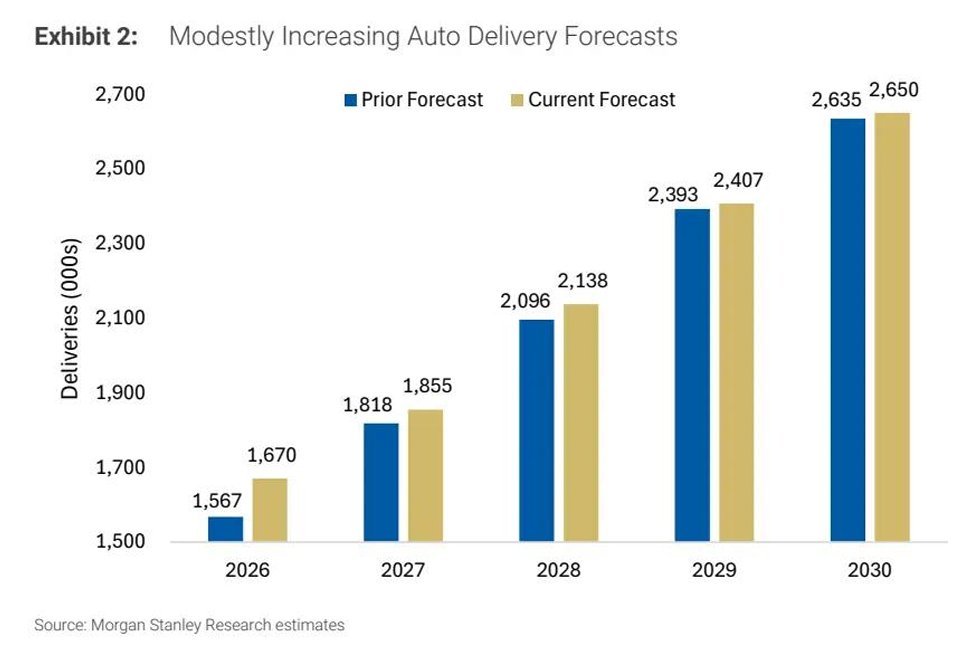
This forecast path for Damo means that the compound revenue growth rate from 2026 to 2028 is about 17%, but it will continue to burn money in 2026 and 2027, and positive free cash flow will not return until 2028. As a result, Damo's outlook for Tesla's future performance is that revenue and delivery will recover moderately, and traditional car profits will stabilize, but AI investment will first eat up cash flow and wait for commercialization to be realized. The model does not assume that the traditional automobile business will return to ultra-rapid growth: the 2030 delivery forecast will only increase slightly from 2.635 million vehicles to 2.65 million vehicles; the real long-term profit elasticity comes from AI-driven expansion of energy storage systems, FSD subscriptions, Robotaxi platform extraction, fleet services, and strong Optimus demand.
Damocar's target price of $417 consists of five components: $47 for the traditional car business, $40 for energy storage and energy business, $125 for Robotaxi/Tesla Mobility, $146 for Network Services, and $60 for Humanoids (i.e. Optimus Prime robot business). In other words, network services, robotaxis, and humanoid robots together contribute about 79% of the target valuation, while traditional cars only contribute about 11%.
Even under the benchmark forecast scenario, the overall valuation given by Damo is still equivalent to about 53 times the expected EV/EBITDA in 2030; the target price for the bull market scenario is 841 US dollars, while the bear market scenario is only 137 US dollars. This extremely wide valuation range shows that Tesla is no longer linearly pricing based on car sales and bicycle profits, but is trading whether Tesla's physical AI systems such as autonomous driving and robots can form a giant platform economy.
In terms of FSD and RoboTaxi, the underlying technology is indeed accumulating: Tesla claims that FSD v14.3 has restructured the reinforcement learning stage, improved low-visibility visual encoders, and reduced inference delays by up to 20%; the next AI5 inference chip has completed the final design. Robotaxi mileage nearly doubled month-on-month in the first quarter. Austin, Dallas, and Houston have promoted unmanned operations, and expanded to Miami in July. Damo expects a total of about 1,500 supervised and unmanned robotaxis by the end of 2026 and 30,000 in 2030, but it also emphasizes that this year's absolute fleet size still has no real contribution to profits; what the market is really observing is urban expansion, unmanned operation, and the speed at which Cybercab is put into production.
Optimus is also moving from laboratory prototypes to manufacturing preparations: Tesla has begun installing first-generation mass production lines. According to Damo's supply chain survey, the company requires some suppliers to increase parts production capacity to about 1,000 units per week by September, and to reach 2,000-2,500 sets per week by the end of the year. However, final design freeze, dexterous hand reliability, actuator life, industrial safety certification, and unit manufacturing cost are still key barriers, so supply chain preparation cannot be equated with large-scale commercial delivery of robots. Damo only valued Humanoids at $60 and added a 50% probabilistic discount. In fact, it already reflects the judgment that this huge potential market coexists with high execution risk.
The energy storage business is the most easily underestimated intersection between Tesla and AI infrastructure. The 13.5 GWh deployment volume reached a strong level in the second quarter, and Megapack 3 is still scheduled to enter mass production in 2026; as AI data center loads show high power and strong fluctuations, battery energy storage can be used to smooth peak loads, improve transmission capacity utilization, cope with power outages, and reduce dependence on diesel backup units. However, Damo expects to deploy 57.7 GWh throughout the year, which is lower than market expectations of 60 GWh, and the energy gross margin forecast is also lower than consensus, indicating that demand is not an issue; short-term bottlenecks are mainly in the supply chain, project integration, and product portfolio. Strictly speaking, the Megapack energy storage project is not an absolutely independent “AI computing power energy storage business”; instead, Megapack is becoming an important supporting asset for AI data center power infrastructure.
Damascus set aside a “bull market target price of $841” to deal with Musk's ambitions to actively advance physical AI
According to the Dama analyst team's benchmark target price forecast scenario, there is no very strong room for growth; according to the scenario where AI successfully realized it, there is a great deal of convexity. Based on Tesla's latest stock price of about 391.06 US dollars, Damo's target price of 417 US dollars only corresponds to a potential increase of about 6.6%, which is completely consistent with its “Equal-weight” rating.
However, the $841 bull market scenario presented by Damo corresponds to about 115% room for growth and a potential market value close to $2.98 trillion. The $841 bull market target is based on an upward scenario where many businesses such as Robotaxi, internet services, FSD autonomous driving subscriptions, energy storage systems and humanoid robots, and potential chip manufacturing plant TeraFab are moving towards a much more optimistic fulfillment assumption than market expectations under CoE Musk's helm, rather than a 12-month benchmark target price.
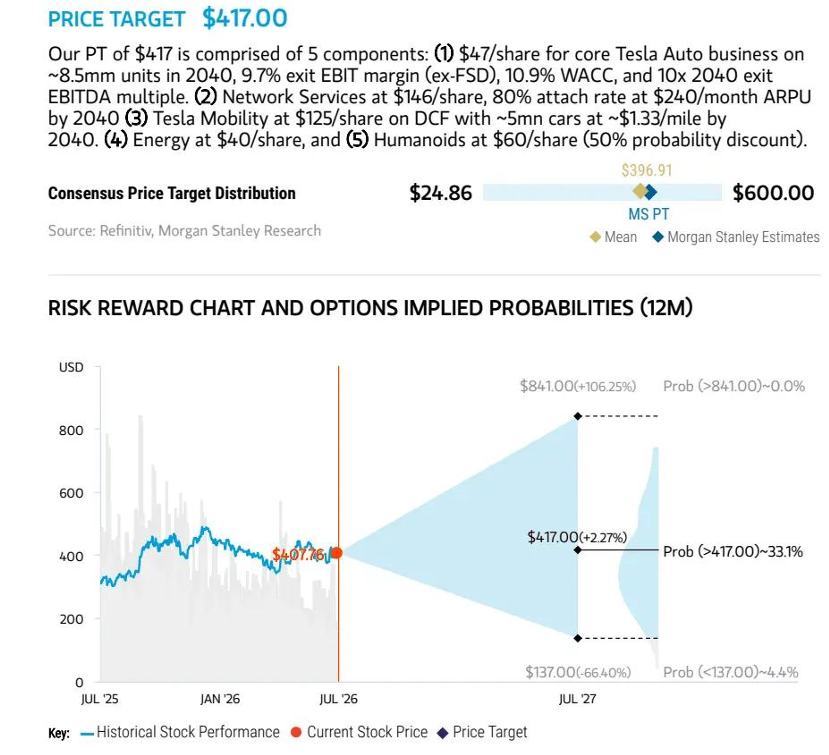
Daimo analysts said that $841 is not an official target price, but rather a scenario valuation based on the Robotaxi fleet, high FSD attachment rate, high ARPU for network services, commercialization of Optimus, and the expansion of the energy business at the same time. Currently, Tesla's market value is about 1.38 trillion US dollars, and the static price-earnings ratio is about 359 times. Therefore, future stock prices will not continue to rise due only to “progress” in AI computing power, AI applications, and physical AI related projects. Instead, unsupervised safety mileage, Robotaxi fleet utilization rate, FSD subscription and gross profit, Optimus mass production yield, and return on capital expenditure have been proven that these businesses can generate sustainable cash flow.
In terms of Wall Street's most optimistic benchmark price target, according to mainstream sellers' 12-month target price, the highest is currently the $600 benchmark target price given by Wedbush analyst Dan Ives. Based on the latest calculation of $391.06, this means an increase of about 53.4%, corresponding to a potential market value of about $2.12 trillion.
Similar to Damo's prediction, Ives's core logic is not the electric vehicle sales cycle, but investors underestimated Tesla's transformation from an electric vehicle manufacturer to a “physical AI superplatform”: FSD autonomous driving software driven by Tesla's AI supercomputing system transforms the existing fleet into a high-margin software network, Robotaxi transforms autonomous driving into a mobile service that charges per mileage, and Optimus further extends the same set of vision, reasoning, and control capabilities to the general labor market. In other words, the $600 benchmark price target placed by Wedbush analyst Dan Ives is that cutting-edge AI technology, autonomous driving, robots, and energy storage systems will jointly drive the restructuring of Tesla's business model and valuation multiples; once the driverless taxi Robotaxi expansion plan or Optimus mass production is delayed, the valuation premium that this goal depends on will also shrink rapidly.