
History repeats itself? 2026 welcomes the biggest IPO frenzy in history. Will the AI feast open a new era or repeat the “internet bubble” mistake
The Zhitong Finance App noticed that the current market background is strangely reminiscent of the final stage of the internet bubble 25 years ago. Extremely high valuation levels are a key common denominator. Another common denominator is that both eras revolved around a major technological paradigm shift, which not only drove market indices, but also the US economy.
Another similarity is the significant increase in the number of IPOs and various other huge financing activities using stock and bond issuances. These funds are being used to fund the massive AI infrastructure that is currently sweeping the US.
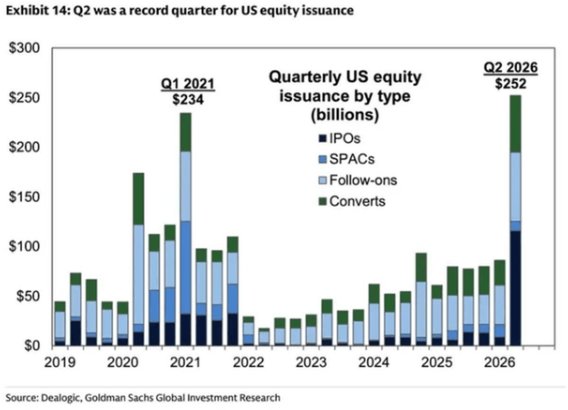
As can be seen from the chart above, there was a huge surge in the amount of capital raised through the US market in the second quarter. The last time a company raised so much capital from the public was in the fourth quarter of 2021. Notably, that was the end of a massive IPO/SPAC wave. That surge was driven by the Federal Reserve's loose monetary policy and a 40% increase in the M2 money supply in the two years since the start of the pandemic.
Notably, the wave of IPOs and SPACs in 2021 subsided substantially the following year. In 2022, the Nasdaq index fell by a third. The S&P 500 dropped slightly more than 18% in 2022. Fortunately, ChatGPT's debut in November 2022 ignited an AI-related rebound in the market and continues to this day.
Last quarter's IPO offering was led by SpaceX (SPCX.US)'s massive IPO in mid-June. Elon Musk's company raised just over $85 billion through its market debut, making it the largest IPO in US history. Less than two weeks later, the company raised money again to the public through a $25 billion bond deal.
Notably, after SpaceX's stock was significantly fervently sought after in the early days of its listing, the stock experienced a roller coaster and has now fallen back to its initial IPO price. The current market capitalization is around $1.8 trillion. For a company with revenue of just under $1.9 billion in fiscal year 2025 and a loss of nearly $5 billion, this performance is still not bad. Even so, the stock's recent decline has erased a valuation of just over $1 trillion from its peak since listing. Thanks to changes in listing standards, SPCX has now entered many passive ETFs. Notably, the company's bonds have fallen sharply in recent trading days.
After that, chipmaker SK Hynix (SKHY.US) raised just over $26 billion last week through a listing on the US exchange. OpenAI and Anthropic are also hoping to launch soon. Anthropic is aiming to debut this fall, while OpenAI's potential debut is currently speculated in early 2027. Both loss-making companies will target a market capitalization of around $1 trillion.
Additionally, data center developers may be preparing to cash out of the AI boom by selling majority shares in their companies. These potential data center affiliates include Netrality Data Centers, DataBank, Agencies, and EdgeCore Digital Infrastructure.
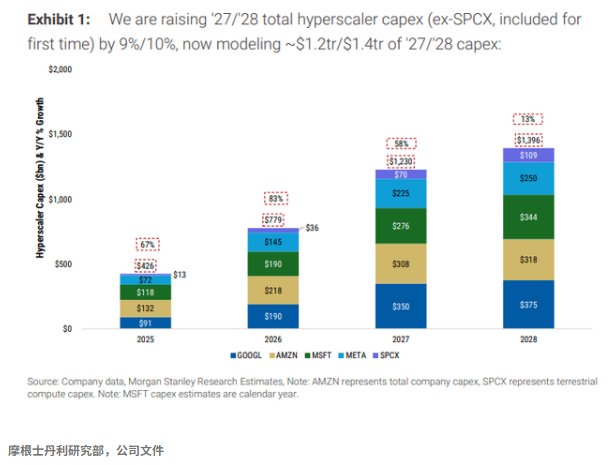
As capital expenditure budgets for hyperscale data centers continue to rise, the amount of capital raised through debt financing, IPOs, and equity offerings will continue to grow at an accelerated pace. At least, this will continue until the market is overwhelmed by the scale of such huge equity and debt issuance. 2026 is expected to be the year with the largest number of IPOs ever issued.
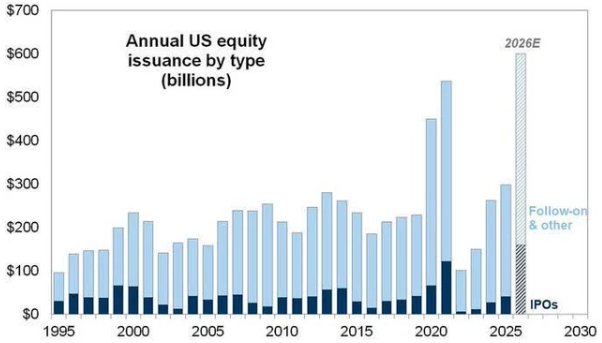
So, for investors, will this huge IPO/capital raising frenzy follow a different trajectory over the next few quarters than it did in 1999 and 2021? While AI-related companies are raising hundreds of billions of dollars from the open market to fund their capital expenditure budgets, insiders are cashing out huge amounts of chips.
For example, insiders at AI cloud service provider CoreWeave (CRWV.US) have sold approximately $2.3 billion worth of shares since the company went public in May 2025 and the lockdown period expired. In the past three months, they have net sold just over 18.5 million shares. These stocks currently trade at around $77.00 per share and have a market capitalization of around $42 billion.
To paraphrase Mark Twain, history may not repeat itself, but it's always strikingly similar. In light of this, analyst Bret Jensen remains cautious about the overall market. About a quarter of its portfolio is allocated to short-term treasury bonds, and the current yield is close to 4%.