
Stock prices rose violently by more than 50% within 5 days. Can the “sky-high price monkey” become a shock absorber for Zhaoyan New Pharmaceutical (06127)?
The stock price violently rose by more than 50% within 5 trading days. When the “sky-high monkey” market arrived, Zhaoyan New Pharmaceutical (06127) once again played a good role in the market where volume and price had risen sharply.
The Zhitong Finance App learned that on July 15, Zhaoyan Pharmaceutical released its 2026 semi-annual performance forecast. According to the data, the company's revenue for the first half of the year is expected to be 669 million yuan to 739 million yuan, a year-on-year increase of 0% to 10.5%; at the same time, its net profit to mother reached 600 million yuan to 900 million yuan, surging 884.9% to 1377.4% year on year; corresponding deducted non-net profit of 561 million yuan to 842 million yuan, a year-on-year increase of more than 35 times.
On July 15, the Hong Kong stock price of Zhaoyan Pharmaceutical opened high. At one point, the biggest intraday increase reached 29.73%, and the highest intraday price reached HK$28.94. The next day, Zhaoyan Pharmaceutical's stock price soared to HK$29.98, bringing the stock price back to the HK$30 mark just one step away.
“Sky-Priced Monkey” took off, and “Monkey Maw” gained strength again
Every time the “sky-high monkey” market takes off, the popularity of domestic innovation and research continues to rise.
Since this year, the innovative drug sector has shown a basic characteristic of a high divergence between stock prices and fundamentals. At this stage, stock prices within the innovative drug sector of AH and AH continued to be under pressure. Corresponding indices fluctuated and declined, making it difficult for leading companies to escape the contraction in valuation.
In fact, behind the downturn in the pharmaceutical sector of Hong Kong stocks is the result of multiple factors resonating with capital, market sentiment, and geopolitics.
In terms of capital, in the first half of this year, Hong Kong stocks showed strong performance in major technology such as AI computing power and semiconductors, thus attracting a large amount of active capital in the market. In contrast, innovative drugs act as a track for long-term, low-frequency catalysis. Under the pattern of stock capital games, the siphon effect of technology stocks has created a clear flow of liquidity in the pharmaceutical sector.
Second, the tense global geopolitical landscape has accelerated the uncertainty of the Federal Reserve's monetary policy. The recent market's bet on the delay or even interest rate hike expectations of the Federal Reserve's interest rate cut has directly led to a tightening of global liquidity. For interest rate sensitive assets such as innovative drugs, this certainly directly suppresses their valuation level.
However, at the fundamental level, the State Drug Administration revealed that by the end of June 2026, a total of 38 Class 1 innovative drugs had been approved for the launch in the first half of the year, 11 of which were new targets and new mechanism drugs, and all were independently developed by Chinese companies; at the same time, in the first half of this year, China's innovative drug BD reached 110 billion US dollars in overseas transactions, once again setting a new historical record; and at this year's ASCO annual conference, a total of 94 Chinese research projects were selected for the oral report session. The latest breakthrough summaries (LBA) reached 12 items, and both figures reached record highs.
The above data all verify the continuous improvement of R&D capabilities and clinical efficiency of Chinese innovative drug companies, and clarify the boom cycle of the domestic innovative drug industry. And this is the key to supporting the price of experimental monkeys.
In fact, market hype about “sky-high monkeys” began as early as December of last year. According to market data, the price of crab-eating monkeys around the age of 3-5 had already risen to 140,000 yuan at the time, and supply was in short supply. However, this market price has increased by more than 50% compared to the 90,000 yuan/crab-eating monkey cost obtained by the company's merger and acquisition in 2022.
In addition, according to Fangzheng Securities estimates, the supply of experimental monkeys is estimated to be about 48,000 to 52,400 monkeys per year in 25-27, and the demand for experimental monkeys is about 513-62,600 monkeys per year. The bank believes that in the short term, due to the recovery in new drug research and development, the supply side will be more difficult to improve in the short term, and the gap between supply and demand may continue to expand.
According to the Zhitong Finance App, the reason why the upward trend in the monkey cycle can directly affect the performance of Zhaoyan Pharmaceutical is because Zhaoyan Pharmaceutical's experimental monkey biological asset measurement method in the 2020 annual report was changed from the previous “cost method measurement” to “fair value measurement.” As a result of this change in accounting policy, when biological assets continue to rise in price, their price surpluses are released in current statements. In other words, the beginning and end of the monkey price boom cycle will have a direct impact on the company's net profit.
Standing at a critical point in time for the disclosure of results, holding 50,000 experimental monkeys, and then using the stock advantage to drive a recovery in orders, Zhaoyan New Pharmaceutical has undoubtedly taken an advantageous position within the CXO industry's recovery range.
Is Hong Kong Stock Connect funding moving from disagreement to agreement?
Looking at the market, due to a wave of sharp increases in recent performance forecasts, the Hong Kong stock price of Zhaoyan Pharmaceutical reached a high of HK$29.98, a new high since January 2023.
However, in reality, Zhaoyan Pharmaceutical's path to a new high in stock prices since January of this year has not been easy. From a technical perspective, after the stock price of Zhaoyan Pharmaceutical hit a high on January 14 this year, the stock price quickly technically returned to the BOLL mid-line. It then fluctuated between the middle and lower BOLL line for 2 months until March 23, when it hit a phased low of HK$14.99. Meanwhile, in the next three months, Zhaoyan New Pharmaceutical's stock price “went on a roller coaster” again, but the bottom W was also determined on June 9, paving the way for the subsequent rise in the “sky-high monkey” market.
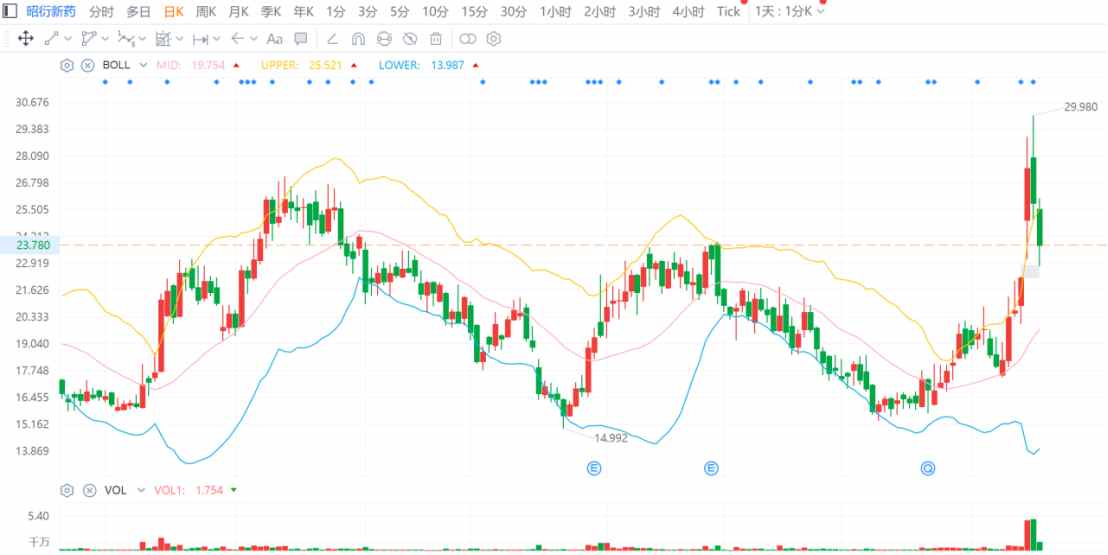
The volatile market of Zhaoyan New Pharmaceutical since this year did not show signs of stopping its decline until June 9, when a double bottom was confirmed and the K-line continued to break out of the Xiaoyin and Xiaoyang K-line. During this round of turbulence, Hong Kong Stock Connect capital once again became the main force in the market to take up the chips. However, the two capital stocks of Hong Kong Stock Connect (Shanghai) and Hong Kong Stock Connect (Shenzhen) have differences.
Looking at the long-term timeline, in the past 60 days, the top five sellers of Zhaoyan Pharmaceutical were Hong Kong Stock Connect (Shenzhen), Citibank, Morgan Stanley, and BNP Paribas. Among them, Hong Kong Stock Connect (Shenzhen) was the biggest seller, with a cumulative net sale of 2.5033 million shares; from the buyer's perspective, China Investment (Shanghai-Hong Kong Stock Connect) was the biggest buyer, with a net purchase of 5.920,900 shares. This performance shows, on the one hand, that most of the recent OTC coin holders of Zhaoyan New Pharmaceutical are retail investors in the mainland from Hong Kong Stock Connect; on the other hand, it shows that the two shares of Hong Kong Stock Connect funds have some differences in the holding strategy of Zhaoyan New Pharmaceutical. However, in terms of shareholding ratio, China Investment (Shanghai-Hong Kong Stock Connect) and China Chuangying (Shenzhen-Hong Kong Stock Connect) are still the largest shareholding brokers of Zhaoyan New Pharmaceutical, with ratios of 39.48% and 20.75%, respectively.
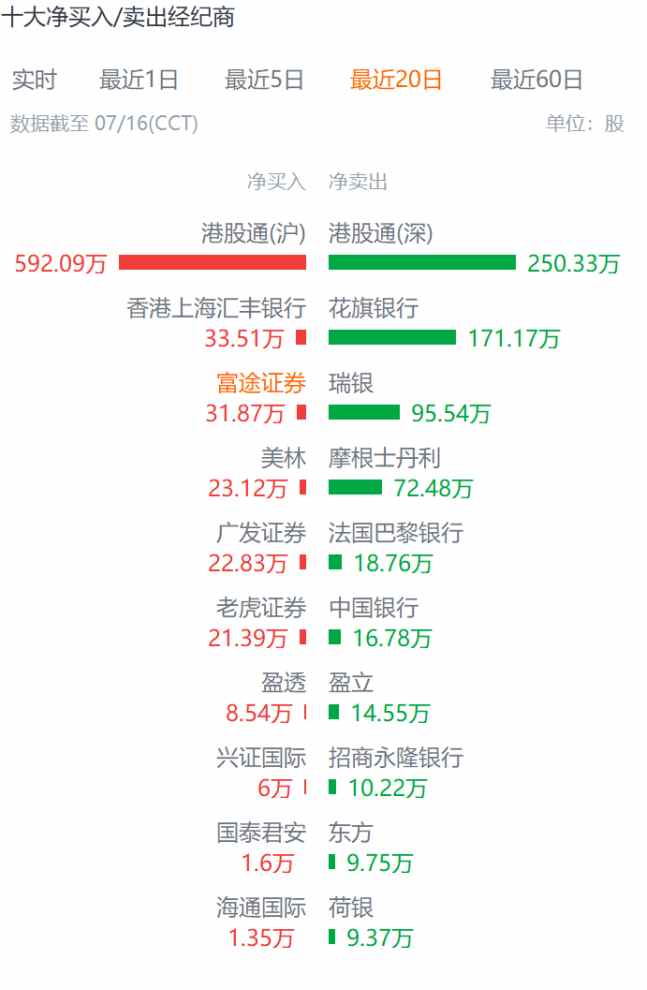
After breaking out of the 20cm Dayang line on July 15, Zhaoyan New Pharmaceutical also showed a clear correction under the influence of the decline in the general market in AH. This is mainly due to the fact that on July 16, 2026 FOMC voting committee and Dallas Federal Reserve Chairman Logan publicly released major hawkish views, which directly impacted the pricing logic of global growth assets.
In fact, the underlying logic of the sharp decline in innovative drugs in the past two trading days is that the asset attributes of the racetrack are highly bound to the Federal Reserve's monetary policy: if the subsequent market maintains a high interest rate environment, the difficulty of US dollar borrowing and equity financing for innovative pharmaceutical companies will rise simultaneously again. Unprofitable innovative pharmaceutical companies continue to burn money for clinical trials and expand pipelines. Rising financing costs directly increase operating pressure, thereby inducing capital to speed up the sell-off of small and medium-sized Biotech targets.
As a result, in recent short-term operations, some market capital chose to settle in. However, in the brokerage transaction data for the past day, both Hong Kong Stock Connect (Shanghai) and Hong Kong Stock Connect (Shenzhen) chose the operation of net purchase of Zhaoyan New Drugs. The logic may lie in the medium to long term. Domestic innovative pharmaceutical companies are relying on strong fundamentals to counter poor liquidity. For Zhaoyan New Pharmaceutical, “monkey prices” maintain high prices or continue to improve company fundamentals during the innovative drug boom cycle, thereby effectively hedging fears in the market.