
Is G7's strongest Hawk about to quit? Economists predict that the ECB will complete the “Last Plus” in September. The whole suspense is about the situation in Iran
The Zhitong Finance App learned that economists generally expect that the ECB will suspend interest rate hikes next week to assess the inflation situation, and may then complete the last rate hike in September.
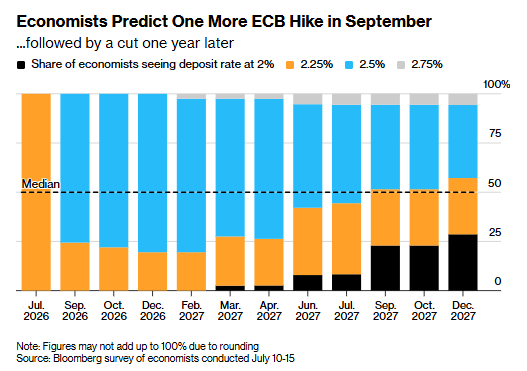
According to a survey, all respondents predicted that the ECB would not adjust borrowing costs next Thursday. Most respondents expect that after receiving the latest quarterly economic forecast in September, policymakers will raise deposit interest rates by 25 basis points to 2.5%. This interest rate level is widely regarded by economists as the end point of the ECB's austerity cycle — the war in Iran caused oil prices to soar and triggered the worst inflation shock in the Eurozone since 2023.
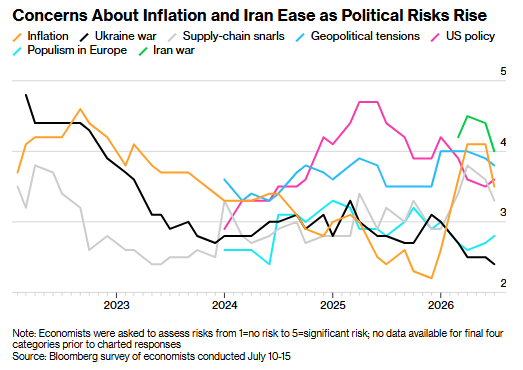
However, in line with the ECB's own signals, analysts are unsure about this because the situation in the Middle East is changing rapidly — over the past month, the region has once again slipped from a fragile cease-fire to renewed fighting.
“The key question is whether the tension between the US and Iran is only temporary,” said Dennis Shen, a lecturer at the School of International Management at the Technical University of Berlin. If the situation is manageable, “it will support keeping interest rates on hold,” but a more serious conflict “may trigger a second round of effects and put pressure on inflation expectations.”
Considering the policy trends of other central banks, the interest rate hike in September may further strengthen the ECB's hawkish position in the Group of Seven (G7). Last month, the bank became the first central bank in the G7 to raise interest rates after the war in Iran.
Next Thursday's policy meeting will set the tone for financial markets' bets before the long summer recess. In view of this, Kristian Toedtmann, an economist at the German Central Bank for Cooperation, believes that the focus of this week's meeting will be to release policy signals.
“The supply shock is gradually spreading to the entire economic system,” he said. “The ECB will show that it is closely monitoring the situation, that its current position is steady, and that it is ready to act if necessary.”
Officials including Bank of Austria Governor Martin Kochel and ECB Executive Director Piero Cipollone said this week that there is currently no evidence that wage dynamics will further solidify price pressure. The June inflation data and a much-publicized service sector indicator all showed that price increases fell more than expected.
Despite this, Bundesbank President Joachim Nagel insisted that the ECB would maintain a “vigilant stance.” He said on Wednesday that current borrowing costs are at an “appropriate” level, adding that the management committee will continue to comprehensively consider all relevant data at future meetings.
For economists, the key variable in whether to raise interest rates in the fall still depends on the direction of the war in Iran and its associated impact on oil and gas circulation.
“Eurozone inflation slowed in June, eliminating the need for urgent action. However, high commodity prices still tempt the management committee to raise interest rates again in September — when policymakers will get the latest forecasts from in-house economists — this may be the last rate hike in this short cycle of austerity,” said economists David Powell and Simona Delle Chiaie.
“We don't think the September rate hike is a foregone conclusion,” said Chris Hare, an economist at HSBC. “If the peace process progresses and energy supply improvements get back on track, we think the ECB may eventually not need to raise interest rates.”
About 41% of respondents expect that despite President Lagarde's recent statement that it will avoid providing forward-looking guidance, the ECB will still release at least some signals about interest rate trends in the coming months next week.
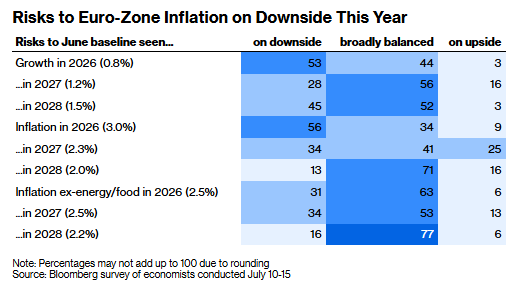
Economists believe that the ECB's June benchmark forecast for economic growth and inflation for this year and next two years faces downside risks, but it is roughly balanced in the medium term.
Only 9% of respondents believe there is evidence that inflation expectations are unanchored, and most are not overly concerned about the second-round effects.
This prospect may shift future policy into the field of interest rate cuts. According to the median survey forecast, the first rate cut may be in September 2027, while the four respondents predicted that interest rate cuts could begin as early as March next year.