
Wenyuan Zhixing (00800) released WITT, a large physical AI model to reconstruct AI perception with physical facts
The Zhitong Finance App learned that on July 17, Wenyuan Zhixing WeRide (WRD.US,00800), the world's leading autonomous driving technology company, officially released WeRide WITT, a self-developed physical AI cognitive foundation model. Based on Visual Language Big Model (VLM) capabilities, WITT first introduced the “minimum physical fact unit” concept to open up multi-modal information such as video, images, and text, disassemble continuously changing real scenes into factual units that can be recognized and verified, and build a next-generation AI understanding framework with physical facts as the core.
Witt is the full name of World Intelligence Understanding Truth, which means “establishing world awareness with credible facts.” This name also pays homage to the 20th century philosopher Ludwig Wittgenstein (Ludwig Wittgenstein), who proposed the idea that “the world is the sum of facts” is highly compatible with the underlying logic of physical AI: the key to understanding the real world is to extract believable facts from the relationships between environment, behavior, rules, risk, and timing, and form judgments and reasoning about the physical world on this basis.

(Wenyuan Zhixing WeRide WITT, a large model based on physical AI cognition, constructs a next-generation AI understanding framework centered on physical facts.)
As the implementation process of physical AI accelerates, autonomous driving has become the first racetrack that can be commercialized on a large scale, and pain points are also concentrated: there is more and more data, but data with actual training value, evaluation value, and iterative value is not easy to be efficiently identified and used; high-value long-tail samples are scarce, and noise such as human takeover and invalid fragments are mixed in L4 actual operation and L2 mass production data; general models are also prone to illusions and misjudgments when understanding complex traffic scenarios.
The industry urgently needs an efficient and trustworthy data understanding mechanism to continuously extract effective scene facts from real road data, improve the quality and efficiency of data entering a closed loop of training, evaluation, and iteration, and allow real-world experience to sink into the evolutionary ability of autonomous driving systems.
WeRide WITT was born for this reason. It is rooted in the data soil of Wenyuan Zhixing's global commercial operation. It distills cognitive laws of the physical world from massive operational information, and forms four core competencies: fact extraction, factual reasoning, factual evidence, and fact orchestration. It penetrates the complete link from scene recognition and event attribution to data verification and learning distribution, making every kilometer of real road data a credible model iteration signal.
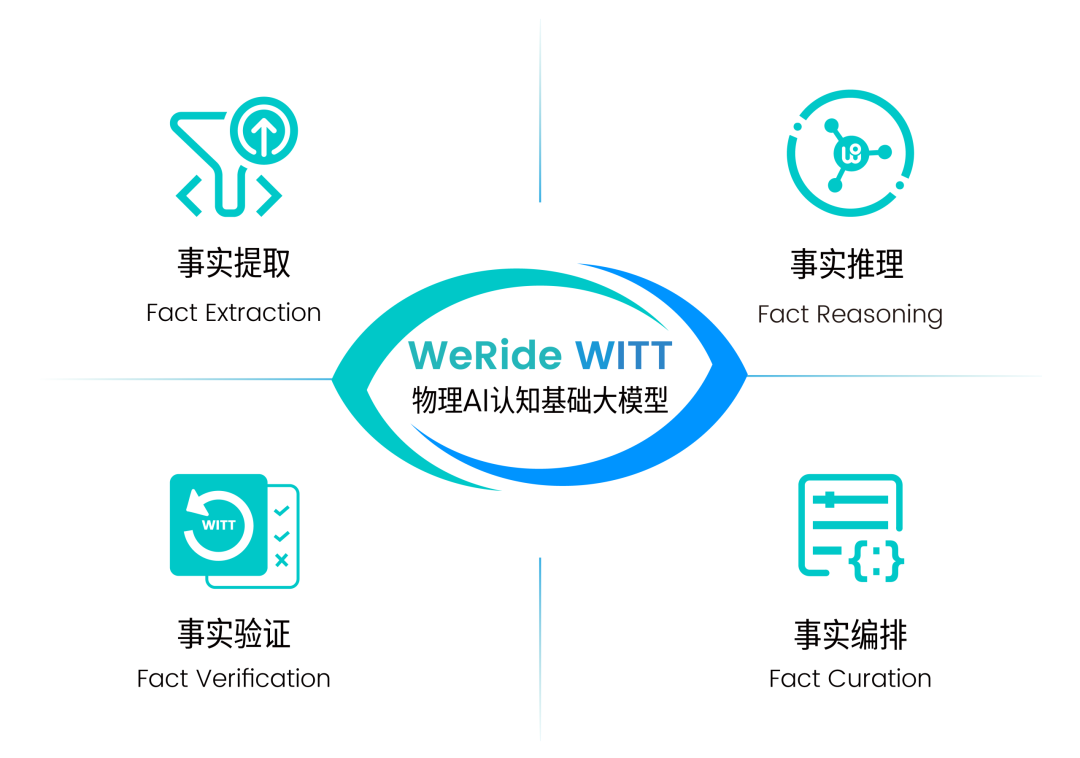
(WeRide WITT's four core competencies)
1. Fact extraction
WITT can identify the “smallest physical fact unit” in real road videos from the three dimensions of standard driving facts, multi-subject interaction facts, and physical blurring conditions, covering changes in daily traffic behavior, traffic participant relationships, and physical state uncertainty in complex environments.
For example, a video of driving on a city road on a rainy day at night will be broken down by WITT into multiple factual units such as car turning right, changing signals on city roads, intersections, and intersections. Each factual unit has high-confidence, calibratable, and traceable characteristics, and can generate high-density scene descriptions, providing a foundation for subsequent understanding, verification, and learning distribution.
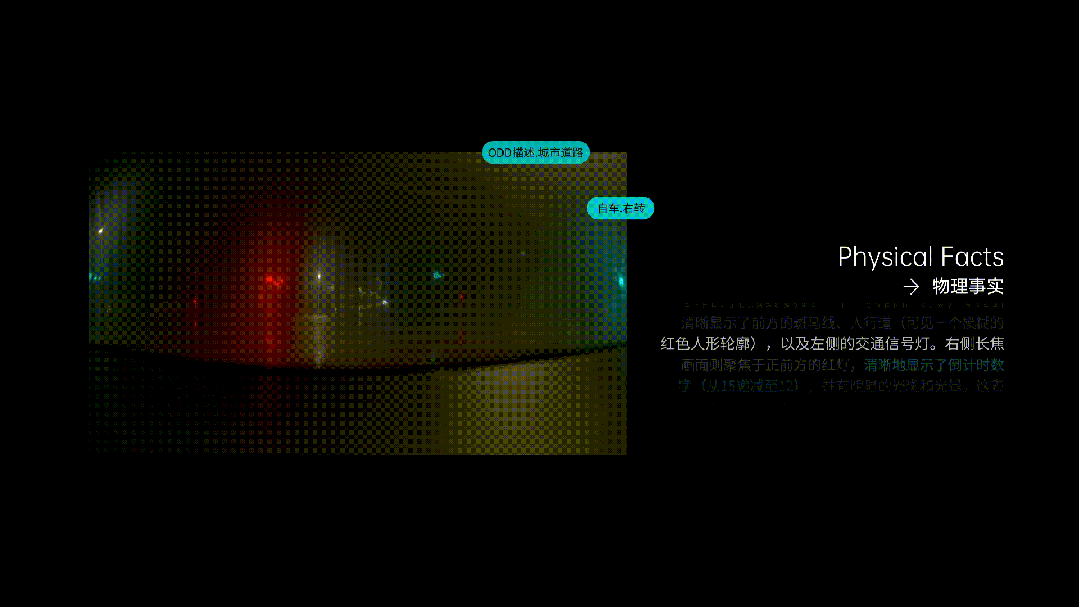
(WeRide WITT recognizes and refines the “minimum physical reality unit” from real road videos to accurately identify complex road conditions.)
2. Factual reasoning
After extracting facts, WITT can further reason about key events, behavioral relationships, and risk changes in the scenario, and analyze the causes of the events and subsequent evolutionary trends.
In the autonomous driving research and development process, engineers often need to search for specific long-tail scenes from massive videos, such as “a pedestrian suddenly crossing the construction area”, “another vehicle's pressure line under low visibility on a rainy day,” and “decelerating and avoiding traffic on a narrow road”. Relying on a built-in video data engine, WITT supports rapid retrieval of massive video data through keywords or natural language questions, accurately positioning relevant timing and target scenarios, and greatly improving the efficiency of long-tail sample discovery, data traceability, and problem location.
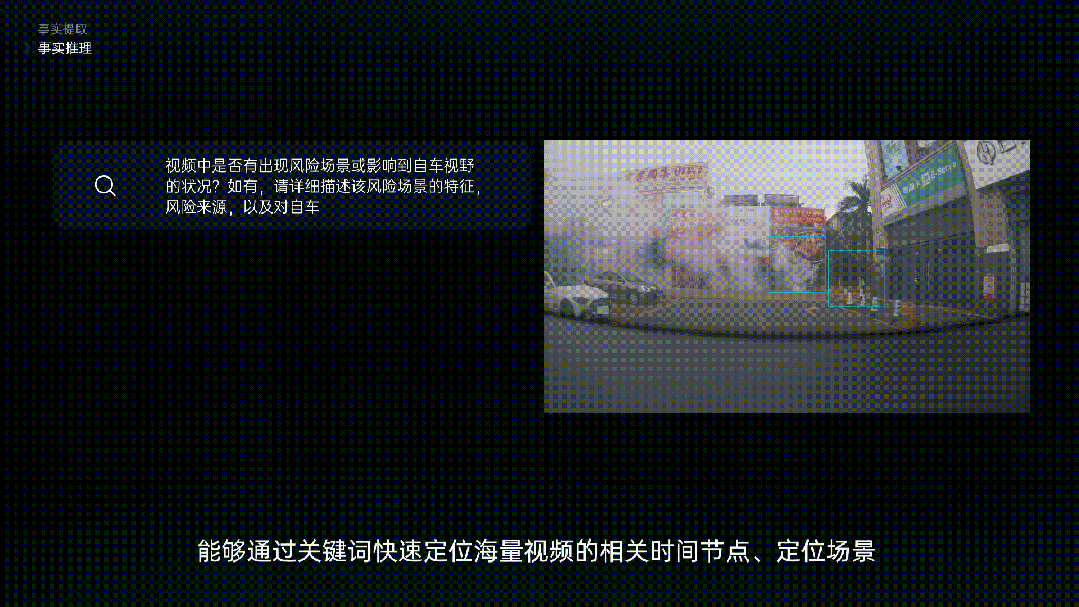
(WeRide WITT has a built-in video data engine that supports quick retrieval of massive video data through keywords or natural language questions.)
3. Factual evidence
In order to avoid the illusion of the GM model in complex traffic environments, WITT evaluates model output from the six dimensions of vulnerable road users, vehicle behavior, scene understanding, factual completeness, and traffic facilities, and introduces factual confidence to reverse verify whether the conclusion is true using external physical evidence.
By tracking factual errors, illusions, omissions, and timing errors, WITT not only provides quality judgment standards for data users, but also provides preference signals for model training, and guides the model to continuously generate understanding results that are more in line with the laws of physics. Currently, the average factual error rate per segment of WITT in autonomous driving scenarios is only about one-third of the GM large model.
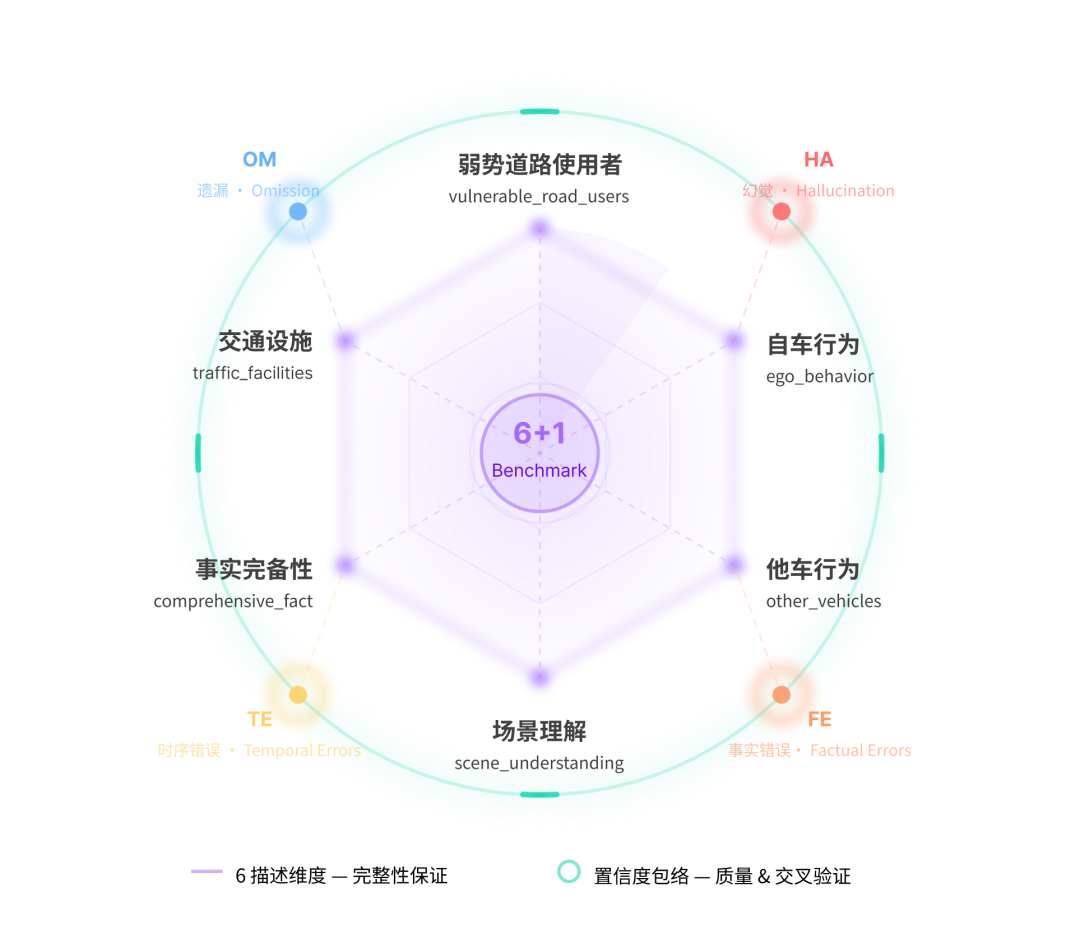
(The “6+1” fact-verification dimension compares the effects of the WeRide WITT model and mainstream general-purpose models in understanding autonomous driving vertical scenarios.)
4. Factual arrangement
In real road operations, the value of different data is not the same. WITT can intelligently distribute factual videos according to learning values, so that each piece of data enters the most appropriate learning path.
Scarce long-tail scenes flow back to Wenyuan Zhixing's self-developed world model WeRide GENESIS for simulation training and scenario expansion; high-frequency everyday scenes are used to reinforce learning and process optimization; abnormal fragments enter the review mechanism to prevent key data from being misjudged as “dirty data” and maximize the value of real road data.
As a result, WeRide Witt and WeRide GENESIS jointly drive Wenyuan Zhixing's physical AI flywheel in the cloud: WITT is responsible for extracting, understanding, verifying, and orchestrating physical facts from real road data. GENESIS generates high-fidelity simulation scenarios and long-tail training scenarios based on this. The two cooperate to train car-side models to promote the implementation and continuous evolution of autonomous driving capabilities in the real world.
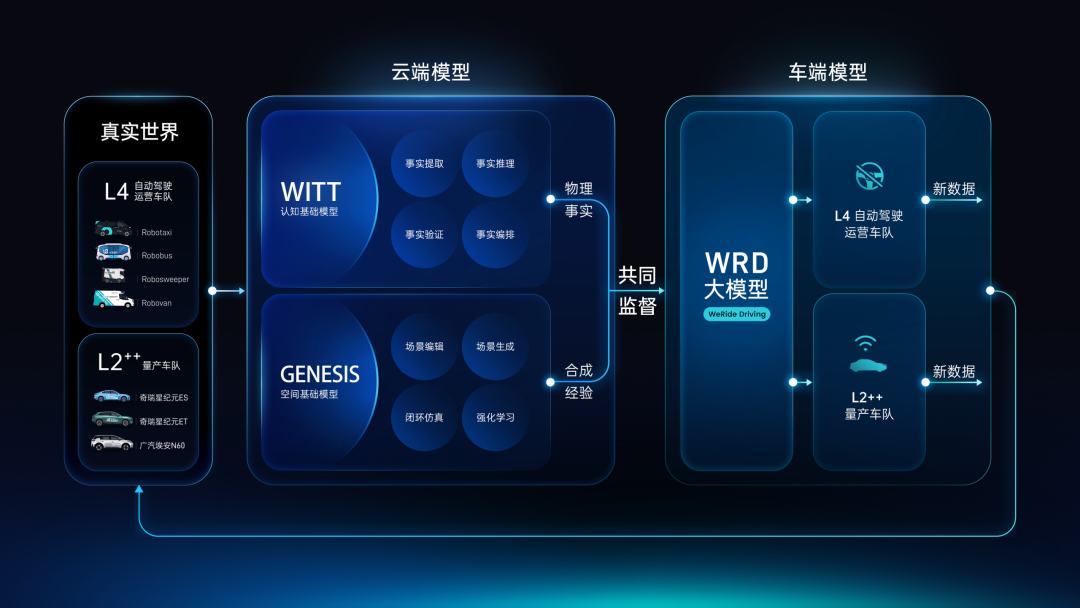
(WeRide Witt, the basic model for physical AI perception, and Weride GENESIS, the world model, jointly drive the Wenyuan Zhixing physical AI flywheel to train the autonomous driving car side model.)
What supports the efficient operation of this set of physical AI flywheels is the engineering deployment efficiency of WeRide WITT. Compared to the general-purpose model with 100 B-level parameters, WeRide WITT can save 98% of token costs in similar tasks with a lighter model scale. A single card can process 10,000 minutes of vehicle operation video in a single day, improving data processing efficiency by up to 200 times. In the tag mode, WITT can output 100+ dynamic tags in a single request, and a large number of real road videos can be quickly retrieved, verified, and entered into model iteration, becoming a factual asset that continues to accumulate.
Relying on physical AI flywheels, Wenyuan Zhixing became the only company in the world to achieve large-scale commercial applications of L4 class unmanned driving and L2++ assisted driving. In the field of L4 driverless driving, Wenyuan Zhixing holds autonomous driving licenses in eight countries. Its autonomous driving products have landed in 12 countries and more than 40 cities, and the number of L4 autonomous vehicles exceeds 3,000 vehicles. Robotaxi has begun normalized large-scale pure unmanned commercial operations in the four cities of Guangzhou, Beijing, Abu Dhabi, and Dubai.
At the same time, the high-quality data and model capabilities accumulated by L4 are continuously migrating to WRD 3.0, an L2++ single-stage end-to-end ADAS solution, through a physical AI flywheel. At present, the WRD 3.0 has won an unprecedented six consecutive championships in the 2nd China Smart Driving Competition, obtained fixed targets for nearly 30 models, mass-produced models such as the Chery Starway Star Era and GAC Aian N60, and successfully went overseas with technology to countries such as Germany, France, and Japan.
Starting from the high-density, high-complexity verification scenario of autonomous driving, WeRide WITT shows general potential for physical AI. Its ability to unify modeling physical facts also provides the underlying ability to understand the real world for a wider range of physical AI scenarios, such as embodying intelligence.
Standing at a new stage where physical AI is being implemented on a large scale, Wenyuan Zhixing will continue to advance the evolution of the basic cognitive model of physical AI based on real-world verification, and push AI from the cognitive physical world to the physical world on a larger scale.