
Jefferson: Inflation will be difficult to cool down, or will raise interest rates, AI and energy shocks will put the Fed's policy in a dilemma
The Zhitong Finance App learned that Federal Reserve Vice Chairman Philip Jefferson said on Thursday that if inflation does not cool down quickly, the Federal Reserve should consider raising interest rates, but at the same time, he said that the current monetary policy situation is good. Jefferson also said that the implementation of artificial intelligence (AI) promotion compounded the energy disturbances brought about by the Iran war, causing the Federal Reserve's policy to fall into a dilemma.
Speaking at an event at Stanford University in California on Thursday, Jefferson said that the Federal Reserve's current interest rate policy may support the labor market while reducing inflation. But he immediately added an additional condition.
“If actual inflation doesn't start to cool down in the short term, I think we should probably reconsider our current policy position,” he said. “Fortunately, our current policy position allows us to respond well to developments in the economic situation.”
Inflation concerns are rekindled, and Federal Reserve officials are intensively “setting up hawks”
As the labor market shows more signs of stability, discussions among Federal Reserve officials have focused on the issue of inflation. The pressure brought about by tariffs has abated, but energy prices affected by the situation in the Middle East are still worrying. At the same time, market demand brought about by the development of AI has become a new focus.
After the US price data for June was weaker than expected, investors abandoned their expectations for the Federal Reserve's interest rate hike in July, but they still expect interest rate hikes this year.
Earlier on Thursday, two Federal Reserve officials expressed stronger concerns about rising prices. In 2026, FOMC voting committee and Dallas Federal Reserve Chairman Lori Logan became the first US Federal Reserve official to call for interest rate hikes, saying that inflation does not seem to continue to return to the Fed's 2% target level.
“I currently believe that a moderate increase in interest rates would better balance prospects and risks,” Logan said on Thursday.
Kansas City Federal Reserve Chairman Jeff Schmid said that since the risk of inflation is likely to increase further in the next few months, inflation is his biggest concern right now. Although the US inflation data for June was better than market expectations, Schmid warned that it was too early to determine that inflation would start a downward trend.
He said, “My biggest concern is inflation. The current level of inflation is too high and has continued to exceed the target level for too long. Therefore, when formulating an appropriate monetary policy path, I am still focusing on the issue of inflation.”
This week, the new Federal Reserve Chairman Kevin Walsh said during his testimony in Congress that policymakers have “zero tolerance” for high inflation and promised to restore price stability, but he did not clearly support interest rate hikes.
In June, at the first interest rate meeting since Walsh took office, Federal Reserve officials voted to keep the Fed's benchmark interest rate in the 3.5% to 3.75% range, for the fourth time in a row.
Federal Reserve officials will hold the next monetary policy meeting from July 28 to 29. Although some officials are concerned about high inflation and suggest that interest rate hikes may be necessary, the market is now generally betting that the Federal Reserve will keep interest rates unchanged at this meeting.
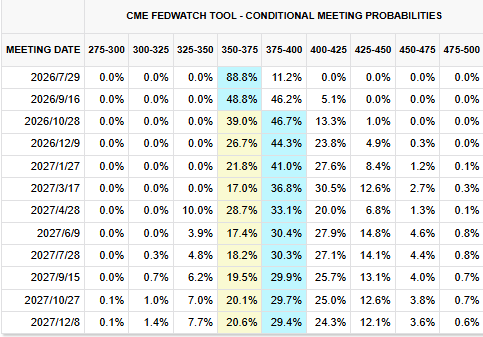
According to the Chicago Mercantile Exchange (CME) “Federal Reserve Watch” tool, traders currently believe that the probability that the Fed will keep interest rates unchanged in July has risen to 88.8%, and the market generally postponed the window for the next rate hike until September or October.
AI and energy shocks intertwine the Federal Reserve falls into a “difficult balance game”
Jefferson spent part of his speech discussing the potential impact of AI on the US economy. He emphasized that AI may impact both supply and demand, and changes in supply and demand will have diametrically opposite effects on inflation.
He said, “The point in time when the impact on both supply and demand becomes apparent is critical for monetary policy makers.”
Jefferson said that the large-scale implementation of AI combined with the energy shock caused by the Iran war caused the Federal Reserve to fall into a “difficult balance game,” while increasing the risk that inflation will persist and inflation expectations will be unanchored.
He said, “Whether the recent rise in energy prices will lead to long-term inflation expectations, which in turn will cause inflation to continue to rise is a critical question.”
Notably, the Federal Reserve announced the establishment of a productivity and employment task force on July 9, 2026 to assess the impact of new general-purpose technologies, including AI, on the economy. In the minutes of the June monetary policy meeting, the Federal Reserve first listed the “AI investment boom” as one of the three major sources of risk driving up inflation, along with tariff policies and geographical conflicts.
Walsh has publicly stated many times that AI is beneficial to the economy as a whole and is expected to become an important anti-inflationary force. But he also admits that although AI has driven an increase in corporate investment, it has also brought uncertainty to the economy. “We still don't know to what extent the economy can benefit from the development of AI,” he said. “The new opportunities that have arisen in the economic sector have also brought new challenges to policy makers. The Federal Reserve is closely monitoring the impact of these changes on inflation and the labor market.”
Currently, the “AI trading” boom in US stocks has clearly cooled down. The Philadelphia Semiconductor Index has fallen by nearly 17% so far this month, and is only one step away from a technical bear market. The memory chip sector became the hardest hit area in this round of adjustments, and leading stocks such as Micron Technology (MU.US) and SanDisk (SNDK.US) fell sharply one after another.
Many Federal Reserve officials have released hawkish statements one after another, compounding the situation in the Middle East to repeatedly push up oil prices and increase the stickiness of inflation. The risk of interest rate hikes continues to ferment, making the AI market worse.