
Record capital poured into Korean ETFs, and SK Hynix's ADR premium sparked a “proxy investment” frenzy
The Zhitong Finance App learned that the listing of SK Hynix (SKHY.US) American Depositary Receipts (ADR) is triggering a rare wave of cross-border capital arbitrage. Investors indirectly held SK Hynix's local shares by buying a South Korean ETF listed in the US, causing the iShares MSCI Korea ETF (EWY) under BlackRock (BlackRock) to absorb US$1.1 billion in a single day on Wednesday (July 15). The ETF had a record inflow of US$814 million the day before (July 14). The daily inflow of capital for two consecutive days caused EWY's asset size to expand by more than 180% during this period, reaching 23 billion US dollars.
EWY became an “alternative channel”, attracting nearly 2 billion US dollars in two days
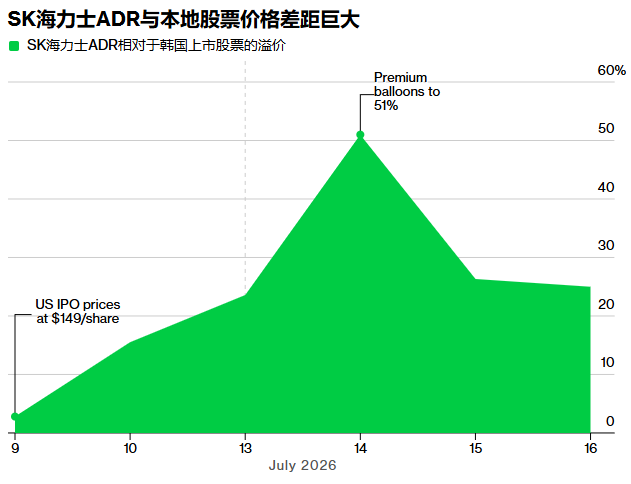
The core logic that contributed to this capital feast was the huge premium that SK Hynix ADR experienced after the US stock listing. On July 10, SK Hynix issued ADR at a price of 149 US dollars each, raising 26.5 billion US dollars, making it the largest IPO for a foreign company to go to the US. After listing, the US Options Exchange began providing SK Hynix ADR options products, which further stimulated enthusiasm for trading. The ADR price immediately soared. On Tuesday (July 14), it soared 27% to $193.92 in a single day, which was as high as 51% of the premium on domestic stocks in South Korea, far exceeding the 3% premium level at the time of issuance. Even after domestic stock prices rose on Thursday (July 16), the price difference between the two places remained high at around 40%.
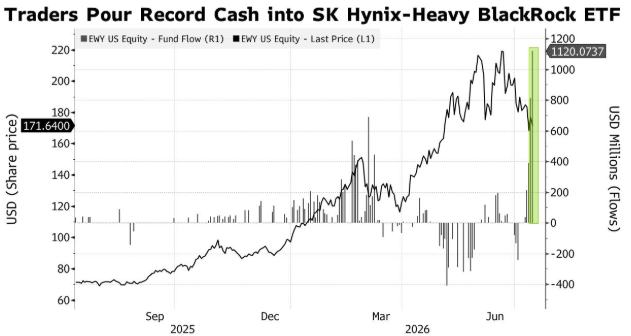
This huge spread has created an alternative arbitrage logic for savvy investors: instead of paying a high premium to buy ADR, it is better to buy a heavy SK Hynix ETF and indirectly hold its shares at a price close to the local market.
According to the data, EWY attracted more than 1.1 billion US dollars on Wednesday (July 16), and the day before (July 15) had set a record of attracting 814 million US dollars. About a quarter of the fund's portfolio is allocated to SK Hynix shares listed in Korea, providing investors with one of the most convenient ways to participate in SK Hynix stock trading in Seoul. Since this year, EWY has received more than 6.3 billion US dollars in capital inflows, and the fund's assets have expanded by more than 180% during this period, reaching 23 billion US dollars.
Todd Sohn, chief ETF strategist at Strategas Securities, said, “ETFs are a proxy investment tool that is very effective for investing in emerging or mature market topics.” Dave Lutz, a stock sales trader at Jonestrading Institutional Services, stated more directly: “Investors are using EWY to access stocks listed in Korea.”
The direct trigger for this financial flood was SK Hynix's official listing on NASDAQ on July 10. The memory chip giant issued 177.9 million copies of ADR at a price of 149 US dollars each, and raised 26.5 billion US dollars, setting a new record for the size of foreign companies' IPOs in the US. On the first day of listing, SK Hynix ADR closed up 12.76%, reaching a market capitalization of 1.22 trillion US dollars.
The ADR premium soared to 51%, and the arbitrage channel was blocked as a key driver
After SK Hynix ADR went public, the price gap between it and local Korean stocks widened rapidly. On July 14, ADR closed at $193.92, surging 27.29% in a single day, and a 51% premium over local Korean stocks. As of July 16, although the premium has declined somewhat, it has remained at around 27%.
The root cause of this abnormal premium is the structural failure of the cross-market arbitrage mechanism. SK Hynix ADR consists of newly issued shares, accounting for about 2.5% of the company's total tradable shares, and its circulation in the US market is extremely limited. More importantly, the two-way conversion channel between ADR and Korean common stock is currently closed — the Korea Securities Depository (KSD) confirmed that the conversion channel will not open until July 29 at the earliest. Prior to that, the conversion of Korean common stock to ADR was strictly limited by the pre-set issuance amount, and retail investors were completely excluded from the conversion process.
Kim Jae-seung, an analyst at Hyundai Motor Securities, pointed out: “The ADR premium reflects structural scarcity — US institutions finally have a clean channel to hold SK Hynix on a large scale, but the channel for converting arbitrage spreads is physically closed.” This unidirectional flow structure made it impossible for the supply side to respond to explosive growth on the demand side, which ultimately led to an abnormal premium of more than 50%.
TSMC's lessons from the past: Premium prices may become the norm, but extreme levels are difficult to sustain
The same phenomenon has already taken precedent with TSMC. According to the data, TSMC's ADR has averaged a premium of about 20% over the past year. Since the rise of the generative AI wave in 2022, TSMC's ADR premium range has fluctuated between 10% and 30%. Using TSMC as a template, Hyundai Motor Securities analyzed that when the premium exceeds 25%, global investors will continue to buy relatively cheap Taiwanese common stock for arbitrage, so the ADR premium cannot expand indefinitely.
However, there is an important difference between SK Hynix's situation and TSMC. TSMC ADR has decades of trading history, and the market already has a mature reference benchmark for its reasonable premium. However, SK Hynix ADR experienced extreme premiums as soon as it went public. There was no historical data to refer to, and arbitrage was far more difficult than TSMC.
Barclays Bank recently released a research report to drastically raise SK Hynix's ADR target price from $150 to $330. KB Securities, on the other hand, anticipates that, driven by increased investment in AI data centers and increased long-term supply agreements, the tight global supply of memory chips will continue until at least 2028, maintaining a target price of 4.2 million won. However, some market participants warned that as ADR trading gradually stabilizes and market liquidity increases, the price gap between it and local Korean stocks is expected to gradually narrow.
South Korea's regulation took urgent action, and individual stock leveraged ETFs were suspended
Behind SK Hynix's ADR premium storm, the Korean market is experiencing a severe shock caused by leveraged ETFs. On July 16, the Korea Financial Services Commission (FSC) announced a series of urgent measures for single-stock leveraged ETFs: suspending listing applications for all new individual stock leveraged exchange trading products (ETP) from now on; increasing the basic margin required to invest in such products from 10 million won to 30 million won, and only cash is included. In addition, regulators also tightened the ETF premium rate management standard from 3% to 2%, and temporarily raised the minimum trading unit from 1 to 20 shares.
The direct reason for this “sharp brake” is a surge in retail demand for leveraged funds related to chip giants such as Samsung Electronics and SK Hynix, which has triggered sharp market fluctuations. On May 27, 2026, the Korea Exchange approved the simultaneous listing of 16 2-fold leveraged ETFs based on individual stocks for the first time, breaking the previous restriction that only allowed index-leveraged ETFs. However, the daily rebalancing mechanism of leveraged ETFs “chase the rise and fall” naturally helps the decline when the market falls.
According to the data, as of July 13, all 14 leveraged ETFs tracking Samsung Electronics and SK Hynix had dropped from 15.9 trillion won at the end of June to 9.3 trillion won, a decrease of 41.4%. On July 16, Korea's KOSPI Index plummeted 6.37% to 6820.6 points, a cumulative decline of nearly 30% from the June high. SK Hynix Korea's stock price fell 11.53% to 1,842,000 won on the same day, while Samsung Electronics fell 8.77%.
The boom is far from over
Tom Graff, Chief Investment Officer of Facet, said: “Market demand is still very strong. It remains to be seen whether this strong momentum will continue, but it is reasonable for most short positions to be triggered quickly.”
Looking ahead to the future market, EWY has become one of the most direct alternative exposures to the AI memory chip theme in the US market. So far this year, EWY has received more than $6.3 billion in net capital inflows. Tom Graff, Facet's chief investment officer, commented: “Part of the flow may have been made up by bears. Market demand is still very strong. It remains to be seen whether this strong momentum will continue, but it is reasonable for most short positions to be triggered quickly.” Barclays Bank recently raised SK Hynix's ADR target price sharply from $150 to $330.
July 29 will be a key turning point — the Korea Securities Depository will open a two-way conversion channel between ADR and Korean common stock. Analysts expect that once the arbitrage channel opens, the current high premium will likely quickly subside. However, the amount of ADR that can be converted is limited by the amount issued. The Morgan Stanley trading department estimates that the amount of ADR that can be converted accounts for about 2.5% of SK Hynix's tradable shares. The more strict the conversion amount, the higher the ADR premium.
Meanwhile, South Korea's regulatory “deleveraging” storm continues. The FSC clearly stated that it will continue to monitor market conditions and will consider additional measures in stages when the market is unstable. According to China Merchants Securities analysts, when regulatory measures are implemented and the leverage bubble is squeezed out, the market pricing logic will return back to corporate profits and industry sentiment.
For global investors, SK Hynix's high ADR premium is both an opportunity and a risk. Until the arbitrage channel opens, EWY's role as a “proxy investment tool” may continue to attract capital inflows. And when the transition window actually opens on July 29, this premium spree driven by structural scarcity may face a real test.