
South Korea's regulators are offering a “combo punch” to cool down the market! Raise the margin and urgently stop the listing of single-share leveraged ETFs
The Zhitong Finance App learned that South Korea will temporarily suspend new listings of individual leveraged exchange-traded funds (ETFs) to curb market fluctuations. Previously, funds linked to Samsung Electronics and SK Hynix surged in popularity, causing significant market fluctuations.
The Korea Financial Services Commission (FSC) said in a statement on Thursday that the ban will continue until market conditions stabilize. The regulator will also raise the minimum margin requirement for trading leveraged ETFs (that is, the minimum balance required for a cash account) from 10 million won to 30 million won (approximately $20,300), which is expected to be implemented starting August 5.
These measures mark the South Korean government's most comprehensive effort to quell retail trading frenzy so far. Previously, this trading frenzy had turned the $4.1 trillion stock market into one of the hottest and most volatile stock markets in the world. The rules were announced after a meeting of regulators, Treasury officials, and central bank governors after growing concerns that leveraged ETFs linked to Samsung and SK Hynix were causing excessive market volatility.
FSC Director Byun Je-Ho told reporters late Thursday, “Due to the rapid growth of these products overseas, we initially launched them domestically, and we determined that local investment was necessary to enhance the attractiveness of the Korean capital market,” “but since then, the volatility of the stock market has increased.”
Thanks to attracting large amounts of retail capital, these products and the two chipmakers they track have become extremely popular and currently account for more than 70% of transactions. However, foreign investors have become increasingly cautious, selling off more than $100 billion worth of domestic stocks this year alone.
On Thursday, the Korea Composite Stock Price Index (Kospi) fell 6.4%, while Samsung and SK Hynix each plummeted more than 8%. Since its June high, the benchmark index has plummeted by more than 25%. At the same time, volatility soared, and the 30-day volatility indicator reached unprecedented levels, with daily changes of 5% or more becoming more common.
While stricter rules may curb engagement, some market participants say this trade-off may be worth it.
Jason Minsang Kam, head of active stock management at Seoul Kyobo Life Insurance Company, said that these measures “are likely to limit retail investors' access to leveraged ETFs to a certain extent,” and “from the perspective of retail investors, these tighter requirements are expected to have a positive effect in mitigating short-term fluctuations.”
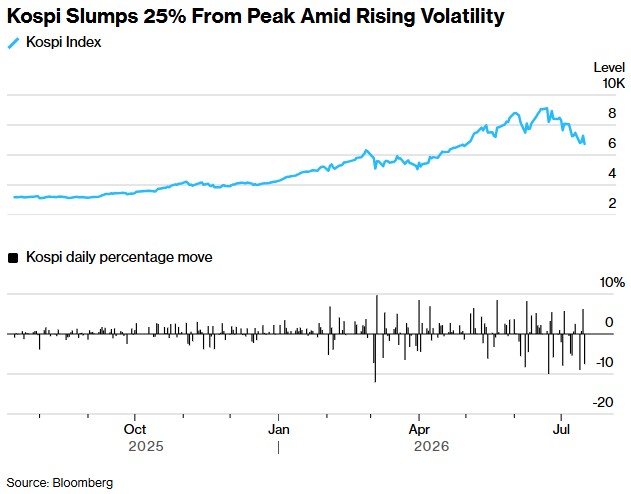
Increased volatility in KOSPI
As part of the adjustments, regulators also raised the mandatory training requirement for leveraged ETF investors from two hours to three hours, while increasing the minimum trading unit from 1 unit to 20 units. Regulators will also tighten controls on the discount premium between the ETF market price and its net asset value, requiring liquidity providers to keep the gap below 2% from the current 3%.
The FSC said the higher margin ratio also applies to leveraged ETFs listed overseas, a move aimed at preventing investors from switching to offshore assets. The FSC added that if the market is not stable, further steps may be considered.
Fears about a rebound in the South Korean stock market seem to have spread to the highest levels of government. President Lee Jae-myung said on Wednesday that the stock market had become “quite unstable” after experiencing an unprecedented rebound, and urged regulators to prepare next steps.
ETF performance
Even as regulators act to curb speculative trading and investors are increasingly concerned about overvaluation and concentration risks in the artificial intelligence (AI) boom, there is little sign that demand is weakening. Investors continue to pour money into products linked to this theme, finding new ways to profit from one of the strongest stock market rallies in modern history.
On Thursday, the top 10 most actively traded securities on the Korea Exchange by trading volume were all leveraged or reverse ETFs linked to the index and the chip duo mentioned above.
The data shows that since their debut about two months ago, the prices of more than a dozen leveraged ETFs tracking Samsung and SK Hynix in South Korea have plummeted by about 40%. Despite this, investors continue to pour money into these products. At its peak in June, the amount of assets under management reached more than $10 billion, according to the data.
BI's ETF analyst Rebecca Sin said these measures may help slow the product's wild growth, but they haven't addressed the fundamental issue of investors' high appetite for AI exposure.
“Recent market activity shows that many investors continue to focus on potential upside even in the face of significant fluctuations and losses,” she said. Despite the sharp pullback, investors' willingness to 'absorb the diff' highlights the firm belief surrounding these themes.”