
Rumor has it that Britain's new finance minister has settled a “fiscal conservative” and the British pound index hit a one-year high
The Zhitong Finance App learned that as the British Prime Minister's handover enters the countdown, the suspense that the market is most concerned about finally took a critical turn on Wednesday. People familiar with the matter revealed that Andy Burnham (Andy Burnham), who will officially take office as Prime Minister next Monday, has decided to appoint current Home Secretary Shabana Mahmood (Shabana Mahmood) as Minister of Finance. The news quickly ignited market sentiment — the British pound index rose 1% on Wednesday to its highest level since July 2, 2025, and remained near this high during Thursday's Asian trading session.
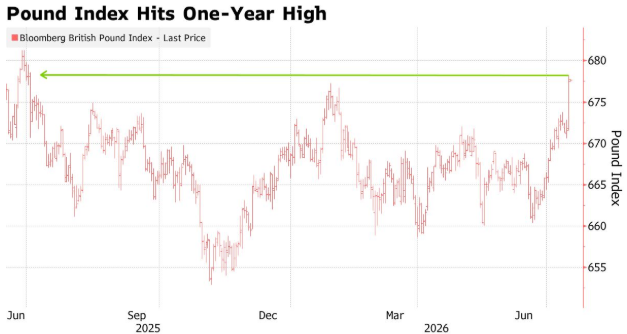
The pound once rose 1.1% against the US dollar, hitting an intraday high of 1.3542, the strongest level since May 13. The performance of GBP/EUR was also impressive. EUR/GBP fell below 0.8500 for the first time since June 2025. Meanwhile, the yield on UK 10-year treasury bonds fell 4 basis points to 4.94%, and the performance of British bonds was clearly superior to European and US peers.
“Miliband Alert” lifted: the market is relieved
The core driving force behind the pound's rise this time was not Mahmoud himself viewed by the market as the “perfect candidate,” but rather that the option that worried investors the most before — Energy Minister Ed Miliband (Ed Miliband) — was likely to go out.
Miliband has long been regarded as a popular candidate for Chancellor of the Exchequer and has been working with Burnham on economic plans for several months. However, his tough stance on energy and net zero emissions sparked a strong backlash from the business community and the financial city. A banker said bluntly that Mahmoud “would be popular in the Financial City.” According to a Bloomberg survey of investors, only 5% of respondents supported Miliband as finance minister.
Validus Risk Management analyst Pierre Roke stated, “Mahmoud is likely to be seen as a more responsible choice than other popular candidates (including Miliband). Her reputation should convince investors that spending restraint and fiscal credibility will remain a priority.” James Sproule, chief British economist at Handelsbanken, said, “People are very nervous about Miliband. He is seen as more aggressive, so he may be reluctant to listen to the voices of the market.”
Former Prime Minister Truss's “mini-budget” crisis in September 2016 was not far off. At that time, the scenario where British bond yields soared and the pound plummeted left investors with lingering feelings. The market is highly wary of any fiscal risk-taking that could be repeated.
Who is Mahmoud? ——Labor Party's right-wing fiscal conservatives
Shabana Mahmoud is the current UK Home Secretary and is known for her tough stance on immigration and criminal justice issues. She belongs to the more socially and financially conservative “Blue Labor Party” faction within the Labor Party.
The market generally sees her as a Labor Party politician with strict fiscal discipline and a central position. It is expected that she will prioritize responsible public finances, stable economic policies, and maintaining investor confidence. Ray Attrill, head of foreign exchange strategy at the National Bank of Australia, commented: “Mahmoud comes from the more socially and financially conservative faction of the Labour Party, which allays people's previous concerns about Burnham's excessive financial waste.”
However, Burnham's previous statement still left a hint of uncertainty about the fiscal outlook. In a recent interview, he warned that fiscal decisions would be “fraught with difficulties,” and refused to rule out the possibility of a new wealth tax. This means that even if Mahmoud takes office, there are still variables in the direction of British fiscal policy.
Personnel schedule and follow-up highlights
Burnham warned in a recent interview that fiscal decisions would be “very difficult,” and did not rule out the possibility of a new wealth tax. The Organisation for Economic Cooperation and Development (OECD) warned that the UK's tax burden has reached a record high, and the new government should focus on cutting spending rather than further increasing taxes on households and businesses. Furthermore, market expectations for the Bank of England's interest rate hike are heating up — due to the escalating conflict in the Middle East driving up oil prices, the money market has fully priced an interest rate hike at the November policy meeting, and it is expected that a second rate hike may be carried out before April 2027.
Whether current finance minister Rachel Reeves can stay in the new cabinet is uncertain, and Burnham's advisory team includes former Goldman Sachs chief economist Lord Jim O'Neill and former Bank of England chief economist Andy Haldane, suggesting that the economic strategy may be dominated by Downing Street rather than the Treasury.
Burnham will officially take over as Labor Party leader this Friday (July 17) and accept the king's invitation to form a government next Monday (July 20). Official appointments to cabinet positions will be confirmed on Monday. According to reports, Miliband may instead serve as Minister of Foreign Affairs as a “consolation prize.”
Attrill said, “The pound is already the best performing G10 currency in the past month, and I'm curious how much room the pound will have to rise if Mahmoud is confirmed as finance minister. We should know the results when Burnham takes over next Monday.”
In addition to the finance minister's nominee, the market is also concerned about the following key variables: whether the UK and the EU can push forward with resetting the relationship at next week's summit, the Bank of England's interest rate hike path under inflationary pressure, and whether the Burnham administration can find a balance between fiscal discipline and economic growth. The next direction of the pound will depend on the details of Mahmoud's first budget since taking office — and whether this budget is a “reassurance pill” or a “new suspense” in the eyes of the Financial City.