
The IEA Director issued a “few weeks” ultimatum: if the Strait of Hormuz continues to be closed, the global economy will face new shocks
The Zhitong Finance App learned that International Energy Agency (IEA) Director Fatih Birol (Fatih Birol) issued a stern warning at the Aspen Colorado Safety Forum on Wednesday: if transportation disruptions in the Strait of Hormuz cannot be resolved within a few weeks, the global economy will once again face serious challenges. Birol pointed out that the escalation of the US-Iran conflict has made the “market tense and uneasy” and is facing “huge uncertainty,” and that the transportation of crude oil, fertilizer, natural gas, and other goods on this critical waterway is seriously threatened.
“If the Strait of Hormuz continues to be closed, the global economy, including the economies of the Middle East, developing countries, and Asia, may once again face some difficulties,” Birol stressed. “The time window for resolving the crisis is not calculated in months, but in weeks,” and the strait must be “fully opened and unconditionally opened.”
The strait almost “comes to a standstill”: only a single digit number of boats pass through each day
Traffic conditions in the Strait of Hormuz are deteriorating dramatically. The Islamic Revolutionary Guard Corps Navy of Iran announced the closure of the strait on July 12, prohibiting the passage of any ships. According to data from the shipping monitoring agency, “there was almost no visible navigation situation” in the strait on July 12, and only two tankers were close to the strait.
According to data from trade intelligence company Kpler, only 14 ships passed through the Strait of Hormuz last Sunday, a sharp drop of about 60% from 37 ships in the same period of the previous week. Before the US and Israel went to war against Iran on February 28, more than 100 ships passed through the strait every day. On Sunday, July 13, the number of navigable ships dropped to only 6, a new low in five weeks.
Frequent attacks on ships were the direct cause of the sharp drop in traffic volume. Since July 7, 5 ships have been attacked in Omani waters, including 3 crude oil supertankers, 1 LNG carrier, and 1 container ship. In the early morning of July 14, the UAE Ministry of Defense announced that two UAE tankers were hit by Iranian cruise missiles south of the Strait of Hormuz, killing 1 Indian crew member and injuring 8 others. The International Maritime Organization has made it clear that the waterway is still “too dangerous” for merchant ships.
Meanwhile, US President Trump announced that the US will become the “guardian of the Strait of Hormuz” and plans to levy a 20% “protection fee” on all goods passing through the strait. The move was evaluated by the president of the energy consulting firm Goldwyn Global Strategies as “almost extortive.”
Sharp drop in supply: the Gulf's average daily oil exports plummeted by 8 million barrels
The contraction on the supply side was also shocking. Birol told the media on July 10 that the current average daily oil supply in the Gulf region is only 16 million barrels, a sharp drop from 24 million barrels before the Middle East conflict, a drop of 8 million barrels.
The amount of crude oil that Saudi Arabia is loading from the inland terminal in the Persian Gulf has dropped drastically after the attack on the supertanker. Meanwhile, global fuel stocks are being consumed faster than normal. Birol also warned earlier that if this strategic waterway is not completely unconditionally reopened, global commercial and strategic inventories will be exhausted.
“Weeks not months”: Birol's three core warnings
Birol sent three very clear signals during the interview:
First, the time window is extremely tight. “The time window for resolving the crisis is not calculated in months, but in weeks,” Birol emphasized. The strait must be “fully open, unconditionally open” within a few weeks.
Second, the global economy is facing widespread shocks. “If the Strait of Hormuz continues to be closed, the global economy, including those in the Middle East, developing countries, and Asia, may once again face some difficulties,” Birol made it clear.
Third, there are huge differences in the affordability of Asian countries. Birol pointed out that although disruptions in the supply of energy and raw materials in the Persian Gulf have had an impact on economies such as South Korea and Japan, countries such as Bangladesh, Pakistan, and India “are less able to withstand such supply risks and face greater risks.”
Asia's fragility: 85% of Gulf crude oil flows to Asia
Birol's warning was not alarmist. Asia is the most vulnerable region in this crisis. According to the data, about 85% to 90% of crude oil transported through the Strait of Hormuz eventually entered the Asian market. Among them, Japan's dependence on imported oil from the Middle East is close to 94%, South Korea is about 70%, and India is about 50%. Reduced energy supply and rising prices will also spread widely to fields such as transportation, chemicals, fertilizer, and food production. After the Strait of Hormuz was almost closed for two months, Asia's overall oil imports in April plummeted 30% year over year.
The Organization for Economic Cooperation and Development (OECD) has raised the 2026 G20 inflation forecast to 4.0% from 2.8% previously, and clearly indicated that the blockage of shipping in the Strait of Hormuz is one of the important reasons.
Oil prices return to $80: the market has taken into account the risk premium
The market is rapidly pricing this risk. As of press release, the Brent crude oil futures price has broken through $85 per barrel, and WTI crude oil futures are trading around $80. Oil prices have rebounded sharply from around $72 at the end of June.
Meanwhile, as supply chain safety is more important than price, refineries in Asia are urgently switching to procuring crude oil from the US, Latin America, and West Africa and rebuilding inventories, forcing the rapid restructuring of traditional crude oil trade routes.
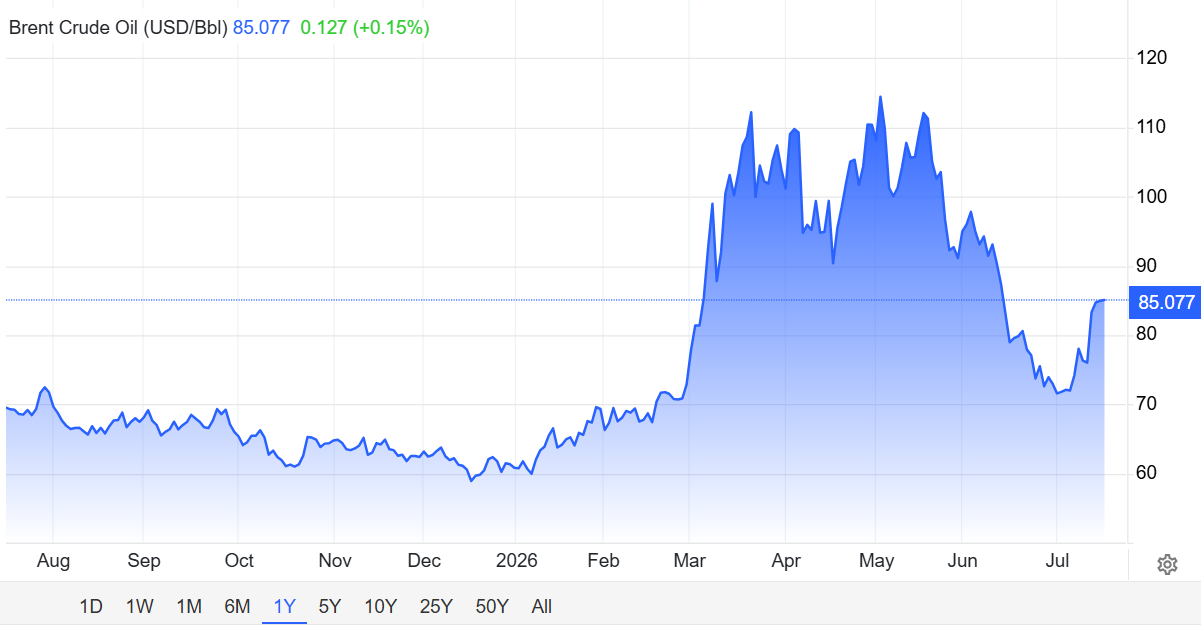
When the average daily traffic volume in the Strait of Hormuz plummeted from more than 100 ships to single digits, Gulf oil exports fell sharply by 8 million b/d, and oil prices returned above $80, Birol's warning was changing from prediction to reality. The ultimatum of “weeks rather than months” closely ties the fate of the global economy to a waterway that is only 33 kilometers wide. For energy import-dependent countries such as South Korea and Japan, as well as developing countries with weak reserve capacity such as India, Pakistan, and Bangladesh, every week of delay in this crisis may mean a further rise in inflation and another derailment of economic recovery.
The IEA has previously warned that if the Strait of Hormuz is not “fully and unconditionally reopened,” global commercial and strategic inventories will quickly run out. In an interview, Birol even described the current situation as “the vase is broken” — “Once the Strait of Hormuz has been closed, it may close again. This is on everyone's mind right now”.